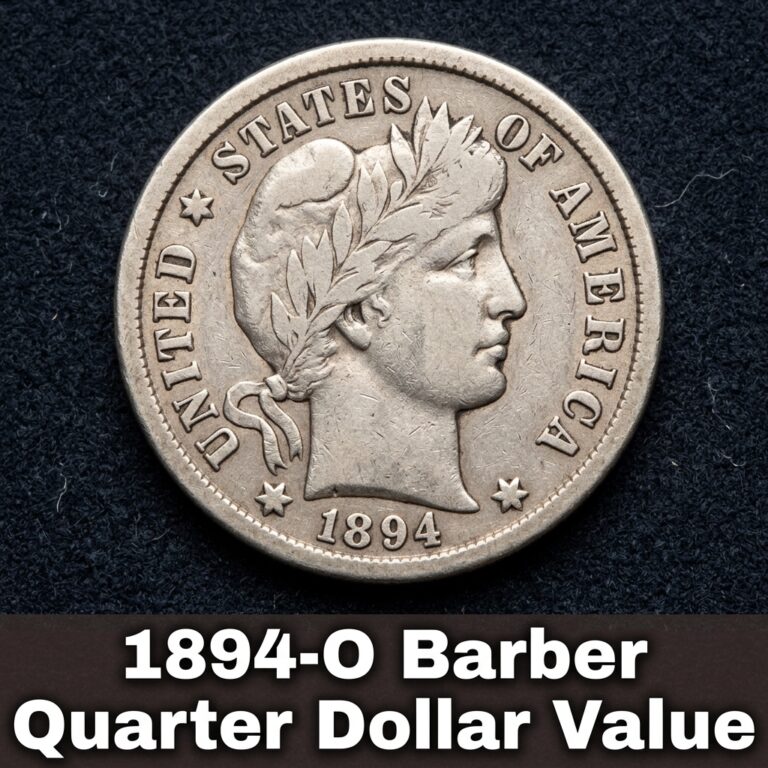
1910 Barber Dime Value Guide: No Mint Mark Coin Worth

Your Old Coin Could Be Valuable!
Identify It & Know Its Real Value — Free Download


The 1910 Barber Dime with no mint mark is worth anywhere from $3 in heavily worn condition to over $600 in high-grade mint state. Whether you found one in a grandparent’s attic or tucked away in an old jar, these silver relics from the early 20th century remain popular favorites for American collectors today.
| Condition / Grade | Estimated Value (USD) |
|---|---|
| Good (G-4) | $3.50 – $5.00 |
| Very Good (VG-8) | $7.00 – $10.00 |
| Fine (F-12) | $15.00 – $22.00 |
| Extremely Fine (EF-40) | $45.00 – $65.00 |
| Uncirculated (MS-60+) | $160.00 – $600.00+ |
Understanding the History of the 1910 Philadelphia Dime
The 1910 Barber Dime belongs to a series officially known as the Liberty Head dime, but it is colloquially named after its designer, Charles E. Barber. By 1910, the Barber design had been the face of the American ten-cent piece for nearly two decades. To determine if your coin is the specific Philadelphia issue, you must look for the absence of a mint mark on the reverse side.
If you are unsure whether your specimen is genuine or if you’re struggling to read the faint details, using a top coin identifier and value app can provide immediate clarity. The 1910 Philadelphia mint produced over 11 million of these dimes, making them relatively common compared to scarcer branch-mint dates.
However, “common” is a relative term in numismatics. Most 1910 dimes circulated heavily in the early 20th-century economy, meaning they were used to buy everything from newspapers to loaves of bread. Finding one today that hasn’t been worn down to a flat silver disk is a win for any casual hunter. CoinKnow users often report that while many of these coins are found in low grades, the silver content alone gives them a solid baseline price.
Identifying the 1910 Barber Dime No Mint Mark
When we talk about the “No Mint Mark” variety, we are specifically referring to coins struck at the Philadelphia Mint. During this era, Philadelphia did not use a mint mark to identify its coinage. On a Barber dime, the mint mark location is on the reverse side (the back), positioned just below the bow of the wreath that encircles the words “ONE DIME.”
Your Old Coin Could Be Valuable!
Identify It & Know Its Real Value — Free Download
If that area is blank, you have a 1910 Philadelphia Dime. If you see a small “S” or “D,” the coin was struck in San Francisco or Denver, respectively. Identifying these marks is crucial because different mints had different production numbers, which directly affects the 1910 dime value and rarity.
Many people confuse the designer’s initial “B” at the base of Liberty’s neck for a mint mark. This “B” is present on all Barber dimes and represents Charles Barber. If you find yourself squinting at the silver, the CoinKnow app can help magnify and identify these small but significant details for you.
Your Old Coin Could Be Valuable!
Identify It & Know Its Real Value — Free Download
Grading and Condition: How it Impacts 1910 Dime Value
The single most significant factor in determining the price of your 1910 Barber Dime is its “grade,” or its state of preservation. Because these coins are made of 90% silver, they are relatively soft and wore down quickly in pockets. Collectors pay a massive premium for coins that still show the fine details in Liberty’s hair and the leaves of the wreath.
In “Good” condition, the word “LIBERTY” on the headband will be completely worn away. As you move into “Fine” and “Very Fine” grades, letters start to become visible. By the time a coin reaches “Uncirculated” status, it looks much like it did the day it left the mint, with a bright luster and sharp strikes.
| Grade Detail | Visual Indicators | Approximate Price |
|---|---|---|
| G-4 Good | Heavy wear, outlines only | $3 – $4 |
| F-12 Fine | LIBERTY is visible but faint | $15 – $20 |
| VF-20 Very Fine | All letters in LIBERTY are sharp | $25 – $35 |
| MS-63 Choice Unc | No wear, original mint luster | $250 – $300 |
The Melt Value of 90% Silver Barber Dimes
Even if your 1910 Barber Dime is so worn that the date is barely visible, it still holds “intrinsic value” because it is a silver coin. Unlike modern dimes, which are made of copper and nickel, the 1910 version contains 0.07234 troy ounces of pure silver. This means the coin will always be worth at least its weight in silver.
Your Old Coin Could Be Valuable!
Identify It & Know Its Real Value — Free Download
When silver prices rise, the value of low-grade “junk” silver coins also goes up. For many everyday Americans, these coins serve as a small hedge against inflation. If you have a handful of these, they are worth significantly more than their ten-cent face value. Using CoinKnow can help you keep track of the daily silver spot price and how it affects your collection.
Investors often buy “culls”—coins that are bent, cleaned, or heavily worn—just for the silver content. However, as a general rule, never clean your coins. Cleaning a 1910 Barber Dime with chemicals or abrasives will destroy its numismatic value, often reducing a $50 coin down to its $2 silver melt value instantly.
Key Variations and Errors to Look For
While the 1910 Philadelphia Barber Dime doesn’t have many famous “major” errors like the 1942/41 Mercury Dime, collectors still look for minor die cracks and doubling. A die crack occurs when the steel stamp used to mint the coin begins to break, leaving a raised line of metal on the coin’s surface.
Your Old Coin Could Be Valuable!
Identify It & Know Its Real Value — Free Download
Some collectors specialize in “Proof” versions of the 1910 dime. Proof coins were specially struck for collectors and have a mirror-like finish. Only 550 Proof dimes were made in Philadelphia in 1910, making them incredibly rare and worth upwards of $700 to $1,000 depending on the quality.
If you suspect you have a Proof or a rare error, it is best to have it authenticated. High-resolution photos uploaded to an app like CoinKnow can help you determine if your coin has the “mirror” fields or frosted details characteristic of a Proof striking before you spend money on professional grading services.
Current Market Trends for Early 20th Century Dimes
The market for Barber silver has remained remarkably steady over the last decade. While some “hot” modern coins fluctuate wildly in price, the 1910 Barber Dime value remains anchored by both its silver content and its historical appeal. As more people take up coin collecting as a hobby, the demand for “entry-level” silver like the Philadelphia Barber Dime continues to grow.
In recent auctions, exceptionally high-grade specimens (MS-66 and above) have fetched prices nearing $1,000. For the average person, however, the target is usually the “Fine” to “Extremely Fine” range. These are the coins that still look beautiful in a display folder but don’t cost a fortune to acquire.
Your Old Coin Could Be Valuable!
Identify It & Know Its Real Value — Free Download
| Year/Mint | Mintage | Rarity Scale |
|---|---|---|
| 1910 Philadelphia (No Mark) | 11,520,000 | Common |
| 1910-S (San Francisco) | 1,240,000 | Scarce |
| 1910-D (Denver) | 3,490,000 | Uncommon |
Where to Sell Your 1910 Barber Dime
If you’ve decided to part with your find, you have several options. Local coin shops are the fastest way to get cash, though they will typically offer you “wholesale” prices so they can make a profit on the resale. Online marketplaces like eBay can net you a higher price, but you must factor in shipping costs and seller fees.
For a high-value 1910 dime in mint condition, professional auction houses or “slabbing” the coin through PCGS or NGC (third-party grading services) is often the best route. This guarantees the coin’s grade and authenticity to potential buyers.
Before you sell, always do your homework. Use a digital tool to get a baseline price and compare your coin’s appearance to known high-grade examples. Knowing whether your coin is worth $5 or $500 is the most important step before walking into a shop or listing it for sale online.
FAQ
Q: Why does my 1910 dime have no mint mark?
A: This means your coin was minted in Philadelphia. At that time, the Philadelphia Mint did not use a mint mark on its coins. It is the most common variety of the 1910 Barber Dime.
Q: Is a 1910 Barber Dime made of real silver?
A: Yes, it is composed of 90% silver and 10% copper. This makes it a “junk silver” coin that will always have value based on the current market price of silver bullion.
Your Old Coin Could Be Valuable!
Identify It & Know Its Real Value — Free Download
Q: Should I clean my 1910 dime to make it look newer?
A: No! Never clean a collectible coin. Cleaning creates microscopic scratches that collectors can easily spot, and it can reduce the value of the coin by 50% or more.
Q: Where is the mint mark located on a 1910 dime?
A: On the reverse side (the back), the mint mark would be located at the bottom, just above the “E” in “DIME,” between the two ends of the laurel wreath. If the space is empty, it’s a Philadelphia coin.
Q: How much is a 1910 dime worth in “Good” condition?
A: In “Good” condition (G-4), which means it has significant wear but the date is still legible, the coin is generally worth between $3.00 and $5.00.