1950-D Franklin Half Dollar Value What It’s Worth and Why Collectors Care

Your Old Coin Could Be Valuable!
Identify It & Know Its Real Value — Free Download


The 1950-D Franklin Half Dollar is worth anywhere from $12 in heavily worn condition to over $500 or more in top mint state grades — and a few exceptional specimens have sold for thousands at auction. If you found one of these silver coins in an old collection or inherited it from a grandparent, you’re in luck. This guide will walk you through exactly what it’s worth and what affects that value.
What Makes the 1950-D Franklin Half Dollar Special
The 1950-D Franklin Half Dollar was struck at the Denver Mint and carries a small “D” mintmark on the reverse side, just above the bell at the Liberty Bell’s right. This coin is part of the Franklin Half Dollar series, which ran from 1948 to 1963. It contains 90% silver, which gives it an automatic baseline melt value even in the worst condition.
The 1950-D had a mintage of 8,031,600 coins — a relatively modest number compared to some later issues in the series. That lower mintage contributes to stronger demand among collectors, especially in higher grades.
If you’ve got one in hand and aren’t sure whether it’s the real deal or what grade it might be, a coin identifier and value app can give you a quick starting point before you take it to a dealer or coin show. Tools like CoinKnow are especially popular with everyday collectors who want fast, reliable answers.
Your Old Coin Could Be Valuable!
Identify It & Know Its Real Value — Free Download
1950-D Franklin Half Dollar Value by Grade
Coin value depends heavily on condition, also called “grade.” A coin that still shows sharp details and original luster is worth far more than one that’s been worn smooth from years in circulation. Here’s a general value breakdown:
Your Old Coin Could Be Valuable!
Identify It & Know Its Real Value — Free Download
| Grade | Description | Estimated Value |
|---|---|---|
| Good (G-4) | Heavy wear, major details visible | $12 – $14 |
| Fine (F-12) | Moderate wear, all lettering clear | $14 – $17 |
| Extremely Fine (EF-40) | Light wear on high points only | $18 – $25 |
| About Uncirculated (AU-55) | Slight friction, most luster remains | $26 – $40 |
| Mint State (MS-63) | Uncirculated, minor marks | $60 – $100 |
| Mint State (MS-65) | Gem uncirculated, strong luster | $200 – $500+ |
For real-time auction results and certified coin sales data, you can check detailed 1950-D Franklin Half Dollar price records in mint state to see what buyers are actually paying today.
How to Identify Your 1950-D Franklin Half Dollar
Flip your coin over to the reverse (back) side. You’ll see the iconic Liberty Bell at the center and a small eagle to the right. Look just above the bell’s base — that’s where the “D” mintmark appears, indicating it was struck in Denver.
Your Old Coin Could Be Valuable!
Identify It & Know Its Real Value — Free Download
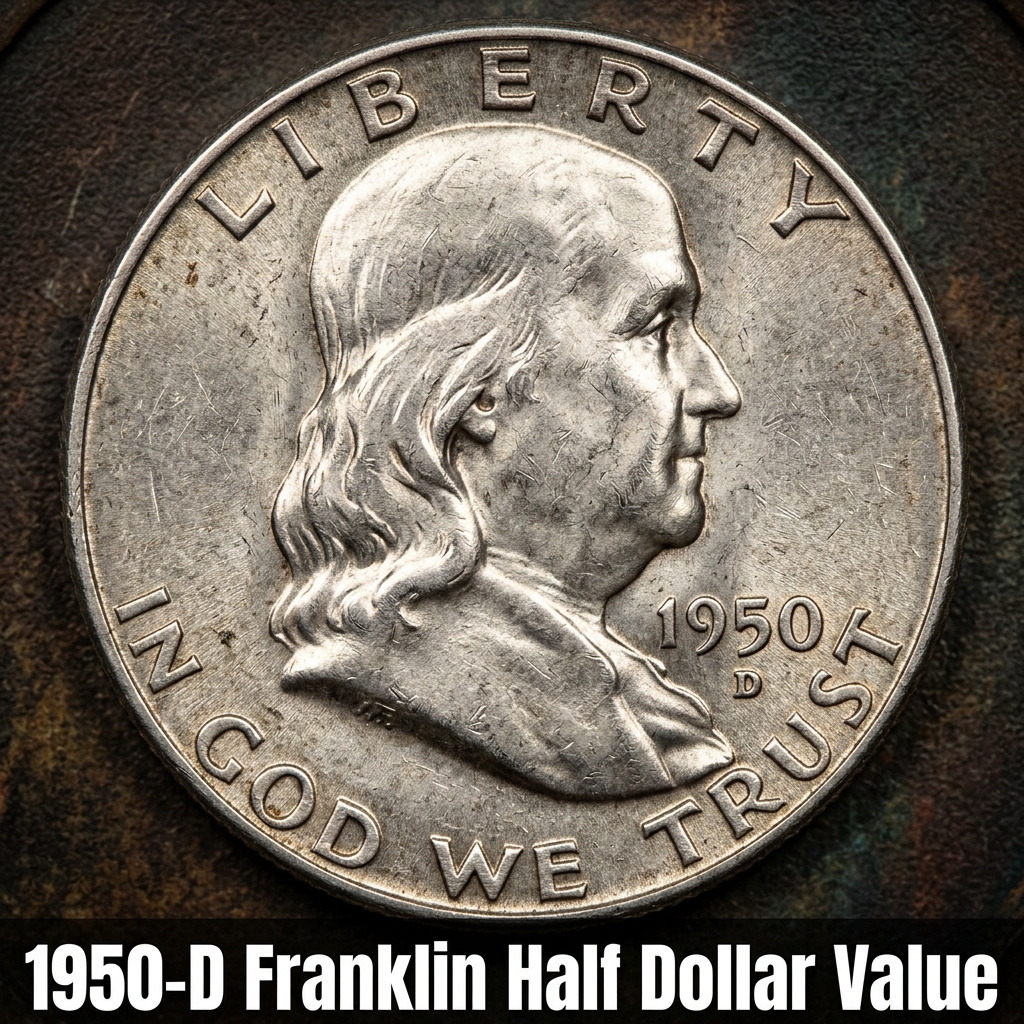
On the obverse (front), you’ll see Benjamin Franklin’s portrait facing right, with “LIBERTY” arching above and the date “1950” at the bottom. The coin is made of 90% silver and 10% copper, measures 30.6 mm in diameter, and weighs 12.5 grams.
One thing collectors pay close attention to on Franklin Half Dollars is whether the coin has “Full Bell Lines” (FBL) — that means the horizontal lines at the bottom of the Liberty Bell are sharp and uninterrupted. Coins with FBL designation can be worth significantly more than those without. A coin graded MS-65 FBL, for example, can fetch several times the price of a regular MS-65.
What Affects the Value of Your 1950-D Half Dollar
Beyond grade and the FBL designation, a few other factors influence what your coin is worth:
Your Old Coin Could Be Valuable!
Identify It & Know Its Real Value — Free Download
Silver melt value sets a floor. With silver prices fluctuating around $25–$30 per troy ounce, a 1950-D Franklin Half Dollar contains about 0.3617 oz of silver — giving it an intrinsic metal value of roughly $9–$11 regardless of condition.
Certification matters. Coins graded and certified by PCGS or NGC (the two leading third-party grading services) typically sell for more than raw, uncertified coins of the same quality. Buyers trust the grade, and that trust adds a premium.
Eye appeal counts. A coin with attractive, original toning — rainbow hues that develop naturally over decades — can sell for more than a “white” coin of the same technical grade. Harsh cleaning, on the other hand, destroys value quickly.
Your Old Coin Could Be Valuable!
Identify It & Know Its Real Value — Free Download
If you want a comprehensive look at how the 1950 Franklin Half Dollar is valued across all mint marks and grades, that’s a great resource to bookmark. And if you enjoy hunting for coin values on the go, CoinKnow is a smart app to keep on your phone — it gives you grade estimates, current market values, and historical auction data all in one place.
Is Your 1950-D Franklin Half Dollar Worth Selling?
If your coin is circulated and grades below AU-55, it’s still worth more than face value because of its silver content. Circulated examples are easy to sell to coin dealers or at local coin shows, usually for a small premium over spot silver price.
If your coin grades MS-63 or higher — especially if it’s uncirculated with strong luster — it’s worth having it professionally graded before selling. A certified MS-65 or MS-65 FBL coin can bring a dramatically higher price than an ungraded example, often making certification fees well worth the investment.
Either way, don’t spend it or toss it out. Even the most worn 1950-D Franklin Half Dollar is worth at least 10–12 times its face value in silver alone. That’s real money for a coin you might have found sitting in a jar.
Your Old Coin Could Be Valuable!
Identify It & Know Its Real Value — Free Download
FAQ
Q: How do I find the mintmark on a 1950 Franklin Half Dollar?
A: Look at the reverse side of the coin, just above the Liberty Bell near the bottom center. The “D” mintmark indicates the coin was struck at the Denver Mint. Philadelphia-minted coins from 1950 have no mintmark at all.
Q: What is a “Full Bell Lines” designation and why does it matter?
A: Full Bell Lines (FBL) refers to the horizontal lines at the bottom of the Liberty Bell on the reverse being sharp, complete, and unbroken. Many 1950-D coins were struck with weak dies, making crisp FBL examples rare. A coin with an FBL designation from PCGS or NGC can be worth several times more than one without it.
Q: Where is the best place to sell a 1950-D Franklin Half Dollar?
A: For circulated coins, local coin dealers or coin shows offer quick, fair deals. For uncirculated or high-grade examples, consider submitting to PCGS or NGC for certification first, then selling through major auction platforms like Heritage Auctions or eBay. Apps like CoinKnow can also help you get a baseline value before you negotiate.