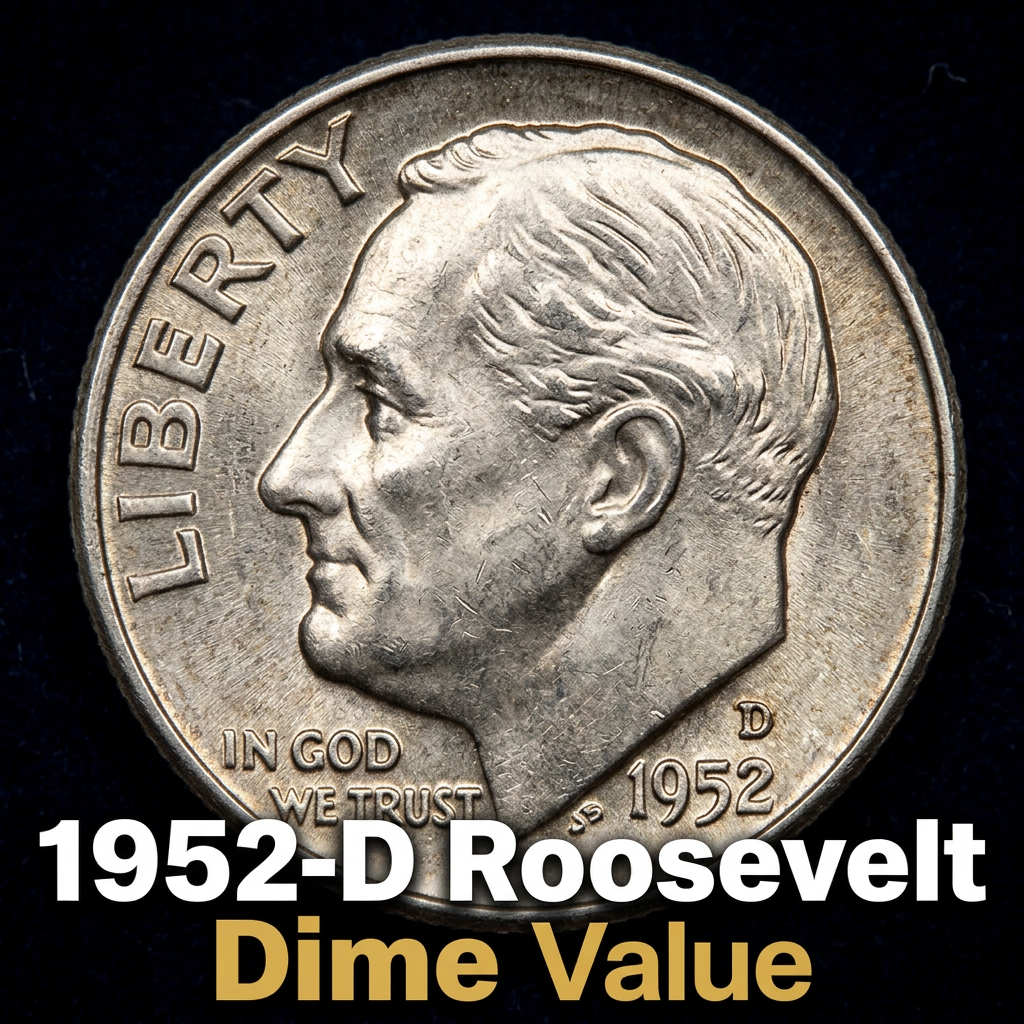
1952-D Roosevelt Dime Value Guide What It’s Worth and How to Find Out

Your Old Coin Could Be Valuable!
Identify It & Know Its Real Value — Free Download


The 1952-D Roosevelt Dime is worth anywhere from around $2 in heavily worn condition to well over $20 or more in mint state, with top-grade examples occasionally fetching $50 or higher at auction. If you just found one of these old silver dimes in a coin jar, a drawer, or an old collection, you’re in the right place to learn exactly what it might be worth.
What Makes the 1952-D Roosevelt Dime Special
The 1952-D Roosevelt Dime was struck at the Denver Mint, indicated by the small “D” mintmark found on the reverse side of the coin, just above the “E” in “ONE.” This coin is part of the early Roosevelt Dime series, which began in 1946 following the death of President Franklin D. Roosevelt.
One important detail that makes these early dimes valuable is their silver content. Coins minted before 1965 contain 90% silver, meaning even a worn 1952-D dime has real metal value just from its silver content alone.
The Denver Mint produced approximately 122,100,000 of these dimes in 1952, making them relatively common — but condition still matters enormously when it comes to value. A well-preserved example is always worth significantly more than a heavily circulated one.
Your Old Coin Could Be Valuable!
Identify It & Know Its Real Value — Free Download
If you want a quick estimate right from your phone, a coin identifier and value app can help you scan your coin and get an instant value estimate without needing any special coin expertise. Apps like CoinKnow make it easy for everyday collectors to understand what they have in seconds.
How Much Is the 1952-D Roosevelt Dime Worth by Grade
Coin value is almost entirely determined by condition, which collectors call “grade.” A coin that looks like it was barely used will always be worth far more than one that’s been jingling around in someone’s pocket for decades.
Your Old Coin Could Be Valuable!
Identify It & Know Its Real Value — Free Download
Here’s a general breakdown of 1952-D Roosevelt Dime values across different grades:
| Grade | Description | Estimated Value |
|---|---|---|
| Good (G-4) | Heavy wear, design barely visible | $2 – $3 |
| Fine (F-12) | Moderate wear, most details clear | $3 – $5 |
| Extremely Fine (EF-40) | Light wear on high points only | $5 – $10 |
| About Uncirculated (AU-50) | Slight wear, nearly full luster | $10 – $18 |
| Mint State (MS-63) | Uncirculated, minor contact marks | $20 – $35 |
| Gem Mint State (MS-66+) | Near-perfect, full bands on torch | $50 – $150+ |
For the most current market prices and auction records on this specific coin, you can check detailed 1952-D Roosevelt Dime price data in mint state grades to see how recent sales compare to these estimates.
Your Old Coin Could Be Valuable!
Identify It & Know Its Real Value — Free Download
The Silver Value Factor
Even if your 1952-D dime is very worn, it still has melt value because it’s made of 90% silver. Each Roosevelt Dime from this era contains about 0.0723 troy ounces of pure silver.
When silver trades around $25 per troy ounce (which is typical in recent years), the base silver melt value of your coin is roughly $1.80. That means even the most worn example is still worth more than face value as a silver coin.
Silver prices fluctuate daily, so the melt value of your coin changes too. Most dealers will pay at least melt value for circulated 1952-D dimes, and you can always check today’s silver spot price to calculate your coin’s base worth before selling.
Your Old Coin Could Be Valuable!
Identify It & Know Its Real Value — Free Download
Full Bands — The Detail That Can Multiply Value
Among Roosevelt Dime collectors, one special designation can dramatically increase a coin’s value: “Full Bands” or FB. This refers to the horizontal bands on the torch shown on the reverse of the coin being fully struck and sharply defined.
A 1952-D Roosevelt Dime with Full Bands in MS-65 grade might be worth significantly more than a standard MS-65 example without that designation. High-end Full Bands coins from Denver can bring $100 or more in top grades.
This is one reason why having your coin professionally graded by PCGS or NGC can pay off if you think it might be in near-perfect condition. CoinKnow also provides helpful guidance on what details to look for when evaluating your coin’s strike quality at home.
Your Old Coin Could Be Valuable!
Identify It & Know Its Real Value — Free Download
For a comprehensive breakdown of 1952 Roosevelt Dime values across all mint marks and grades, including the Philadelphia and San Francisco issues from the same year, that resource covers everything in one place.
Tips for Selling Your 1952-D Roosevelt Dime
If you’re thinking about selling, it helps to know where to look. Circulated examples in lower grades are usually easiest to sell in bulk lots to dealers or on platforms like eBay. Uncirculated or near-perfect coins do better when sold individually to collectors.
Before you sell, always clean up your knowledge — but never clean the coin itself. Cleaning a coin with any abrasive or chemical almost always reduces its value significantly in the eyes of serious collectors and dealers.
Use tools like CoinKnow to research recent sale prices and get a realistic picture of what buyers are paying right now. Knowing your coin’s grade before you walk into a coin shop also gives you more confidence during the negotiation.
Your Old Coin Could Be Valuable!
Identify It & Know Its Real Value — Free Download
FAQ
Q: How do I tell if my 1952-D Roosevelt Dime is silver?
A: All Roosevelt Dimes minted before 1965 are 90% silver. If your coin shows a date between 1946 and 1964 and has no copper-colored edge, it is silver. The 1952-D dime is definitely a silver coin.
Q: Is the 1952-D dime rare?
A: No, the 1952-D is not considered rare. With over 122 million minted, it is a common date in the Roosevelt Dime series. However, high-grade examples — especially those with Full Bands — are much harder to find and can be quite valuable.
Q: Where can I get my 1952-D dime graded?
A: You can submit coins to professional grading services like PCGS (Professional Coin Grading Service) or NGC (Numismatic Guaranty Company). For a quick at-home assessment, CoinKnow and other coin apps can give you a good starting estimate before deciding whether professional grading makes financial sense.