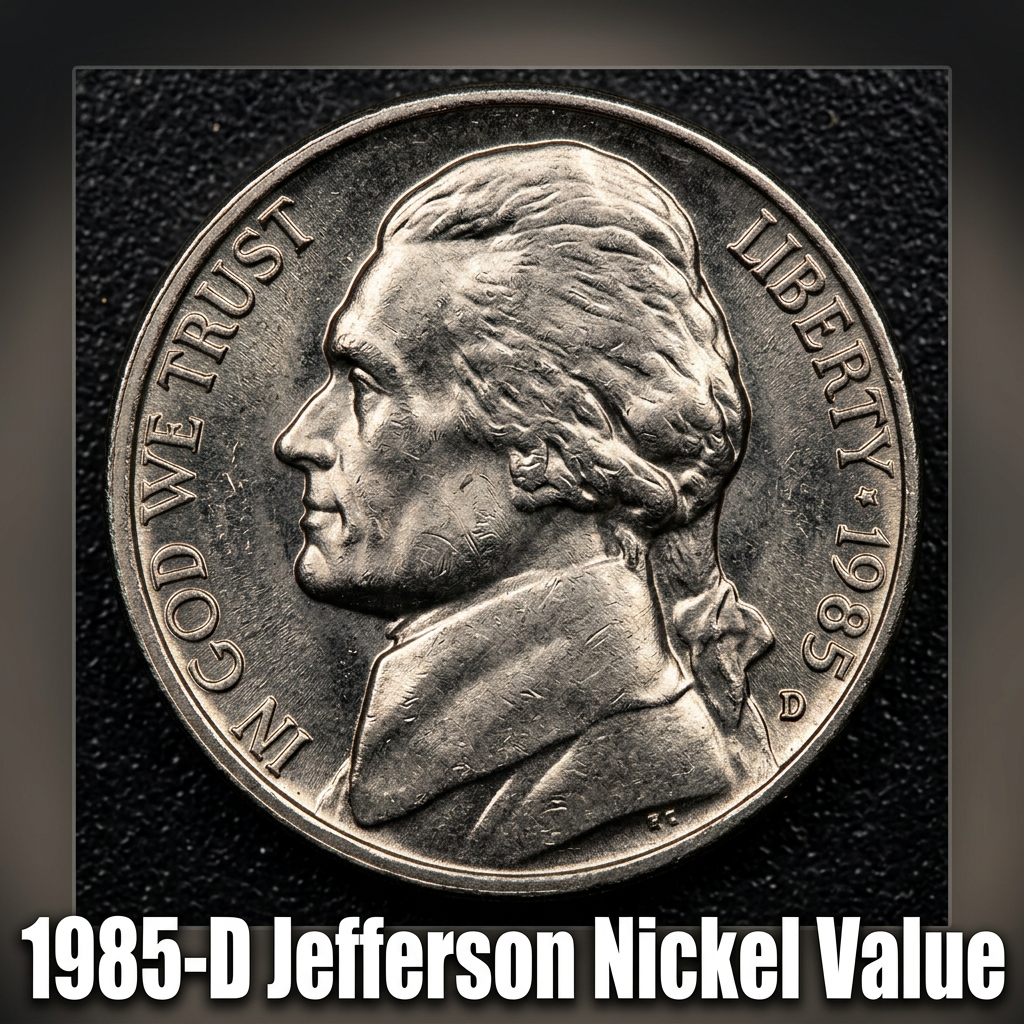
1985-D Jefferson Nickel Value Guide What It’s Worth Today and How to Find Out

Your Old Coin Could Be Valuable!
Identify It & Know Its Real Value — Free Download


The 1985-D Jefferson Nickel is worth anywhere from 5 cents in heavily circulated condition to around $10 or more in pristine, uncirculated grades — and a select few high-grade examples have sold for significantly higher at auction. If you found one of these coins in a jar, old wallet, or coin roll, you’re in the right place. This guide will walk you through everything you need to know about what makes this coin valuable and how to assess what yours might be worth.
What Is the 1985-D Jefferson Nickel?
The 1985-D Jefferson Nickel was struck at the Denver Mint, indicated by the small “D” mintmark found on the obverse (front) of the coin, just to the right of Jefferson’s portrait. The Denver Mint produced over 459 million of these nickels in 1985, making them quite common in circulated grades.
Because so many were made, a typical worn 1985-D nickel from your pocket change is really only worth its face value of 5 cents. However, coins that were never circulated — especially those with sharp, full steps visible on Monticello on the reverse — can command real collector premiums.
If you’re not sure how to read the details on your coin, using a coin identifier and value app can help you quickly figure out what you’re looking at, including the mint mark, grade range, and estimated value — all from your smartphone camera.
How Condition Affects 1985-D Jefferson Nickel Value
When it comes to coin collecting, condition is everything. Collectors use a numeric grading scale from 1 to 70, where higher numbers mean better condition. A coin graded MS-65 (Mint State) looks nearly perfect, while a coin graded Good-4 shows heavy wear with most fine details worn flat.
Your Old Coin Could Be Valuable!
Identify It & Know Its Real Value — Free Download
For the 1985-D Jefferson Nickel, coins in circulated grades (G through AU) are generally worth face value to maybe 10–25 cents. It’s only when you get into uncirculated territory — MS-63 and above — that the coin starts to become interesting for collectors.
One special designation to look for is “Full Steps” (FS), which means the steps on Monticello’s portico are fully defined and unbroken. A 1985-D nickel graded MS-65 Full Steps can be worth $20 to $50 or more, while an MS-66 FS example might fetch $100+. These are the coins that serious collectors chase.
Your Old Coin Could Be Valuable!
Identify It & Know Its Real Value — Free Download
| Grade | Description | Estimated Value |
|---|---|---|
| Good (G-4) | Heavy wear, outline visible | Face value ($0.05) |
| Fine (F-12) | Moderate wear, some detail | $0.05 – $0.10 |
| Extremely Fine (EF-40) | Light wear on high points | $0.10 – $0.25 |
| Uncirculated (MS-63) | No wear, some bag marks | $0.50 – $1.50 |
| Gem Uncirculated (MS-65) | Strong luster, minimal marks | $3 – $10 |
| MS-65 Full Steps | Gem grade + full Monticello steps | $20 – $60+ |
| MS-66 Full Steps | Superb grade + full steps | $80 – $150+ |
You can explore detailed 1985 Jefferson Nickel MS grade price data to compare auction results and current market trends across different grade levels.
How Many Were Made and Does Mintage Matter?
The Denver Mint struck 459,747,446 Jefferson Nickels in 1985. That’s nearly half a billion coins — one of the higher production years for this denomination. High mintage generally means lower rarity, which is why the 1985-D in average condition isn’t a coin that’s going to make you rich.
Your Old Coin Could Be Valuable!
Identify It & Know Its Real Value — Free Download
That said, mintage numbers don’t tell the whole story. Many of those 459 million coins were spent, lost, or melted down over the decades. Coins that survived in gem uncirculated condition are far rarer than the total mintage figure suggests, which is why high-grade examples still attract collector interest.
The Philadelphia Mint also struck Jefferson Nickels in 1985, without a mintmark, but those are a separate coin. The “D” on your coin specifically identifies it as a Denver issue, and that distinction matters when you’re looking up values.
Are There Any Valuable 1985-D Nickel Errors to Look For?
Error coins are where things get exciting for treasure hunters. While the 1985-D Jefferson Nickel doesn’t have a famous major error series, there are still some worth watching for:
Your Old Coin Could Be Valuable!
Identify It & Know Its Real Value — Free Download
Doubled Die Obverse (DDO): Look closely at the lettering, date, and Jefferson’s eye under magnification. A true doubled die shows a clear doubling of design elements, not just a blurry strike.
Off-Center Strikes: These occur when the coin blank isn’t properly aligned in the press. A coin that’s 10–20% off-center with a visible date can be worth $20–$50 or more.
Die Cracks and Cuds: Raised lines or blobs on the coin’s surface caused by a cracked die. These are minor varieties but still collected by error enthusiasts.
If you think you’ve found an error coin, CoinKnow is a great tool to scan your coin and get an initial assessment before sending it off to a professional grading service like PCGS or NGC.
Your Old Coin Could Be Valuable!
Identify It & Know Its Real Value — Free Download
For a thorough breakdown of 1985 nickel value including errors, varieties, and grade-by-grade pricing, that resource covers everything in one place.
How to Find Out What Your 1985-D Nickel Is Really Worth
Getting an accurate value for your 1985-D Jefferson Nickel depends on a few key steps. First, examine the coin’s condition honestly — is there any wear on Jefferson’s cheek and hair, or does it look like it just came from the mint? That distinction alone can mean the difference between face value and a genuine collectible.
Next, check the reverse for the steps of Monticello. If you can count five or six unbroken horizontal lines between the columns, you may have a Full Steps coin, which significantly boosts value.
CoinKnow makes this process much easier by letting you photograph both sides of the coin and instantly receive a grade estimate and value range based on current market data. It’s a fast, beginner-friendly way to know if your coin is worth holding onto or submitting for professional grading.
For coins that appear to be MS-65 or higher, professional grading through PCGS or NGC is absolutely worth the investment. A certified MS-66 FS coin in a tamper-evident slab can sell for multiples of a raw, ungraded example.
Your Old Coin Could Be Valuable!
Identify It & Know Its Real Value — Free Download
FAQ
Q: Is a 1985-D Jefferson Nickel worth keeping?
A: If your coin shows no wear and has strong luster, it may be worth holding onto, especially if the Monticello steps are clearly defined. Most circulated examples are only worth face value, but uncirculated coins — particularly Full Steps specimens — can be genuinely valuable to collectors.
Q: What does the “D” mintmark on my 1985 nickel mean?
A: The “D” stands for Denver, meaning your coin was produced at the United States Mint’s Denver facility. It’s located on the obverse, to the right of Jefferson’s portrait. Coins without a mintmark were made in Philadelphia. Both are collectible, but they’re tracked separately in price guides.
Q: How can I tell if my 1985-D nickel is uncirculated?
A: An uncirculated coin will have original mint luster — a cartwheel-like sheen when you tilt it under light. There should be no flat, dull spots on Jefferson’s cheek or the high points of Monticello. Any wear, no matter how slight, drops the coin out of Mint State grades. Using CoinKnow to scan your coin can give you a quick preliminary assessment before you invest in professional grading.