2010 Millard Fillmore Presidential Dollar Coin Value and What Collectors Pay Today

Your Old Coin Could Be Valuable!
Identify It & Know Its Real Value — Free Download


The 2010 Millard Fillmore Presidential Dollar is worth between $1 and $5 in typical circulated condition, but certain mint state examples and error coins can fetch anywhere from $10 to over $50 depending on grade and mint mark.
If you recently found one of these golden-colored dollar coins in your change jar or an old collection, you’re in the right place. This guide will walk you through everything you need to know about the 2010 Millard Fillmore dollar — from mintage numbers to what collectors are actually paying today. A quick way to get started is by using a coin identifier and value app to instantly scan your coin and get a real-time estimate before you read further.
Background on the 2010 Millard Fillmore Presidential Dollar
The 2010 Millard Fillmore dollar was issued as part of the United States Mint’s Presidential Dollar Program, which ran from 2007 to 2016. Each year honored a new set of former presidents in the order they served. Millard Fillmore, the 13th President of the United States, was featured on this coin alongside fellow 2010 honorees James Buchanan, Abraham Lincoln, and Andrew Johnson.
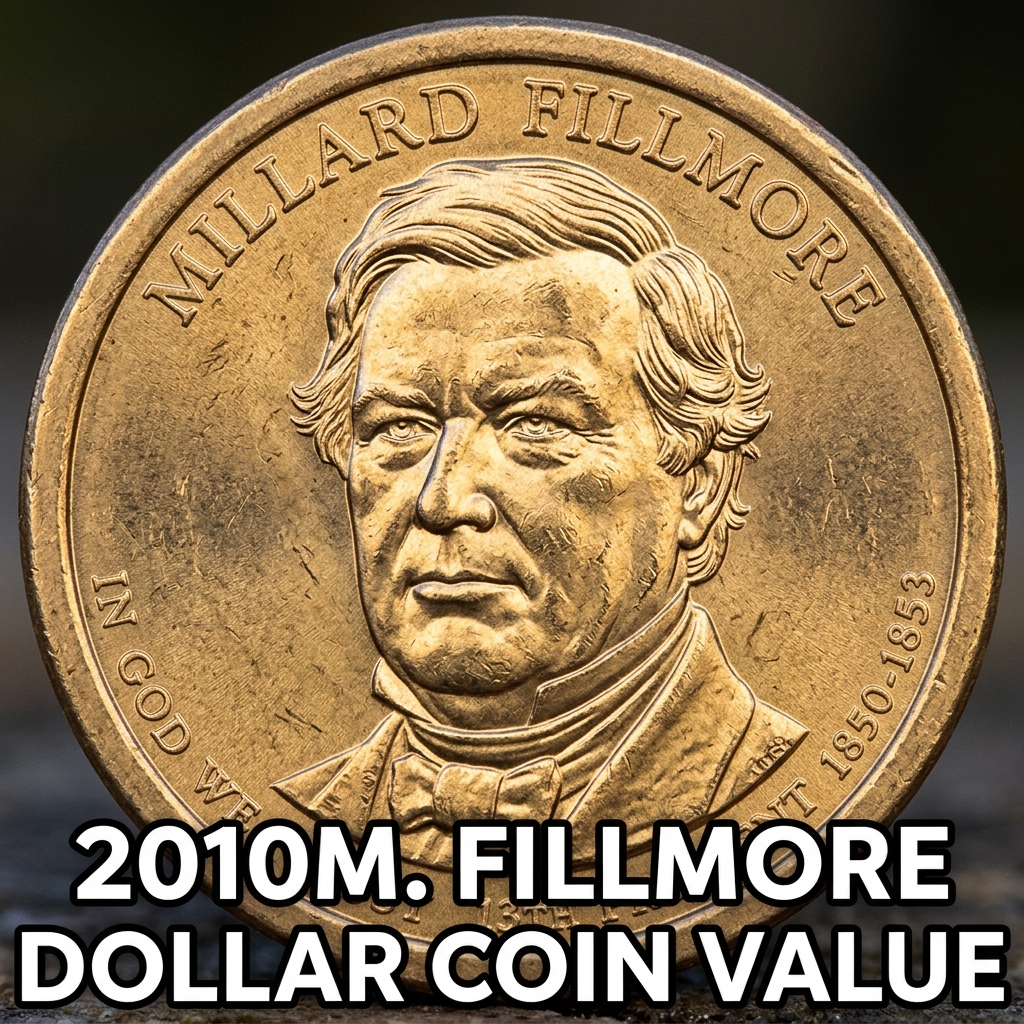
The coin measures 26.5mm in diameter and weighs 8.1 grams, made of a manganese-brass clad composition that gives it that distinctive golden color. The obverse features a portrait of Fillmore with his name, the inscription “13th President,” and his service dates 1850–1853. The reverse carries the Statue of Liberty design shared across the entire Presidential Dollar series.
Your Old Coin Could Be Valuable!
Identify It & Know Its Real Value — Free Download
These coins were struck at both the Philadelphia (P) and Denver (D) mints for general circulation, as well as at the San Francisco (S) mint in proof versions for collectors.
2010 M. Fillmore Dollar Mintage Numbers
Understanding mintage is key to valuing any coin. Higher mintage generally means more coins available, which usually keeps values modest. Here’s a breakdown of the 2010 Millard Fillmore Presidential Dollar mintage figures:
Your Old Coin Could Be Valuable!
Identify It & Know Its Real Value — Free Download
| Mint Mark | Mintage | Type |
|---|---|---|
| Philadelphia (P) | 36,960,000 | Business Strike |
| Denver (D) | 36,848,000 | Business Strike |
| San Francisco (S) | 1,689,216 | Proof |
Both the Philadelphia and Denver issues had large mintages, which is why most circulated examples remain close to face value. The San Francisco proof, however, commands a premium because it was made exclusively for collector sets with a mirror-like finish.
How Much Is a 2010 Millard Fillmore Dollar Worth Today
For most everyday Americans, the 2010 Millard Fillmore dollar they find in a drawer is worth around $1 to $2 in circulated condition — essentially face value. The coin was widely produced, and unless yours is in exceptional condition or has a notable error, it won’t make you rich overnight.
Your Old Coin Could Be Valuable!
Identify It & Know Its Real Value — Free Download
That said, uncirculated examples graded MS65 or higher by professional grading services like PCGS or NGC can sell for $10 to $30 or more. Top-pop specimens graded MS67 have sold at auction for $50 to $100. Proof versions from San Francisco in PR69 or PR70 Deep Cameo condition can reach $20 to $40 in retail markets.
| Condition / Grade | Estimated Value |
|---|---|
| Circulated (F–AU) | $1 – $2 |
| Uncirculated MS63–MS64 | $3 – $8 |
| Gem Uncirculated MS65–MS66 | $10 – $25 |
| Superb Gem MS67+ | $40 – $100+ |
| San Francisco Proof PR69–PR70 | $20 – $45 |
If you’re curious how this Presidential Dollar compares to other modern collector coins, it’s worth exploring current Peace Dollar price data to see how different series hold their value across conditions and grades.
Error Coins and Special Varieties Worth More
Error coins are where things get really exciting. The Presidential Dollar series is known for producing several interesting errors, and the 2010 Millard Fillmore issue is no exception.
Your Old Coin Could Be Valuable!
Identify It & Know Its Real Value — Free Download
The most talked-about error type is the “missing edge lettering” coin. Presidential dollars have inscriptions on the edge including “IN GOD WE TRUST,” the year, and the mint mark. When the edge lettering step is skipped during production, these coins can be worth $25 to $100 or more depending on condition.
Double die errors, where the design appears slightly doubled or blurred, can also increase value significantly. Coins struck off-center or on wrong planchets are rare but extremely desirable to collectors. If your coin looks different from a standard example, it’s worth getting a second opinion.
CoinKnow is a great resource for checking whether your coin matches known error varieties. The app has a growing database of Presidential Dollar errors and can help you identify features that could make your coin worth far more than face value.
Your Old Coin Could Be Valuable!
Identify It & Know Its Real Value — Free Download
Tips for Selling Your 2010 Millard Fillmore Dollar
If you’re looking to sell, knowing your coin’s true condition is the first step. Circulated coins are easy — most dealers and coin shops will pay face value or slightly above. If your coin looks bright, original, and shows no wear, it may be worth having it graded by PCGS or NGC before selling.
Online marketplaces like eBay are a great way to gauge real-world demand. Search completed listings for “2010 Millard Fillmore dollar” to see what buyers have actually paid recently. Coin shows and local coin dealers are also good options, especially for raw uncirculated examples.
For collectors interested in the broader Presidential Dollar series, comparing values across the full set can reveal interesting patterns. For example, checking out rare Eisenhower dollar values gives helpful context for how earlier large-format dollar coins perform in today’s market compared to the Presidential series.
CoinKnow also provides a quick and easy way to get an estimated value for your coin before you head to a dealer, helping you walk in informed and confident.
Your Old Coin Could Be Valuable!
Identify It & Know Its Real Value — Free Download
FAQ
Q: Is the 2010 Millard Fillmore dollar made of gold?
A: No, it is not made of gold. The coin has a golden color because it is composed of manganese-brass clad material, which gives it that warm yellow appearance. It contains no precious metals, which is why circulated examples are generally worth close to face value.
Q: How do I know if my 2010 Fillmore dollar has a missing edge lettering error?
A: Simply look at the edge of your coin carefully. A normal Millard Fillmore Presidential Dollar will have raised lettering around the edge reading “IN GOD WE TRUST,” the date, and the mint mark. If the edge is completely smooth with no inscriptions, you likely have a valuable error coin worth having professionally evaluated. CoinKnow can help you document and identify the error before you seek a professional appraisal.
Q: What is the most valuable version of the 2010 Millard Fillmore dollar?
A: The most valuable examples are typically high-grade specimens certified by PCGS or NGC at MS67 or better, or proof versions graded PR70 Deep Cameo from the San Francisco Mint. Error coins with missing edge lettering or striking flaws can also command strong premiums. In general, a well-preserved, uncirculated coin in original mint condition will always be worth more than a worn circulated example.