1977-S Jefferson Nickel Value: Price Guide for Collectors

Your Old Coin Could Be Valuable!
Identify It & Know Its Real Value — Free Download


The 1977-S Jefferson Nickel is worth anywhere from $1 in typical Proof condition to over $1,500 for rare, high-grade specimens. While most of these shiny coins found in old collections are worth a few dollars, certain “Deep Cameo” examples can command significant premiums from serious numismatists.
| Grade / Condition | Estimated Value |
|---|---|
| Proof 65 (Standard) | $1.50 – $3.00 |
| Proof 69 Deep Cameo | $15 – $25 |
| Proof 70 Deep Cameo (Perfect) | $250 – $450 |
| Major Errors (Double Die/Clip) | $50 – $500+ |
What Makes the 1977-S Jefferson Nickel Special?
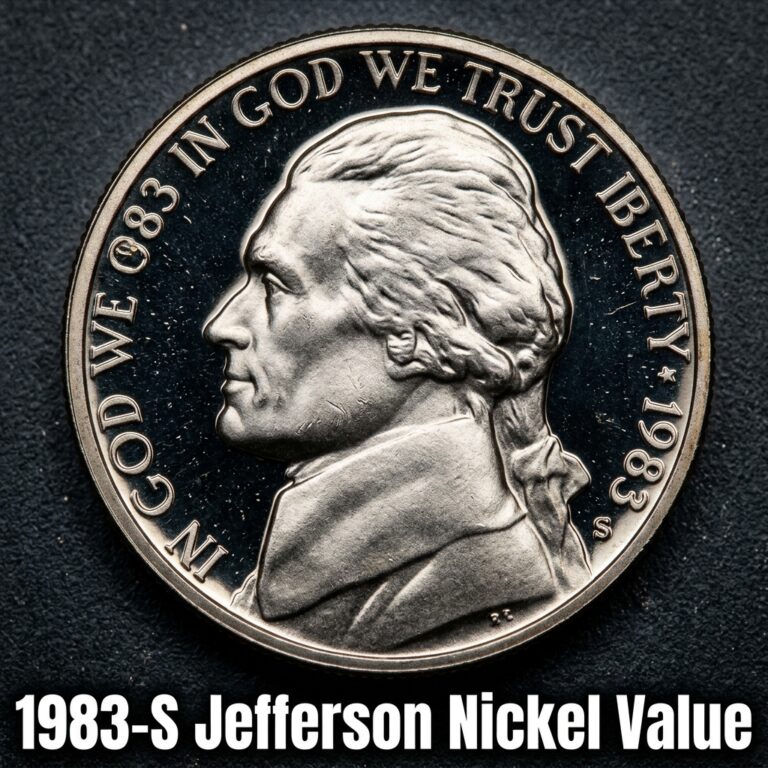
If you have discovered a nickel dated 1977 with a small “S” mint mark to the right of Monticello, you are holding a “Proof” coin. Unlike the nickels you find in your pocket change, which were struck for general circulation in Philadelphia or Denver, the 1977-S version was struck specifically for collectors at the San Francisco Mint.
These coins were produced using specially polished dies and planchets (coin blanks), resulting in a mirror-like finish. To identify yours properly, you might want to use a top coin identifier and value app to confirm its mint mark and condition before selling it.
Because they were sold in plastic-encased Proof Sets, most 1977-S nickels remain in excellent condition today. However, their value is heavily dependent on the “eyeball appeal”—specifically the contrast between the frosted portrait of Thomas Jefferson and the shiny background. Thousands of Americans find these in inherited collections, and using an app like CoinKnow can help you determine if yours fits the “Deep Cameo” description.
Your Old Coin Could Be Valuable!
Identify It & Know Its Real Value — Free Download
Understanding the Grade and 1977-S Proof Nickel Prices
When determining the market value of your coin, collectors look at professional grading scales ranging from 1 to 70. Since the 1977-S was never meant to circulate, almost all survivors are graded Proof 60 or higher. The real money lies in “Deep Cameo” (DCAM) designations, where the design looks like it is floating on water.
You can check the latest 1977-S nickel price data to see how the market fluctuates for these specific grades. A Proof 65 is common, but a perfect Proof 70 is exceptionally rare because even a tiny hairline scratch caused by the original packaging can lower the grade.
Your Old Coin Could Be Valuable!
Identify It & Know Its Real Value — Free Download
| Technical Grade | Visual Appearance | Current Market Value |
|---|---|---|
| PR63 – PR65 | Minor spots or hazy finish | $1 – $4 |
| PR67 Cameo | Strong contrast, light marks | $8 – $12 |
| PR69 Deep Cameo | Nearly flawless contrast | $20 – $40 |
| PR70 Deep Cameo | Perfect under 5x magnification | $350+ |
Identifying the “Deep Cameo” Effect on 1977-S Nickels
One word you will see often in the coin world is “Cameo.” Back in 1977, the San Francisco Mint was still perfecting the process of creating a lasting frosted finish on the dies. The first few hundred coins struck with a new die would have a heavy frost, while later strikes would look more uniform and shiny.
A 1977-S “Deep Cameo” nickel features a thick, white frost on Jefferson’s face and the building of Monticello, contrasting against a black, mirror-like background. If you aren’t sure if your coin has this “pop,” using CoinKnow allows you to take a photo and compare it with known high-grade examples.
Your Old Coin Could Be Valuable!
Identify It & Know Its Real Value — Free Download
Check out the detailed 1977 nickel value and variety information to understand the difference between standard proofs and Deep Cameo versions. Many “raw” coins found in sets are actually “Cameo” but not “Deep Cameo,” which significantly changes the resale price.
The Rarity of 1977-S Error Coins
While 1977-S coins were produced under strict quality control, errors do happen. Because these are Proof coins, errors are much rarer than on regular circulation nickels from Philly or Denver. If you find one, it could be worth hundreds of dollars because collectors love the “mistake on a perfect coin” irony.
Common errors to look for include “Clipped Planchets,” where a piece of the coin is missing in a crescent shape, or “Off-center Strikes,” where the design is pushed to one side. You might also find “Double Dies,” though no major 1977-S double die varieties are currently recognized as high-value blockbusters.
Your Old Coin Could Be Valuable!
Identify It & Know Its Real Value — Free Download
| Error Type | Description | Potential Price |
|---|---|---|
| Curved Clip | Bite-sized chunk missing | $40 – $100 |
| Broadstrike | Coin is wider/flatter than normal | $150+ |
| Struck on Wrong Planchet | Nickel struck on a Penny blank | $1,000+ |
How Mint Mark Placement Affects Value
The “S” mint mark on the 1977 Jefferson Nickel is located on the obverse (front) of the coin. It is tucked just behind the pigtail of Jefferson’s hair and above the date. This placement was standard for the late 70s, but any variation in how clear or well-defined that “S” is can matter to specialized collectors.
In 1977, the Mint produced over 3 million Proof Sets. Because the supply is so high, a 1977-S nickel isn’t “rare” in the traditional sense, but “high-grade survivors” are. If your coin has a faint “S” or a “Filled S” appearance, it is likely just die wear and doesn’t usually add much value.
For everyday Americans, the best way to determine if a specific mint mark variety is worth something is to download CoinKnow. The app’s database tracks auction records for specific mint mark placements and die states, helping you avoid under-selling a potential gem.
Your Old Coin Could Be Valuable!
Identify It & Know Its Real Value — Free Download
Tips for Selling Your 1977-S Jefferson Nickel
If you believe you have a high-grade or error 1977-S nickel, do not clean it! Cleaning a coin with a cloth or chemicals will microscopic scratches into the surface, destroying the “Proof” finish and reducing the value to essentially zero for collectors.
Instead, handle the coin only by the edges. If it is already in a plastic “Proof Set” case, leave it there. Taking it out exposes it to oils from your skin and oxygen in the air, which can cause “turning” or cloudiness on the surface.
Most local coin shops will buy 1977-S nickels, but only if they are in pristine condition or part of a full set. For individual high-value coins, online auctions or professional grading services like PCGS or NGC are your best bet for getting the full market price.
| Where to Sell | Best For… | Estimated Payback |
|---|---|---|
| Local Coin Shop | Quick cash, bulk sets | 50-70% of Retail |
| eBay / Online | Individual high-grade coins | 80-90% of Retail |
| Heritage Auctions | Rare Errors/PR70 DCAM | Top Market Price |
FAQ
Q: Can I find a 1977-S Nickel in my pocket change?
A: While rare, it is possible. These are called “Impaired Proofs.” If someone broke a Proof Set and spent the coins, they would enter circulation. However, once a Proof coin is scratched and worn from general use, it usually loses its collector premium and is only worth its face value of five cents.
Your Old Coin Could Be Valuable!
Identify It & Know Its Real Value — Free Download
Q: What is the most ever paid for a 1977-S Nickel?
A: A perfect PR70 Deep Cameo specimen once sold at auction for over $1,500. Most, however, sell for roughly $2 to $5 in standard Proof condition.
Q: Is there a 1977-S Silver Nickel?
A: No. In 1977, nickels were made of a copper-nickel alloy (75% copper, 25% nickel). The US Mint did not produce silver nickels in 1977. If your coin looks exceptionally shiny, it is because of the Proof finish, not silver content.
Q: How do I know if my 1977 nickel is a “Proof”?
A: Look for the “S” mint mark. If it has an “S” and has a mirror-like, reflective background, it is a Proof. If it has a “D” or no mint mark (Philadelphia), it is a regular business-strike coin made for circulation.