1981-P Kennedy Half Dollar Value: What is Your Coin Worth?

Your Old Coin Could Be Valuable!
Identify It & Know Its Real Value — Free Download


The 1981-P Kennedy Half Dollar is worth anywhere from its $0.50 face value in circulated condition to over $500 in high-grade mint state. While millions were struck for circulation, finding one in pristine, uncirculated condition is what truly excites collectors and determines if your spare change is a hidden treasure.
| Condition / Grade | Estimated Value |
|---|---|
| Circulated (Average Wear) | $0.50 – $0.75 |
| About Uncirculated (AU58) | $1.00 – $2.50 |
| Mint State (MS63) | $5.00 – $12.00 |
| Mint State (MS65 Gem) | $25.00 – $45.00 |
| High Grade (MS67+) | $500.00+ |
Identifying Your 1981-P Kennedy Half Dollar
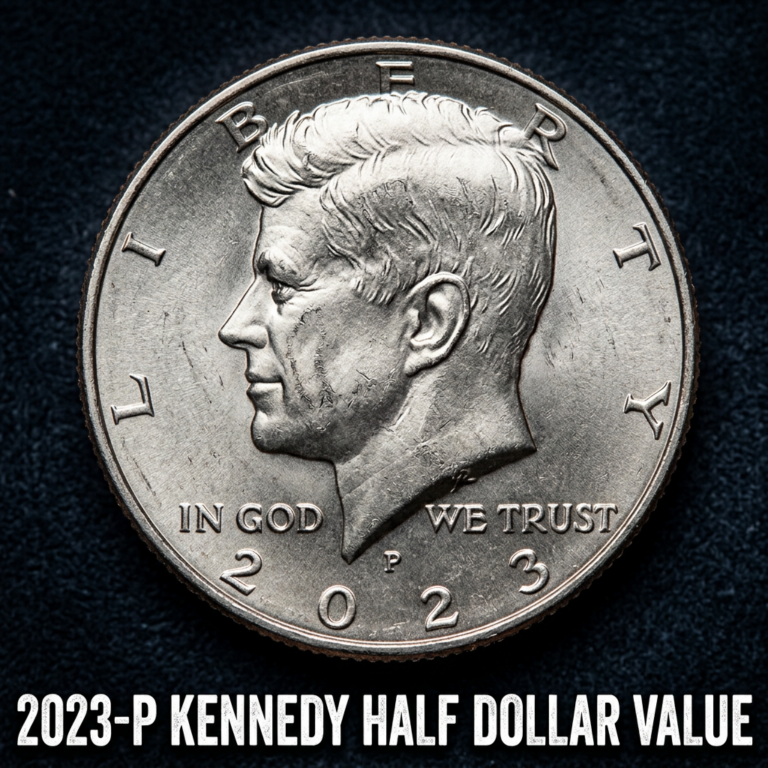
If you just looked through your kitchen drawer or a jar of old change and found a 1981 half dollar with a small “P” above the date, you have a Philadelphia Mint strike. In 1981, the United States Mint produced over 29 million of these coins at the Philadelphia facility.
Because so many were made for general use, most of the coins you will find today have been passed from hand to hand for decades. These “circulated” coins usually show scratches, dullness, and a loss of detail in President John F. Kennedy’s hair. For an accurate assessment, many beginners use a top coin identifier and value app to see if their specific coin has the luster required for a higher payout.
The 1981-P is composed of a copper-nickel “clad” layers over a pure copper core. Unlike half dollars from 1964 and earlier, these do not contain any silver. This means their value is driven purely by their condition and rarity in the eyes of collectors rather than their metal content. Using CoinKnow can help you distinguish between a common spender and a collector’s item in seconds.
Your Old Coin Could Be Valuable!
Identify It & Know Its Real Value — Free Download
How Grading Affects the 1981 Philadelphia Half Dollar Price
In the world of coin collecting, “Grade” is everything. Grading is the process of determining how much wear and tear a coin has suffered. The scale goes from 1 to 70. A coin graded 1 is essentially a flat disc, while a 70 is a perfect coin with no visible flaws even under a microscope.
For the 1981-P, most coins found in bank rolls are in the “Circulated” or “About Uncirculated” range. These are rarely worth more than their fifty-cent face value. However, coins that were tucked away in Mint Sets or protected in rolls can reach “Mint State” (MS) levels.
Your Old Coin Could Be Valuable!
Identify It & Know Its Real Value — Free Download
According to the latest 1981-P Kennedy Half Dollar Mint State price guide, the jump in value from MS65 to MS67 is massive. While an MS65 might sell for the price of a nice lunch, an MS67 is a rarity that causes bidding wars at auction houses.
| Numerical Grade | Market Description | Typical Price |
|---|---|---|
| MS60-MS62 | Uncirculated with marks | $2 – $4 |
| MS63-MS64 | Choice Uncirculated | $6 – $15 |
| MS65 | Gem Uncirculated | $30 – $50 |
| MS66 | Premium Gem | $80 – $150 |
| MS67 | Superb Gem | $400 – $900 |
Historical Context: Why Was the 1981 Half Dollar Special?
By 1981, the Kennedy Half Dollar had become a coin that few people actually used for shopping. Most people kept them as souvenirs or used them in casinos. Because of this, the 1981 production numbers were relatively low compared to the 1970s.
Your Old Coin Could Be Valuable!
Identify It & Know Its Real Value — Free Download
Interestingly, 1981 was a year of transition for the minting process. The Philadelphia Mint was refining its technique for the “P” mint mark, which had only been added to the Kennedy Half Dollar in 1980. Prior to that, Philadelphia coins had no mint mark at all.
When you use CoinKnow to track your collection, you’ll see that 1981 is often considered a “sleepy” year. It isn’t as famous as the silver years, but that actually makes high-grade survivors even rarer. Most people didn’t bother to save them in 1981, so finding a perfect one today is a real challenge.
Value Factors for the 1981-P Kennedy Half Dollar
There are three main factors that will determine how much a collector will pay for your coin: Surface Preservation, Luster, and Strike Quality. For the 1981-P, the “strike” is often the dealbreaker.
Your Old Coin Could Be Valuable!
Identify It & Know Its Real Value — Free Download
The strike refers to how hard the dies hit the coin blank. A weak strike results in faint details on the eagle’s feathers on the back (reverse) or JFK’s hair. Collectors look for a “sharp” strike where every line is crisp. For more amateur-friendly tips on spotting these features, you can check out this guide on 1981 Kennedy Half Dollar worth and rarity.
Luster is the “glow” or “shimmer” a coin has. When a coin circulates, the luster is the first thing to vanish, replaced by a dull gray color. If your 1981-P still looks like it just came from the bank in 1981—shiny, spinning light like a fan—you might have a coin worth significantly more than fifty cents.
Valuable Errors to Look For in 1981-P Half Dollars
Error hunting is one of the most exciting parts of the hobby for everyday Americans. Sometimes, the machines at the Mint make a mistake, creating a “one-of-a-kind” coin that can be worth hundreds of dollars.
For the 1981-P, look for “Double Die” errors. This happens when the die used to stamp the coin has a doubled image. You might see a slight ghosting or doubling on the letters of “LIBERTY” or the date. Another common error is the “Off-Center Strike,” where the coin looks like it was clipped or the design is sliding off the edge.
Your Old Coin Could Be Valuable!
Identify It & Know Its Real Value — Free Download
| Error Type | Description | Potential Value |
|---|---|---|
| Doubled Die Obverse | Doubling on ‘Trust’ or Date | $25 – $100+ |
| Clipped Planchet | Part of the coin is missing a ‘bite’ | $15 – $50 |
| Broadstruck | Coin is wider than normal without ridges | $20 – $60 |
Tips for Selling Your 1981-P Kennedy Half Dollar
If you think you’ve found a high-value 1981-P, don’t rush to the nearest pawn shop. Pawn shops usually pay the lowest possible “bulk” price. Instead, consider these steps:
First, use CoinKnow to get a baseline idea of the grade. If the app suggests your coin is in exceptional condition, you may want to have it professionaly graded by a service like PCGS or NGC.
Second, check recent sales on online auction sites. Look at “Sold” listings, not “Asking” prices. People can ask for $10,000 for a penny, but that doesn’t mean it’s worth that much. Seeing what someone actually paid for a 1981-P in your condition is the best way to set expectations. If your coin is just a standard circulated piece, it’s often best kept as a part of a starter collection for a child or grandchild!
FAQ
Q: Does the 1981-P Kennedy Half Dollar have any silver?
A: No, the 1981-P is a clad coin made of copper and nickel. The U.S. Mint stopped using silver in circulating half dollars after 1970.
Your Old Coin Could Be Valuable!
Identify It & Know Its Real Value — Free Download
Q: Where is the mint mark located on a 1981 half dollar?
A: The “P” mint mark is located on the obverse (front) of the coin, just above the year “1981.”
Q: What is the most ever paid for a 1981-P Kennedy Half Dollar?
A: High-grade examples in MS67 condition have sold for over $1,000 at specialized heritage auctions, though most top-tier uncirculated examples sell in the $500 range.
Q: Should I clean my 1981 half dollar to make it worth more?
A: No! Never clean your coins. Cleaning causes micro-scatches that permanentely damage the coin’s value. Collectors prefer a dirty, authentic coin over a shiny, cleaned one.