1980-S Washington Quarter Value: Is Your Proof Coin Rare?

Your Old Coin Could Be Valuable!
Identify It & Know Its Real Value — Free Download


The 1980-S Washington Quarter is worth anywhere from $2 in typical proof condition to over $100 for flawless specimens. While this coin was not made for general circulation, many everyday Americans find them in inherited collections or “proof sets” and wonder if they have hit a numismatic jackpot.
| Condition / Grade | Estimated Value |
|---|---|
| PR 65 (Typical Proof) | $2.00 – $5.00 |
| PR 69 Deep Cameo | $15.00 – $25.00 |
| PR 70 Deep Cameo (Perfect) | $100.00 – $450.00+ |
Understanding the 1980-S Proof Washington Quarter
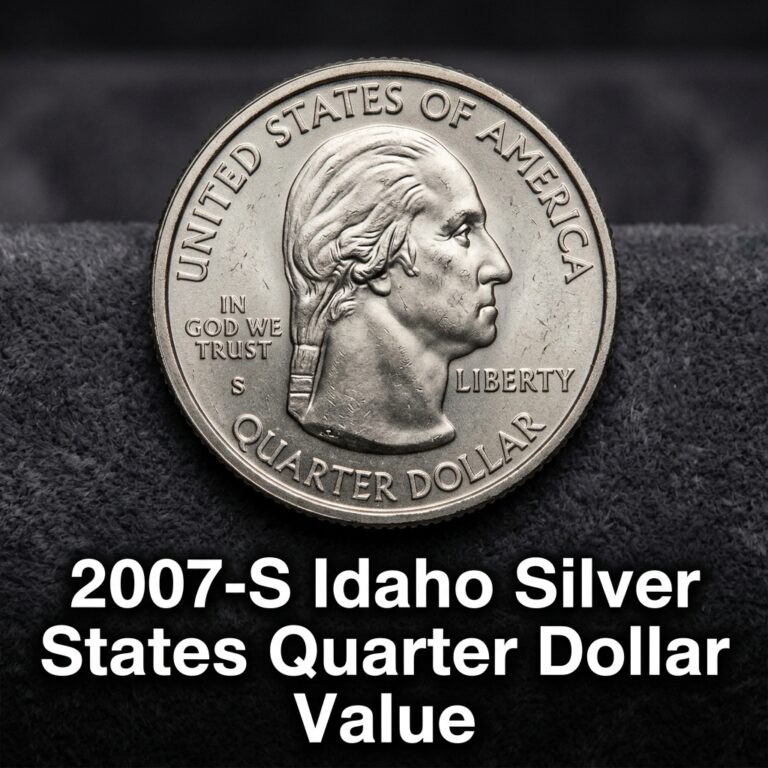
If you are holding a 1980 quarter with an “S” mint mark under the date, you are looking at a “Proof” coin. Unlike the quarters you find in your pocket change which were minted in Philadelphia or Denver, these coins were struck at the San Francisco Mint specifically for collectors. They were originally sold by the U.S. Mint in protective plastic sets. If you recently found one and want to confirm its identity, using a top coin identifier and value app is the quickest way to verify its origin.
The 1980-S Washington Quarter is easily distinguished by its mirror-like background and “frosted” details. This contrast is known as a “Cameo” effect. Because these coins were handled with extreme care and never released into grocery store cash registers, they generally remain in excellent condition. However, because over 3.5 million sets were produced, they are common in the coin world. To get a high value, the coin must be essentially perfect, showing no scratches or “cloudiness” on the surface.
Checking your coin’s details is essential before getting too excited. You should look for any signs of wear; if the “S” mint mark is present but the coin looks dull or scratched, it may have been “broken out” of a proof set and spent as regular money. In such cases, the value drops significantly toward its face value. Professional collectors use CoinKnow to track these specific nuances in strike quality and surface preservation, which allows them to decide if a coin is worth the cost of professional grading.
Your Old Coin Could Be Valuable!
Identify It & Know Its Real Value — Free Download
Evaluating the 1980-S Quarter Market Prices
When determining the 1980-S Washington Quarter value, the most important factor is the numerical grade. Coins are graded on a scale of 1 to 70. Since all 1980-S quarters were minted as proofs, you will only see “PR” (Proof) grades. A PR 65 is considered a standard handsome coin, while a PR 70 is a museum-quality “perfect” specimen. Even slight imperfections invisible to the naked eye can separate a $10 coin from a $200 coin.
Your Old Coin Could Be Valuable!
Identify It & Know Its Real Value — Free Download
Current market trends show that most “raw” (un-graded) 1980-S quarters sell for very modest amounts. However, if you have a coin that looks absolutely flawless, you should compare it against the 1980 quarter auction records to see what the top-of-the-line versions are currently fetching. In many cases, it costs more to have a coin professionally graded than the coin itself is actually worth.
| Grading Tier | Market Range | Scarcity |
|---|---|---|
| PR 67 Deep Cameo | $8 – $12 | Very Common |
| PR 69 Deep Cameo | $18 – $30 | Abundant |
| PR 70 Deep Cameo | $150 – $500 | Very Rare |
The Importance of “Deep Cameo” Designations
You might notice the initials “DCAM” or “Deep Cameo” next to the grade of a 1980-S Washington Quarter. This refers to the contrast between the shiny, mirror-like “fields” (the flat background) and the matted, white appearance of George Washington’s bust. In 1980, the United States Mint had mastered the process of creating these high-contrast coins. Therefore, almost all 1980-S quarters are expected to be Deep Cameo.
Your Old Coin Could Be Valuable!
Identify It & Know Its Real Value — Free Download
If you find a 1980-S that lacks this contrast—meaning the entire coin looks shiny without that “frosted” white relief—it might actually be a lower-quality proof. Ironically, in the modern grading world, a coin that doesn’t meet the “Deep Cameo” standard for this specific year is often less desirable. To see how these visual differences impact the bottom line, you can read more about the specific 1980 quarter value factors that professional buyers look for.
Using CoinKnow can help you visualize these differences. The app allows users to compare their own photos with high-resolution images of “Deep Cameo” specimens. This ensures you aren’t mistaking a polished regular quarter for a true San Francisco proof. Remember, a proof coin’s edges are much sharper and more “squared off” than the rounded edges of a coin intended for circulation.
Your Old Coin Could Be Valuable!
Identify It & Know Its Real Value — Free Download
Rare Varieties and Errors to Look For
While the 1980-S proof is generally a standard issue, error hunters are always on the lookout for anomalies. For the 1980-S Washington Quarter, errors are extremely rare because proof coins undergo rigorous inspection. However, “doubled dies” or “re-punched mint marks” are the holy grails of 1980 coinage. If you see clear doubling in the letters of “IN GOD WE TRUST” or “LIBERTY,” you might have a coin worth hundreds.
Another thing to look for is “panning” or “haze.” Over time, the chemicals in the original plastic packaging could react with the copper-nickel surface of the coin, creating a rainbow-like toning or a dull milk spot. While some collectors love “toning” and will pay a premium for it, most prefer the crisp, white look of a pristine proof. If your 1980-S has unique color, it might actually increase the 1980-S Washington Quarter value to the right specialist buyer.
| Potential Error Type | Observation | Value Impact |
|---|---|---|
| Doubled Die Obverse | Doubling on lettering or date | Significant Premium |
| Off-Center Strike | Design not centered on planchet | Extremely High |
| Secondary Toning | Rainbow colors on surface | Subjective Premium |
How to Sell Your 1980-S Washington Quarter
If you’ve determined that your coin is a high-grade specimen, the next step is finding a buyer. For most people, a local coin shop is the easiest route, but be warned: dealers usually buy at wholesale prices. If your 1980-S Washington Quarter is only worth $5, a dealer might only offer you $1 or $2, as they need to make a profit. Many collectors prefer using CoinKnow to list their coins on digital marketplaces where they can reach a wider audience of enthusiasts directly.
For potential PR 70 candidates, professional grading by services like PCGS or NGC is mandatory. A coin in a “slab” (a protective plastic holder with a certified grade) sells for much more than a loose coin. However, grading costs around $30-$50 per coin. Only send your 1980-S in if you are 100% certain it is perfect under a magnifying glass. If it comes back as a PR 69, you will likely lose money on the transaction.
Your Old Coin Could Be Valuable!
Identify It & Know Its Real Value — Free Download
Final Thoughts for Everyday Collectors
The search for the 1980-S Washington Quarter value is a great entry point into the hobby of numismatics. While most of these coins won’t fund a retirement, they represent a moment in U.S. Mint history where production quality was exceptionally high. Whether you found it in a drawer or inherited a set, take the time to look closely at the “S” mint mark and the mirror-like finish.
Keep your proof quarters in their original packaging or in PVC-free coin flips to maintain their value. Touching the surface of a proof coin with your bare fingers can leave permanent oils that turn into black spots over time. With a little care and the right tools, you can accurately determine if your 1980 quarter is a common keepsake or a rare high-grade treasure.
FAQ
Q: Does the 1980-S Washington Quarter contain silver?
A: No. By 1980, the U.S. Mint had long since switched to a “clad” composition. The 1980-S Washington Quarter is made of an inner core of pure copper with an outer layer of 75% copper and 25% nickel. It contains no silver.
Your Old Coin Could Be Valuable!
Identify It & Know Its Real Value — Free Download
Q: Why is my 1980 quarter shiny but doesn’t have an “S” mint mark?
A: If it is shiny but has a “P” (Philadelphia) or “D” (Denver) mint mark, it is likely a “Business Strike” coin that has simply been well-preserved or perhaps artificially polished. Only coins with the “S” mark were produced as official Proofs in San Francisco that year.
Q: Is a 1980-S quarter worth getting graded?
A: Only if it is absolutely flawless. Because PR 69 examples are so common and sell for under $30, it is only financially worth grading if you believe the coin will achieve the perfect PR 70 grade, which can command much higher prices.
Q: Where is the mint mark on a 1980-S quarter?
A: The “S” mint mark is located on the “Obverse” (heads) side of the coin. You will find it to the right of George Washington’s ponytail, just above the date.