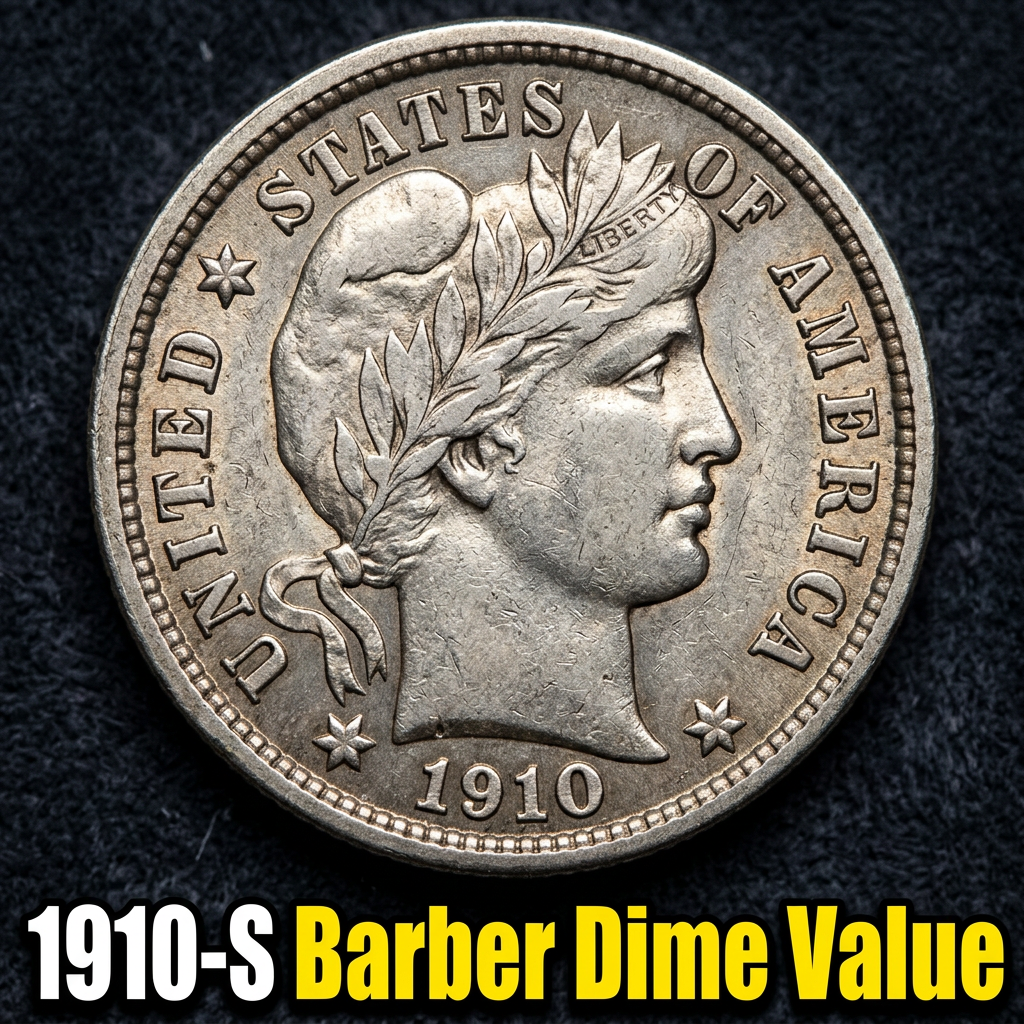
1910-S Barber Dime Value What This San Francisco Rarity Is Really Worth

Your Old Coin Could Be Valuable!
Identify It & Know Its Real Value — Free Download


The 1910-S Barber Dime is worth anywhere from $15 in heavily worn condition to well over $500 in well-preserved mint state examples — and rare high-grade coins can push into the thousands. If you just found one of these in an old jar or inherited coin collection, you’ve got something genuinely worth looking into.
What Makes the 1910-S Barber Dime Special
The 1910-S Barber Dime was struck at the San Francisco Mint and is considered one of the more desirable issues in the classic Barber Dime series. Designed by Charles E. Barber, these dimes were minted from 1892 through 1916, and the San Francisco issues from this era carry a strong collector following.
The “S” mintmark appears on the reverse of the coin, just above the “E” in “ONE.” If your coin has this small letter, you’re looking at a San Francisco strike — not the Philadelphia or Denver version, which have different values.
With a mintage of around 1.24 million coins, the 1910-S is considered a lower-mintage date compared to many others in the series. That scarcity plays directly into its value today.
Your Old Coin Could Be Valuable!
Identify It & Know Its Real Value — Free Download
How Much Is the 1910-S Barber Dime Worth Today
The value of your 1910-S Barber Dime depends heavily on its condition, or “grade” as collectors call it. A coin that’s been passed around for decades will show heavy wear on the design elements — especially Lady Liberty’s hair above the ear, which tends to fade first. Even in rough shape, this coin holds real value.
For a quick look at current estimated values across grades, see the table below:
Your Old Coin Could Be Valuable!
Identify It & Know Its Real Value — Free Download
| Grade | Description | Estimated Value |
|---|---|---|
| Good (G-4) | Heavy wear, outline visible | $15 – $20 |
| Very Good (VG-8) | Moderate wear, some detail remains | $22 – $30 |
| Fine (F-12) | Even wear, design clear | $35 – $55 |
| Very Fine (VF-20) | Light wear on high points | $60 – $100 |
| Extremely Fine (EF-40) | Slight wear, sharp details | $120 – $175 |
| About Uncirculated (AU-50) | Trace wear only | $200 – $300 |
| Mint State (MS-60 to MS-65) | No wear, original luster | $350 – $1,200+ |
These figures reflect the current collector market. For more detailed price data, you can check out a complete breakdown of 1910 Barber Dime values by grade and mintmark that covers the full picture.
Your Old Coin Could Be Valuable!
Identify It & Know Its Real Value — Free Download
How to Grade Your 1910-S Barber Dime at Home
You don’t need to be a professional to get a rough sense of your coin’s grade. Start by looking at Liberty’s head on the obverse — specifically the hair above her forehead and behind the ear. In worn coins, these details become smooth and flat. In better-preserved examples, you can see individual strands of hair and the letters of “LIBERTY” across the headband are sharp and complete.
On the reverse, look at the eagle’s breast feathers and the arrows and olive branch in its talons. Wear shows up quickly on those raised design elements.
If you want to skip the guesswork, CoinKnow is a great tool to have on hand. You can snap a photo of your coin and get an instant identification and value estimate — no coin expertise required.
Your Old Coin Could Be Valuable!
Identify It & Know Its Real Value — Free Download
Using a coin identifier and value app takes the guesswork out of grading, especially if you’ve got a whole jar of old coins to sort through. It can save you hours of research and help you spot any hidden gems.
Key Varieties and What to Look For
There are no widely documented major die varieties for the 1910-S that dramatically change its value, but strike quality and luster can vary significantly from coin to coin. Some San Francisco Barber Dimes from this period are known for weaker strikes, especially on the reverse.
A sharply struck 1910-S with full luster is noticeably more valuable than a flat or lackluster example at the same technical grade. Collectors pay real premiums for coins with great eye appeal — meaning bright surfaces, no distracting marks, and a clean strike overall.
If your coin looks unusually bright or crisp, it’s worth having a professional take a look. You might be sitting on something more valuable than the baseline estimate suggests.
Your Old Coin Could Be Valuable!
Identify It & Know Its Real Value — Free Download
Should You Clean or Sell Your 1910-S Barber Dime
One of the biggest mistakes people make with old coins is cleaning them. Even a gentle polish or wipe with a cloth can damage the surface at a microscopic level, leaving hairline scratches that dramatically reduce collector value. A coin that looks dull but is original will almost always sell for more than one that’s been cleaned to a shine.
If you’re thinking about selling, your best options include local coin dealers, online auction platforms like eBay, or coin shows where collectors actively buy. Getting two or three opinions on value is always smart before you commit to a price.
CoinKnow can also give you a second opinion before you walk into a dealer — so you’re not going in blind. It’s especially useful when you’re dealing with older silver coins where condition details really matter.
—
Your Old Coin Could Be Valuable!
Identify It & Know Its Real Value — Free Download
Frequently Asked Questions
Q: How do I know if my dime is the 1910-S and not another year or mint?
A: Check both sides carefully. The date appears on the obverse (front), and the “S” mintmark is on the reverse above the “E” in “ONE DIME.” If both match, you’ve got the San Francisco issue from 1910.
Q: Is the 1910-S Barber Dime made of silver?
A: Yes. All Barber Dimes are composed of 90% silver and 10% copper. Even a well-worn example has melt value based on its silver content — currently around $2 or more per coin depending on silver spot prices.
Q: Can I get my 1910-S Barber Dime professionally graded?
A: Absolutely. Services like PCGS and NGC will authenticate and grade your coin for a fee. Professional grading makes sense if your coin appears to be in Extremely Fine or Mint State condition, where the value difference between grades can be hundreds of dollars. CoinKnow can help you decide whether it’s worth submitting before you pay for grading services.