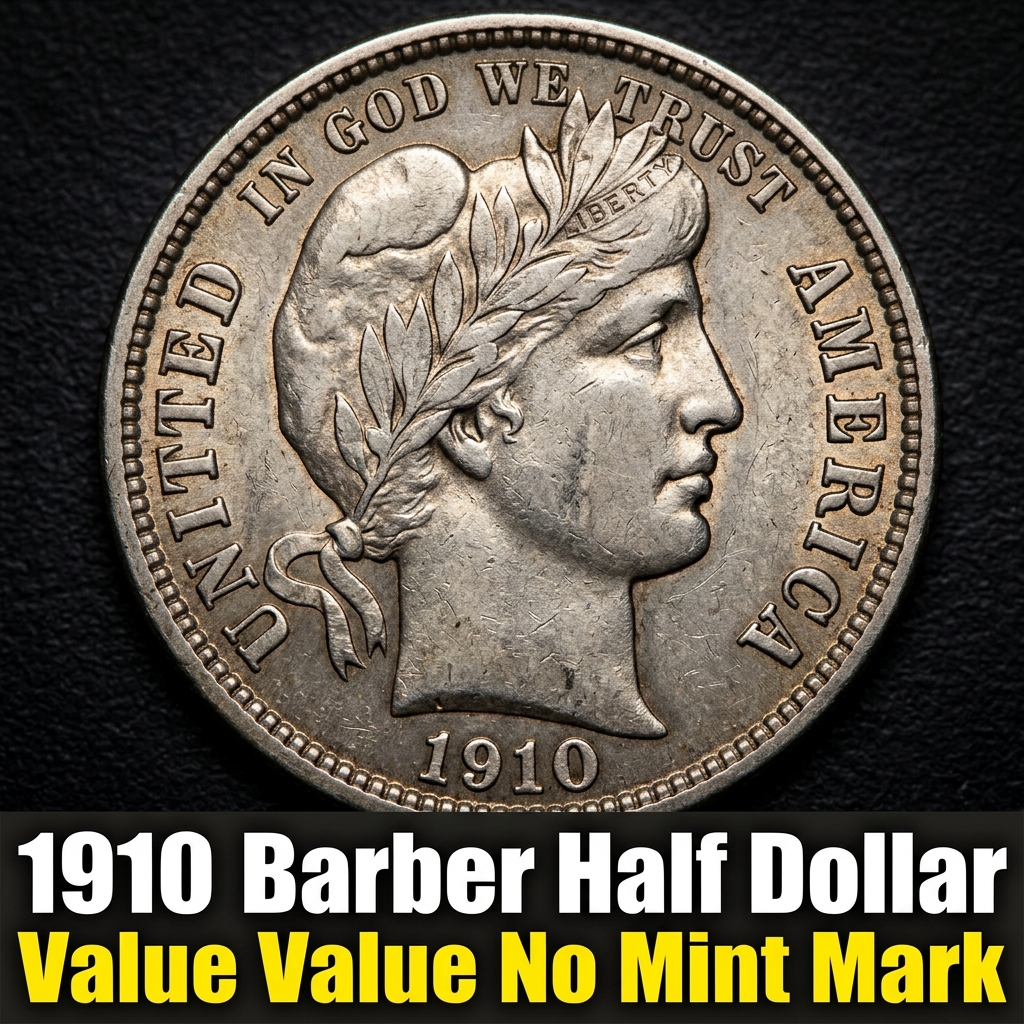
1910 Barber Half Dollar Value with No Mint Mark and What It’s Worth Today

Your Old Coin Could Be Valuable!
Identify It & Know Its Real Value — Free Download


The 1910 Barber Half Dollar (no mint mark) is worth anywhere from $15 in heavily worn condition to over $400 in well-preserved mint state grades. If you found one of these old coins tucked away in a drawer or inherited collection, you’re holding a piece of American history — and possibly some real value.
If you want a quick estimate without doing all the research yourself, a coin identifier and value app can help you scan your coin and get an instant value range based on its condition and mint mark. It’s one of the easiest ways to start figuring out what you’ve got.
What Is the 1910 Barber Half Dollar?
The Barber Half Dollar was designed by U.S. Mint Chief Engraver Charles E. Barber and was minted from 1892 to 1915. The 1910 issue with no mint mark was struck at the Philadelphia Mint, which was the main production facility at the time.
Philadelphia was the only mint producing half dollars in 1910, so all genuine 1910 Barber Half Dollars lack a mint mark. That actually makes identification straightforward — if it says 1910 and has no “S” or “O” below the eagle on the reverse, you have a Philadelphia coin.
Your Old Coin Could Be Valuable!
Identify It & Know Its Real Value — Free Download
The coin features Lady Liberty wearing a Phrygian cap on the obverse, and a heraldic eagle on the reverse. These coins circulated heavily and most survivors today show significant wear. That said, even worn examples carry decent collector value.
Your Old Coin Could Be Valuable!
Identify It & Know Its Real Value — Free Download
How Much Is the 1910 Barber Half Dollar Worth?
Value depends almost entirely on condition. A coin that’s been in circulation for decades will have a very different price from one that was set aside in a cabinet shortly after minting.
Your Old Coin Could Be Valuable!
Identify It & Know Its Real Value — Free Download
Here’s a general value table for the 1910 Barber Half Dollar (No Mint Mark):
| Grade | Condition Description | Estimated Value |
|---|---|---|
| Good (G-4) | Heavy wear, outline visible | $15 – $20 |
| Very Good (VG-8) | Major details clear | $22 – $35 |
| Fine (F-12) | Moderate wear, lettering clear | $40 – $65 |
| Extremely Fine (EF-40) | Light wear on high points | $100 – $150 |
| About Uncirculated (AU-50) | Slight wear, most luster remains | $180 – $250 |
| Mint State (MS-63) | No wear, minor contact marks | $350 – $450+ |
The 1910 Philadelphia issue had a mintage of 418,551 coins — not a huge number by modern standards — which gives it solid demand among Barber series collectors. If you’re curious about which half dollars are worth the most money, the Barber series consistently ranks near the top for early 20th century U.S. coinage.
How to Grade Your 1910 Barber Half Dollar at Home
Grading might sound intimidating, but you can do a pretty good basic assessment with just a magnifying glass and some decent lighting.
Your Old Coin Could Be Valuable!
Identify It & Know Its Real Value — Free Download
Start by looking at the high points of the design — the hair above Liberty’s ear, the ribbon on her cap, and the eagle’s breast feathers on the reverse. If those areas are smooth and flat, you’re probably looking at a coin in the Good to Fine range.
If you can still see individual feathers and hair strands with only minor wear, you may have an Extremely Fine example. Coins with full original luster and no signs of circulation are rare and significantly more valuable.
CoinKnow makes this process easier for everyday collectors. Just take a clear photo of your coin under natural light, upload it to the app, and CoinKnow will give you a grade estimate and current market value in seconds. It’s a tool that removes the guesswork from the process.
Your Old Coin Could Be Valuable!
Identify It & Know Its Real Value — Free Download
Silver Content and Melt Value
Even if your 1910 Barber Half Dollar is too worn for collector premiums, it still has real intrinsic value because of its silver content.
The coin is made of 90% silver and contains 0.3617 troy ounces of pure silver. With silver trading around $28–$30 per troy ounce (prices vary), that gives the coin a base melt value of roughly $10–$11.
In practice, most dealers won’t pay melt value — they’ll offer slightly below it for heavily worn coins. But this silver floor means even beat-up examples aren’t worthless. Many everyday Americans are surprised to find that a dull, scratched-up old half dollar is still worth real money.
Your Old Coin Could Be Valuable!
Identify It & Know Its Real Value — Free Download
FAQ
Q: Is the 1910 Barber Half Dollar rare?
A: It’s not considered rare in circulated grades, but it’s not common either. With a mintage under 420,000, it’s one of the lower-production Philadelphia Barber halves of the era. In high mint state grades, it becomes genuinely scarce and commands strong premiums.
Q: How do I know if my coin is authentic?
A: Genuine 1910 Barber Half Dollars weigh 12.5 grams and measure 30.6mm in diameter. The reeded edge and crisp lettering are also good signs. For peace of mind, you can use CoinKnow to cross-reference your coin’s details against a verified database, or submit it to a grading service like PCGS or NGC for professional authentication.
Q: Where is the best place to sell a 1910 Barber Half Dollar?
A: Options include local coin dealers, online auction sites like eBay, and dedicated coin show events. For higher-grade examples, working with a reputable auction house that specializes in U.S. coins can yield better results. Getting a professional appraisal first is always a smart move before selling.