1912-D Barber Dime Value Guide What This Denver Mint Coin Is Worth Today

Your Old Coin Could Be Valuable!
Identify It & Know Its Real Value — Free Download


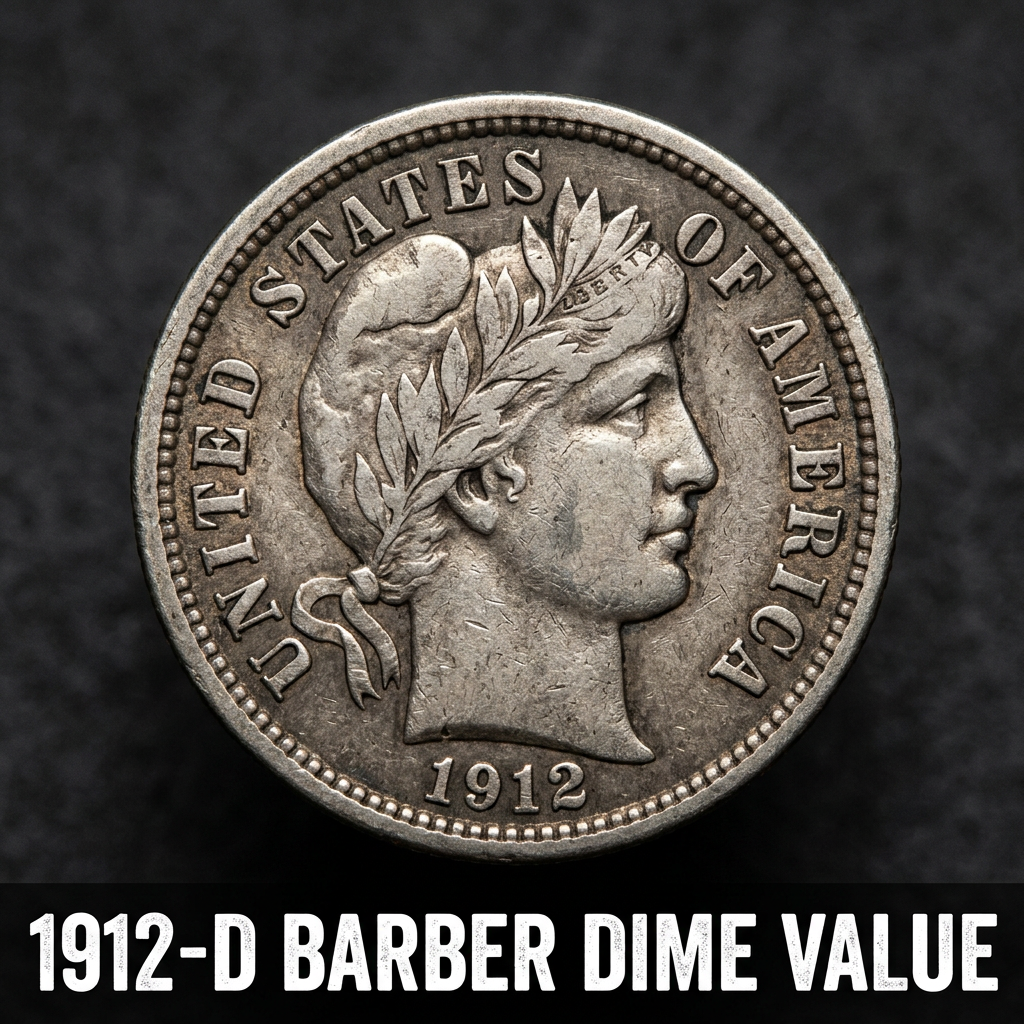
The 1912-D Barber Dime is worth anywhere from $4 in heavily worn condition to well over $100 in fine or better grades, with uncirculated examples sometimes reaching $300 or more depending on their eye appeal and strike quality. If you just found one of these old silver dimes in a coin jar, a drawer, or an estate collection, you’re holding a piece of early American history that’s worth more than ten cents — often quite a bit more.
What Makes the 1912-D Barber Dime Special
The “D” in 1912-D stands for Denver, which means this dime was struck at the Denver Mint rather than Philadelphia or San Francisco. The Denver Mint had only been open for about a decade at this point, and coins from this era carry a certain charm that modern collectors love.
The Barber Dime series ran from 1892 to 1916, designed by Charles E. Barber, who served as Chief Engraver of the U.S. Mint. Liberty appears on the obverse wearing a Phrygian cap and a laurel wreath, surrounded by stars. The reverse features a simple but elegant design of an eagle with a bundle of arrows and an olive branch.
The 1912-D had a mintage of 11,760,000 coins — not especially rare, but not a massive number by modern standards either. Most examples that survived did so in well-worn condition, making mid-grade and uncirculated examples more desirable to serious collectors. If you want a quick way to identify your coin and get a value estimate right on your phone, a coin identifier and value app can save you a lot of time and guesswork.
Your Old Coin Could Be Valuable!
Identify It & Know Its Real Value — Free Download
1912-D Barber Dime Value by Grade
The value of your 1912-D Barber Dime depends heavily on its condition, also known as its “grade.” Coin grading runs from Poor (P-1) at the very bottom to Mint State (MS-65 or higher) at the top. Here’s a general look at what you can expect:
Your Old Coin Could Be Valuable!
Identify It & Know Its Real Value — Free Download
| Grade | Description | Estimated Value |
|---|---|---|
| Good (G-4) | Heavy wear, outlines visible | $4 – $6 |
| Very Good (VG-8) | Major details clear | $7 – $12 |
| Fine (F-12) | Moderate wear, lettering sharp | $15 – $25 |
| Very Fine (VF-20) | Light to moderate wear | $30 – $55 |
| Extremely Fine (EF-40) | Light wear on high points only | $70 – $110 |
| Mint State (MS-63) | Uncirculated with minor marks | $200 – $350+ |
These values reflect the current collector market and can shift based on silver prices, auction results, and overall demand. For a more detailed breakdown, you can check out how much a 1912 Barber Dime is worth across all mint marks and grades to compare your coin against the full picture.
How to Grade Your 1912-D Barber Dime at Home
You don’t need to be a professional numismatist to get a rough idea of your coin’s grade. Start by looking at the word LIBERTY on the headband across Liberty’s forehead — this is the first area to show wear on Barber Dimes.
Your Old Coin Could Be Valuable!
Identify It & Know Its Real Value — Free Download
If all seven letters of LIBERTY are bold and fully visible, your coin is in Very Fine or better condition. If only a few letters show, it’s likely Good to Fine. If the headband is completely flat and featureless, you’re looking at a lower-grade coin.
Also check the eagle on the reverse. The feathers in the breast and wings are another telltale sign of grade — well-defined feathers point to a higher-grade coin. Use a magnifying glass in good lighting, and avoid touching the coin’s face with your fingers, as oils from your skin can reduce its value over time.
Your Old Coin Could Be Valuable!
Identify It & Know Its Real Value — Free Download
CoinKnow is a great tool if you want to skip the guesswork entirely. The app lets you photograph your coin and get an instant grade estimate along with current market values, all from your smartphone.
Silver Content and Melt Value
Even a heavily worn 1912-D Barber Dime has intrinsic value because it’s made of 90% silver. Each Barber Dime contains approximately 0.0723 troy ounces of silver. With silver hovering around $28–$30 per ounce in recent times, the melt value of any Barber Dime is roughly $2.00 to $2.20.
That means even a coin in the worst possible condition is still worth at least a couple dollars in silver alone, and in most grades, the numismatic (collector) value far exceeds the melt value.
This is one reason why CoinKnow reminds its users never to clean or polish old silver coins — even well-meaning cleaning destroys surface luster and can drop a coin’s value by 50% or more overnight.
Your Old Coin Could Be Valuable!
Identify It & Know Its Real Value — Free Download
Where to Sell a 1912-D Barber Dime
If you’ve decided to sell, you have several good options. Local coin shops are convenient and will give you an immediate offer, though they typically pay 60–80% of retail to leave room for profit. Online platforms like eBay and Heritage Auctions reach a larger audience and often fetch higher prices.
For rare or high-grade examples, professional grading through PCGS or NGC adds credibility and can significantly increase what a buyer is willing to pay. A coin certified as MS-64 or above will always sell more confidently than a raw coin of the same quality.
—
Your Old Coin Could Be Valuable!
Identify It & Know Its Real Value — Free Download
Frequently Asked Questions
Q: How do I know if my dime is the 1912-D and not another mint mark?
A: Flip the coin over and look at the reverse, just below the eagle’s tail and above the letter E in ONE. You should see a small “D” mintmark there. No letter means it was made in Philadelphia, while an “S” indicates San Francisco.
Q: Is the 1912-D Barber Dime rare?
A: It’s not considered a key date or a rare coin in circulated grades, but it’s a solid mid-series issue with decent collector demand. Uncirculated examples with original luster are genuinely hard to find and command premium prices.
Q: Should I get my 1912-D Barber Dime professionally graded?
A: If your coin appears to be in Extremely Fine or better condition, professional grading through PCGS or NGC is often worth the cost. For circulated examples in lower grades, the grading fee may outweigh the added value. CoinKnow can help you get a preliminary estimate before you decide whether to invest in a professional grade.