1906-D Barber Quarter Dollar Value and What Collectors Are Paying Today

Your Old Coin Could Be Valuable!
Identify It & Know Its Real Value — Free Download


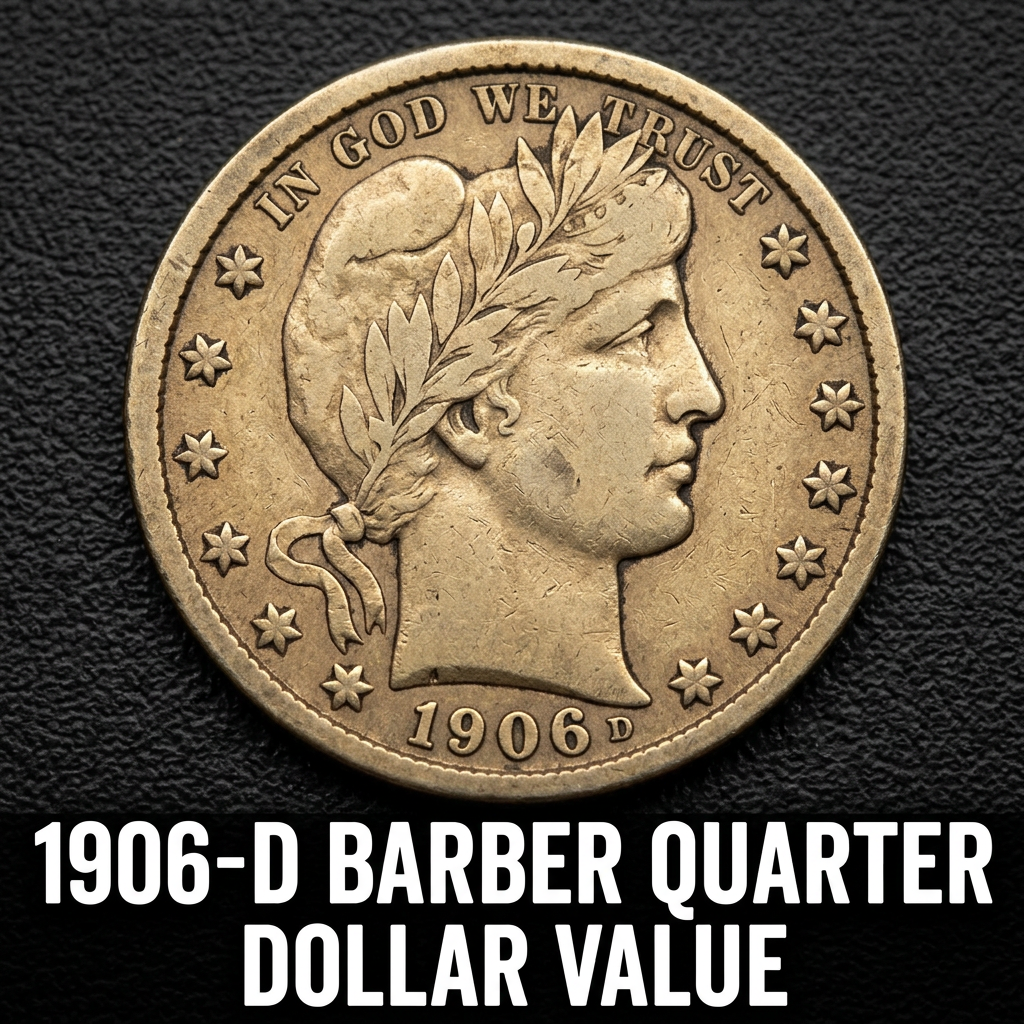
The 1906-D Barber Quarter Dollar is worth anywhere from $8 in heavily worn condition to over $400 or more in high-grade mint state examples. If you found one of these silver coins tucked away in an old drawer or inherited collection, you may be sitting on something genuinely valuable — and this guide will help you figure out exactly what you have.
What Is the 1906-D Barber Quarter?
The 1906-D Barber Quarter was struck at the Denver Mint, which is indicated by the small “D” mintmark you’ll find on the reverse side of the coin, just below the eagle. It was designed by Charles E. Barber, the U.S. Mint’s Chief Engraver at the time, and features Lady Liberty wearing a laurel wreath on the obverse. These coins were made for everyday circulation, so finding one in excellent condition today is actually quite a find.
The Denver Mint produced 3,280,000 quarters in 1906, making the 1906-D a moderately available issue — not rare, but not common either. Most examples that survive today show heavy wear from decades of use in commerce.
If you want a fast and reliable way to check what your coin is worth, using a coin identifier and value app can give you an instant estimate right from your phone. It’s a great first step before heading to a dealer or auction.
Your Old Coin Could Be Valuable!
Identify It & Know Its Real Value — Free Download
How Much Is the 1906-D Barber Quarter Worth?
The value of your 1906-D Barber Quarter depends almost entirely on its condition, or what coin collectors call “grade.” Even coins that look old and beat-up can still have real silver value, since these quarters are made of 90% silver.
Here’s a straightforward value breakdown based on grade:
Your Old Coin Could Be Valuable!
Identify It & Know Its Real Value — Free Download
| Grade | Condition Description | Estimated Value |
|---|---|---|
| Poor / Fair (P-1 to F-2) | Heavily worn, barely identifiable | $8 – $10 |
| Good (G-4 to G-6) | Outline visible, major details worn smooth | $10 – $14 |
| Very Good (VG-8) | Some design elements visible | $15 – $22 |
| Fine (F-12) | Moderate wear, lettering clear | $25 – $40 |
| Very Fine (VF-20 to VF-35) | Light wear on high points | $50 – $90 |
| Extremely Fine (EF-40 to EF-45) | Slight wear only, sharp details | $110 – $175 |
| About Uncirculated (AU-50 to AU-58) | Traces of wear, nearly full luster | $180 – $280 |
| Mint State (MS-60 and above) | No wear, original mint luster | $300 – $500+ |
Keep in mind that silver melt value adds a floor to all Barber Quarter prices. With a silver content of roughly 0.1808 troy ounces per coin, even a heavily worn example is worth something in silver value alone.
Your Old Coin Could Be Valuable!
Identify It & Know Its Real Value — Free Download
How to Identify the Denver Mint Mark on Your 1906-D Barber Quarter
Finding the mintmark is one of the first things you should do when evaluating a Barber Quarter. Flip the coin over to the reverse and look just below the eagle, above the “QUARTER DOLLAR” text. A small “D” means it was struck in Denver.
No mintmark at all means it came from the Philadelphia Mint — a different coin with slightly different values. An “O” means New Orleans, and an “S” means San Francisco. Each mint produced different quantities, which affects rarity and price.
For the 1906-D specifically, the Denver issue is one of the more accessible dates in the Barber Quarter series. You won’t struggle to find one at a coin show, but finding one in EF or better condition is a real treat for any collector. CoinKnow is a great tool to help you compare market prices and understand how mintmarks affect value across different Barber Quarter dates.
Your Old Coin Could Be Valuable!
Identify It & Know Its Real Value — Free Download
What Affects the Value of a 1906-D Barber Quarter the Most?
Beyond grade, there are a few other factors that can push the value of your 1906-D Barber Quarter higher or lower:
Strike quality — Some coins came off the press with weak strikes, meaning details like the hair on Liberty’s head or the eagle’s feathers appear soft or incomplete. A sharply struck coin commands a premium.
Original luster and toning — Coins that have never been cleaned and show original mint luster or attractive natural toning are far more desirable to serious collectors. Cleaned coins, even in high grades, often sell for significantly less.
Your Old Coin Could Be Valuable!
Identify It & Know Its Real Value — Free Download
Certification — A coin graded and encapsulated by PCGS or NGC carries more credibility in the marketplace and often sells for more than a raw (ungraded) coin of the same apparent quality.
If you’re curious how the 1906-D Barber Quarter compares to other silver coins from the same era, learn about the 1906 Barber Dime value to see how related issues from the same year are valued differently based on denomination and mintage. CoinKnow also lets you track and compare values across multiple coins in your collection all in one place.
Should You Clean Your 1906-D Barber Quarter?
Please don’t. This is one of the most important things any new coin collector should hear. Cleaning a coin — even gently — removes microscopic layers of metal and destroys the original surface. To a trained eye, a cleaned coin is immediately obvious, and it can cut the coin’s value by 50% or more.
If your coin looks dirty or dull, that’s okay. Natural patina and toning are actually considered desirable by many collectors. Let it be. If you’re unsure, take it to a local coin dealer or send it to a grading service before doing anything else. CoinKnow can also help you understand condition without physically touching or altering your coin.
Your Old Coin Could Be Valuable!
Identify It & Know Its Real Value — Free Download
FAQ About the 1906-D Barber Quarter Dollar
Q: How do I know if my 1906-D Barber Quarter is worth getting professionally graded?
A: If your coin appears to be in Very Fine condition or better — meaning you can see most of the fine details in Liberty’s hair and the eagle’s feathers — it’s worth considering professional grading from PCGS or NGC. In those higher grades, a certified coin can sell for significantly more than an ungraded one.
Q: Is the 1906-D Barber Quarter rare?
A: It’s not considered rare. With over 3.28 million minted, it’s one of the more available dates in the Barber Quarter series. That said, finding one in Extremely Fine or Mint State condition is uncommon, and those examples are genuinely scarce and desirable.
Q: What is the silver melt value of a 1906-D Barber Quarter?
A: All Barber Quarters contain 0.1808 troy ounces of pure silver. To find the current melt value, simply multiply that number by the current spot price of silver. At $28 per ounce, for example, the melt value would be approximately $5.06 — giving every coin a base value regardless of its grade.