
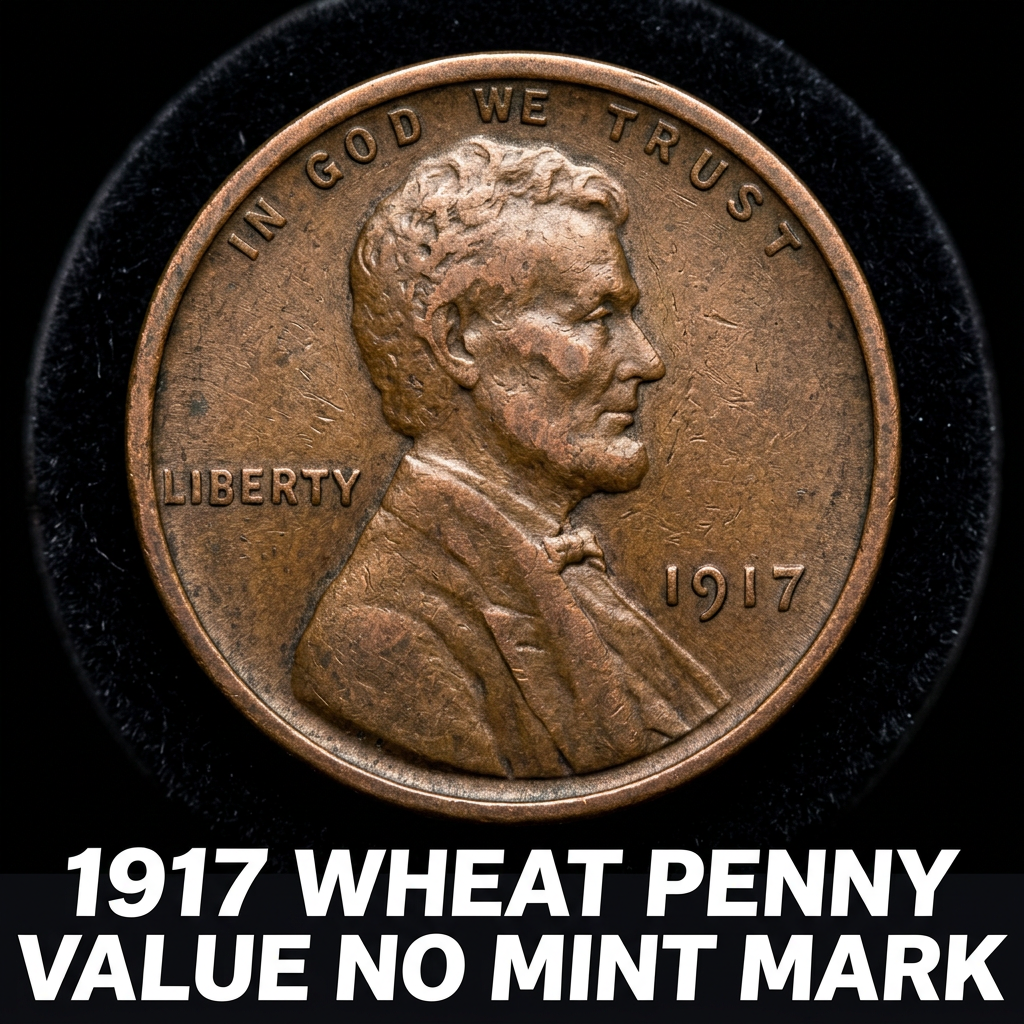
1917 Wheat Penny Value No Mint Mark What It’s Really Worth

Your Old Coin Could Be Valuable!
Identify It & Know Its Real Value — Free Download


The 1917 Wheat Penny with no mint mark is worth anywhere from $0.25 in heavily worn condition to over $100 or more in high mint state grades. Most circulated examples fall in the $1–$10 range, making this a surprisingly accessible coin — but one that can carry real value if you’re lucky enough to have a nice specimen.
What Does “No Mint Mark” Mean on a 1917 Penny?
If you flip your 1917 Lincoln Wheat Penny over and don’t see a small letter beneath the date, you have a Philadelphia Mint coin. The Philadelphia Mint did not use a mint mark during this era, so the absence of a letter is actually a sign of origin — not a mistake.
In 1917, the Philadelphia Mint struck over 196 million Lincoln cents. That’s a large mintage, which is one reason why circulated examples are so common and affordable today. Still, well-preserved coins with strong luster and sharp details are far harder to find.
If you’re not sure what you’re looking at, a coin identifier and value app can help you quickly confirm the mint mark location, coin grade, and estimated market value — no coin expertise required.
Your Old Coin Could Be Valuable!
Identify It & Know Its Real Value — Free Download
1917 Wheat Penny Value No Mint Mark by Grade
The condition of your coin — what collectors call the “grade” — plays a massive role in its value. A coin that looks beat up and dark is worth a few cents to maybe a dollar. A coin that still shows its original red copper luster can be worth dramatically more.
Here’s a general value breakdown for the 1917 no mint mark Wheat Penny:
Your Old Coin Could Be Valuable!
Identify It & Know Its Real Value — Free Download
| Grade | Description | Estimated Value |
|---|---|---|
| Good (G-4) | Heavy wear, design outline visible | $0.25 – $0.50 |
| Fine (F-12) | Moderate wear, legends clear | $1 – $2 |
| Extremely Fine (EF-40) | Light wear on high points only | $4 – $8 |
| About Uncirculated (AU-50) | Slight wear, most luster remains | $10 – $20 |
| MS-63 (Red-Brown) | Uncirculated, mixed luster | $30 – $50 |
| MS-65 (Full Red) | Gem uncirculated, full red luster | $100 – $150+ |
For more detailed pricing at specific mint state grades, check out this 1917 Wheat Penny MS-RD price data by grade — it covers certified coin auction results and population reports that serious collectors rely on.
Your Old Coin Could Be Valuable!
Identify It & Know Its Real Value — Free Download
What Makes a 1917 No Mint Mark Penny More Valuable
Not all 1917 Lincoln cents are created equal. Several factors push the value of a 1917 Wheat Penny no mint mark above typical estimates.
Color designation matters a lot in uncirculated pennies. Grading services like PCGS and NGC classify copper coins as Red (RD), Red-Brown (RB), or Brown (BN). A coin labeled “Red” retains its original copper shine and commands a significant premium over a brown example in the same grade.
Strike quality is another factor. Some 1917 Philadelphia cents came off the press with soft, mushy details — especially around Lincoln’s hair and the wheat stalks on the reverse. A coin with a sharp, well-defined strike is more desirable to collectors and can bring higher prices at auction.
Your Old Coin Could Be Valuable!
Identify It & Know Its Real Value — Free Download
Errors and varieties also exist. Doubled die varieties and repunched dates can dramatically increase a coin’s value. Examine your 1917 penny under magnification to check for any unusual doubling in the lettering or date.
How to Check If Your 1917 Penny Is Worth Getting Graded
Submitting a coin to a professional grading service like PCGS or NGC costs money, so it’s worth thinking carefully before you send it in. Generally, grading makes financial sense if your coin appears to be in AU or better condition, shows strong red or red-brown color, and has no major damage like cleaning or scratches.
If you’re unsure where your coin stands, CoinKnow is a smart first step. The app uses AI-powered image recognition to help you estimate the grade and condition of your coin right from your phone. It’s free to try, and it can save you from spending grading fees on a coin that ends up worth just a couple of dollars.
Your Old Coin Could Be Valuable!
Identify It & Know Its Real Value — Free Download
You can also browse comprehensive 1917 penny value information by date and mint mark to compare your coin against known examples before making any decisions.
Should You Clean Your 1917 Wheat Penny?
Please don’t. This is one of the most common mistakes coin finders make. Cleaning a coin — even gently with soap and water — removes the original surface and leaves microscopic scratches that grading experts can spot immediately.
A cleaned coin is almost always worth significantly less than an uncleaned one, even if it looks shinier to the untrained eye. Grading services will note cleaning on their labels, which can reduce a coin’s value by 50% or more.
If your coin is dirty, leave it alone. Store it in a soft plastic flip or a 2×2 holder and let a professional assess it as-is. CoinKnow can help you document and track your coins digitally, so you always have a record of what you own and what it might be worth — without risking any damage.
Your Old Coin Could Be Valuable!
Identify It & Know Its Real Value — Free Download
FAQ About the 1917 Wheat Penny No Mint Mark
Q: How do I know if my 1917 penny has no mint mark?
A: Look at the obverse (heads side) of the coin, just below the date. If you see nothing there — no “D” for Denver and no “S” for San Francisco — then your coin was minted in Philadelphia. Philadelphia cents from this era were issued without a mint mark, so a blank space confirms you have the Philadelphia version.
Q: Is a 1917 wheat penny with no mint mark rare?
A: Not in general circulation grades. With over 196 million struck in Philadelphia alone, circulated examples are plentiful. However, gem uncirculated examples with full red color are genuinely scarce and can be worth $100 or more depending on the grade.
Q: What’s the most valuable 1917 Lincoln cent?
A: The top-grade examples — MS-67 or MS-67+ in full red — are the most valuable. These have sold at auction for thousands of dollars. The 1917-S (San Francisco) in high grades tends to be even more valuable due to its lower mintage, but a pristine 1917 no mint mark in MS-67 RD is no slouch either.