1939-D Mercury Dime Value Guide What Yours Could Be Worth

Your Old Coin Could Be Valuable!
Identify It & Know Its Real Value — Free Download


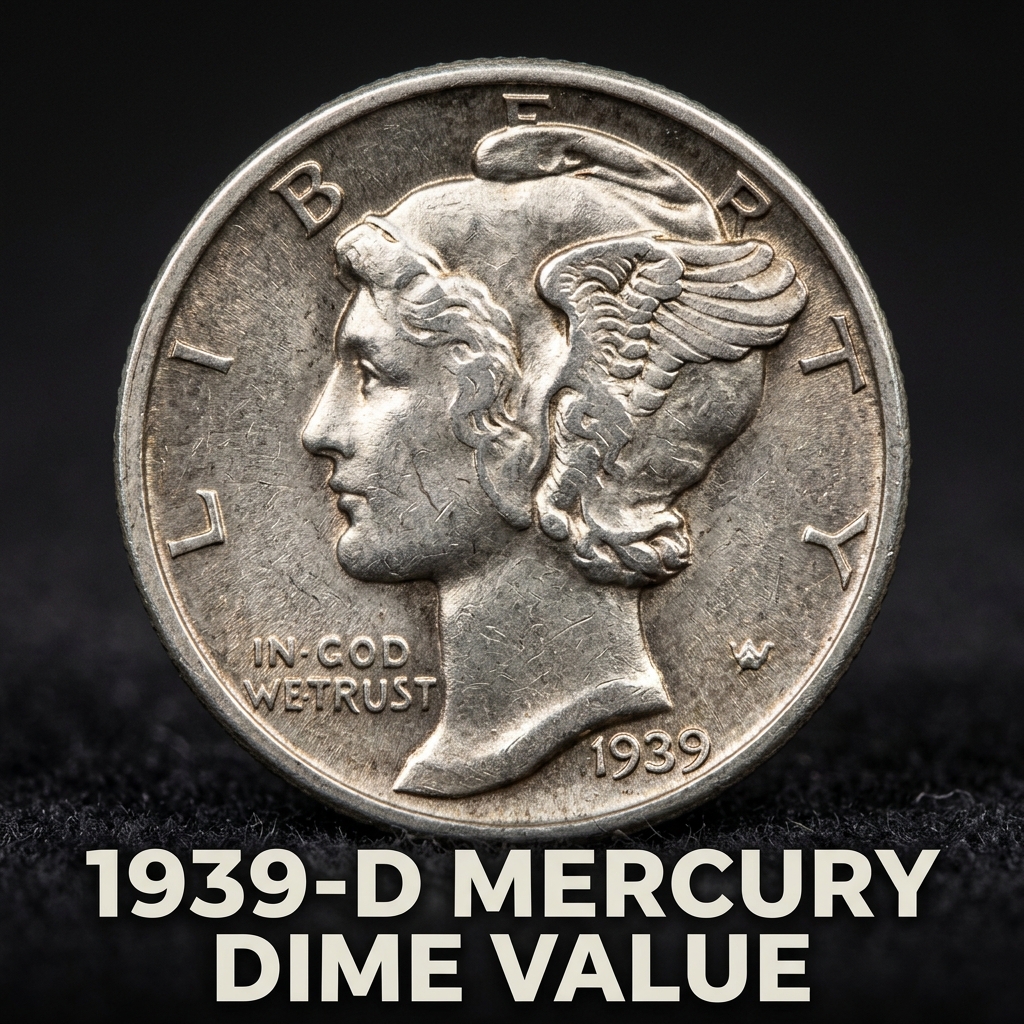
The 1939-D Mercury Dime is worth anywhere from $3 to $5 in heavily worn condition, but can climb to $20 or more in lightly circulated grades — and pristine uncirculated examples have sold for $50 to several hundred dollars depending on the strike quality and eye appeal. If you found one of these silver dimes in an old coin jar or inherited collection, you may be holding something more valuable than its face value suggests.
What Makes the 1939-D Mercury Dime Special
The 1939-D Mercury Dime was struck at the Denver Mint, indicated by the small “D” mintmark found on the reverse of the coin, just to the left of the “ONE DIME” inscription. Denver produced a solid mintage of around 24,394,000 coins that year, making it a relatively common date in the Mercury Dime series — but common doesn’t mean worthless.
These coins are made of 90% silver, which means even a worn example carries melt value based on the current silver spot price. As silver prices fluctuate, so does the baseline value of any Mercury Dime regardless of condition.
If you’re not sure what you have, using a coin identifier and value app on your smartphone is one of the easiest ways to get a quick read on your coin’s grade and estimated worth.
Your Old Coin Could Be Valuable!
Identify It & Know Its Real Value — Free Download
1939-D Mercury Dime Value by Condition
Coin collectors grade coins on a scale from Poor (P-1) all the way up to Perfect Mint State (MS-70). For the 1939-D Mercury Dime, condition has a dramatic effect on price. A coin that looks barely recognizable will fetch only a couple of dollars, while a sharply struck uncirculated example with full bands on the reverse fasces can command a significant premium.
Your Old Coin Could Be Valuable!
Identify It & Know Its Real Value — Free Download
The “Full Bands” (FB) designation is especially important for Mercury Dimes. This refers to the horizontal bands on the fasces (the bundle of rods on the reverse) being fully split and defined. Coins with Full Bands are considered superior strikes and are worth considerably more than regular uncirculated examples.
Here’s a breakdown of typical retail values for the 1939-D Mercury Dime:
Your Old Coin Could Be Valuable!
Identify It & Know Its Real Value — Free Download
| Grade | Description | Estimated Value |
|---|---|---|
| G-4 (Good) | Heavily worn, major details visible | $3 – $4 |
| VF-20 (Very Fine) | Moderate wear, clear features | $5 – $8 |
| EF-40 (Extremely Fine) | Light wear on high points | $10 – $15 |
| MS-63 (Mint State) | Uncirculated, some contact marks | $25 – $40 |
| MS-65 FB (Gem Full Bands) | Gem quality with Full Bands | $80 – $200+ |
For the most up-to-date 1939-D Mercury Dime price data across mint state grades, checking a live database can give you a more current picture of what buyers are actually paying.
How to Check Your Coin’s Grade at Home
You don’t need to be a professional numismatist to get a rough idea of your coin’s grade. Start by examining the coin under good lighting — natural daylight or a focused lamp works well. Look at the highest points of the design: Liberty’s hair above her ear, the bands on the fasces, and the date area.
If these areas show smooth, flat wear with little to no detail, your coin is likely in Good to Fine condition. If you can see hair strands and the bands still have some definition, you’re probably looking at a Very Fine or better example.
Your Old Coin Could Be Valuable!
Identify It & Know Its Real Value — Free Download
CoinKnow is a handy app that walks you through this process step by step. It uses AI-assisted grading to help everyday collectors identify key features and estimate a realistic value range without any prior experience.
Silver Melt Value and Why It Matters
Every 1939-D Mercury Dime contains 0.07234 troy ounces of pure silver. That means the intrinsic silver value acts as a floor — your coin will almost never sell for less than its melt value, even if it’s heavily worn.
When silver trades at around $25 per troy ounce, the melt value of a Mercury Dime is roughly $1.80. At $30 per ounce, that bumps up to about $2.17. This is why even junk-bin Mercury Dimes hold their own compared to modern clad coinage.
Your Old Coin Could Be Valuable!
Identify It & Know Its Real Value — Free Download
To get a full picture of what your 1939-D dime is worth in today’s market — including silver melt value, graded auction results, and variety premiums — the detailed 1939 dime value breakdown at CoinValueApp is a great resource to bookmark.
Where to Sell a 1939-D Mercury Dime
If you’ve decided to sell, you have several good options. Local coin shops offer convenience and fast payment, though dealers typically buy at wholesale prices (around 60–70% of retail value). Online platforms like eBay allow you to reach collectors directly and often fetch higher prices for nicer examples.
For coins in MS-65 or better grades, consider getting them certified by PCGS or NGC — the two leading third-party grading services. A certified grade adds credibility and can significantly boost your selling price.
CoinKnow can also point you toward the right selling channel based on your coin’s estimated grade, helping you avoid leaving money on the table.
Your Old Coin Could Be Valuable!
Identify It & Know Its Real Value — Free Download
Frequently Asked Questions
Q: How do I know if my 1939-D Mercury Dime has Full Bands?
A: Look at the fasces on the reverse — the bundle of rods bound together. The horizontal bands crossing the rods should appear as two fully split, clearly separated lines. If they look merged or flat, the coin does not qualify for the Full Bands designation. A loupe or magnifying glass (at least 5x) makes this much easier to assess.
Q: Is the 1939-D Mercury Dime rare?
A: Not particularly. With a mintage of over 24 million, it’s one of the more common dates in the Mercury Dime series. That said, finding one in true uncirculated condition with Full Bands is much harder than finding a worn example, and those high-grade coins can still command strong collector premiums.
Q: Should I clean my 1939-D Mercury Dime before selling it?
A: Absolutely not. Cleaning a coin — even gently with soap and water — removes the natural surface patina and can cause microscopic scratches that destroy eye appeal. A cleaned coin is almost always worth significantly less than an original, untouched example in the same grade. Leave it exactly as you found it.