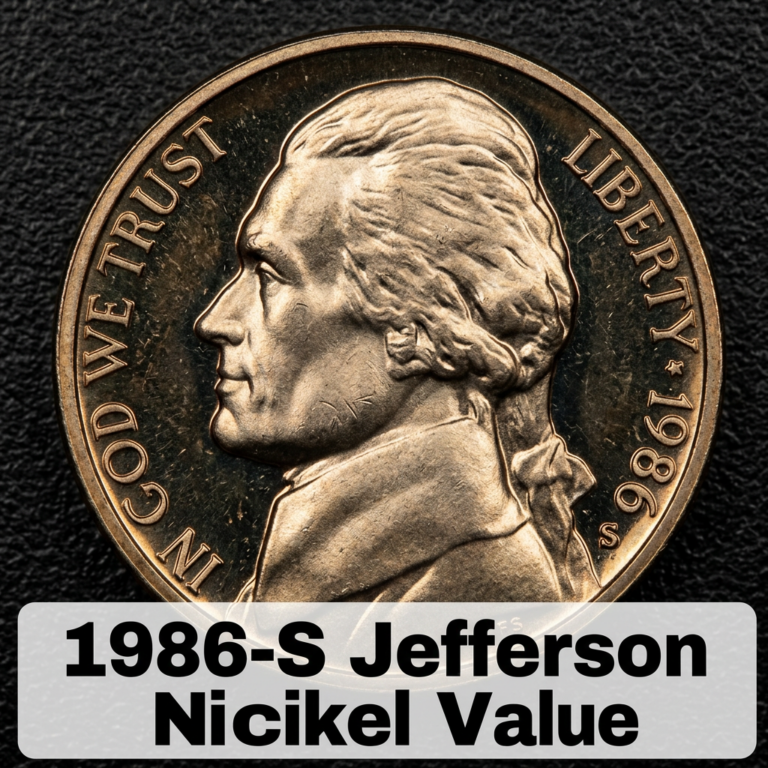
1999-S New Jersey State Quarter Value — Collector Price Guide

Your Old Coin Could Be Valuable!
Identify It & Know Its Real Value — Free Download


The 1999-S New Jersey State Quarter is worth anywhere from $0.50 in typical proof condition to over $1,200 for rare silver deep cameos. While your pocket change might only be twenty-five cents, the special “S” mint mark quarters from San Francisco hold much higher potential for collectors and everyday finders.
| Condition / Variety | Estimated Value |
|---|---|
| 1999-S Clad Proof (PR69) | $3.00 – $5.00 |
| 1999-S Clad Proof (PR70 DCAM) | $25.00 – $45.00 |
| 1999-S Silver Proof (PR69) | $15.00 – $20.00 |
| 1999-S Silver Proof (PR70 DCAM) | $100.00 – $1,200.00+ |
Understanding the 1999-S New Jersey Quarter Proofs
When you look at the 1999-S New Jersey quarter, the most important thing to notice is the “S” mint mark located to the right of George Washington’s ponytail. Unlike the common quarters you find at the grocery store, these were never intended for circulation. They were minted in San Francisco specifically for collectors and sold in official United States Mint sets. If you’ve stumbled upon one in your home, you may be holding a piece of history that is part of the top coin identifier and value app database used by thousands of hobbyists.
There are actually two distinct versions of the 1999-S New Jersey quarter: the Clad version and the Silver version. The Clad version is made of a copper-nickel alloy, similar to standard quarters, but finished with a mirror-like surface. The Silver version is struck on a planchet of 90% silver and 10% copper. Because they look nearly identical to the untrained eye, many people use CoinKnow to quickly distinguish between them. Determining which one you have is the first step in figuring out if you have a common collectible or a high-value treasure.
To check if your “S” quarter is silver, look at the edge of the coin. If you see a solid silver-colored edge without a copper stripe, you likely have the silver variety. If you see a brown or orange copper stripe, it is a clad proof. The distinction is vital because the 1999-S New Jersey quarter value varies significantly based on metal content and the quality of the finish, often referred to as “Deep Cameo” or “DCAM.”
Your Old Coin Could Be Valuable!
Identify It & Know Its Real Value — Free Download
Visual Characteristics and Design of the New Jersey Quarter
The New Jersey quarter was the third coin released in the 50 State Quarters Program. Its reverse design features a historical scene: General George Washington and his troops crossing the Delaware River on Christmas night in 1776. This iconic image is based on the famous painting by Emanuel Leutze. The 1999 release year is significant because it marked the very beginning of the state quarter craze that swept through America, making these early “S” mint marks particularly nostalgic for collectors.
The “S” mint proofs are struck twice using special polished dies, which gives them a high-contrast appearance. This results in a “frosted” look on Washington’s portrait and the crossing scene, while the background (the field) remains incredibly shiny like a mirror. When these coins are submitted to professional grading services like PCGS or NGC, they are often given the “Deep Cameo” designation.
Your Old Coin Could Be Valuable!
Identify It & Know Its Real Value — Free Download
If you aren’t sure if your coin has this “Deep Cameo” finish, you can use the CoinKnow app’s visual recognition feature to compare your coin against high-resolution examples. Maintaining this mirror-like finish is crucial for value. Even small fingerprints or hairline scratches from a soft cloth can drastically reduce the price a collector is willing to pay. Always handle these coins by the edges or wear cotton gloves to preserve their surface.
| Mint Mark | Metal Composition | Mintage Volume |
|---|---|---|
| 1999-P (Philadelphia) | Clad | 363,200,000 |
| 1999-D (Denver) | Clad | 301,064,000 |
| 1999-S Clad Proof | Clad | 3,713,359 |
| 1999-S Silver Proof | 90% Silver | 804,565 |
Detailed 1999-S New Jersey Quarter Value Breakdowns
When discussing the market price for these coins, condition is everything. A “Proof-69” (PR69) coin is nearly perfect but might have one or two tiny imperfections visible only under magnification. These are very common and usually sell for a few dollars. However, a “Proof-70” (PR70) is a “perfect” coin. For the silver variety, a PR70 Deep Cameo can reach prices that surprise most casual observers. This is many times the value of a standard 1999 New Jersey quarter in mint state compared to other inaugural year releases.
Your Old Coin Could Be Valuable!
Identify It & Know Its Real Value — Free Download
The silver 1999-S New Jersey quarter is particularly prized because it was the first year of the series. Collectors who want to build a complete “Silver State Quarter” set must start with this coin. Because the mintage for the silver proof set was significantly lower than the clad proof set (around 800,000 versus 3.7 million), the silver version carries an inherent “scarcity” premium on top of its raw silver melt value.
If you find a 1999-S quarter in a standard coin jar, it has likely been “impaired.” This means someone broke it out of its protective plastic case and spent it. Even if it is silver, an impaired proof is only worth its weight in silver (approximately $4-$5 depending on market rates) or a small premium to a curious individual. However, if the coin is still in its original US Mint plastic lens, the value remains much more stable.
Rare Errors to Look For in 1999 Quarters
While the 1999-S New Jersey quarter is already a special strike, error hunters are always on the lookout for mistakes that shouldn’t have left the San Francisco mint. Though rare in proof coins, errors can skyrocket the value into the thousands. Common errors in this series include “Double Dies,” “Off-Center Strikes,” or “Wrong Planchet Errors.” For the New Jersey quarter specifically, collectors look at the lettering in the word “LIBERTY” and the detail on Washington’s hair for signs of doubling.
Your Old Coin Could Be Valuable!
Identify It & Know Its Real Value — Free Download
Another unusual occurrence is finding a proof coin with “frosting” that is fading or missing on certain parts of the design. While this is technically a quality control issue, it rarely adds value unless it is a dramatic “Die Trail” error. Most people who discover a 1999-S New Jersey quarter will find that it is a standard proof, but it is always worth spending a few seconds with CoinKnow to double-check for oddities.
| Error Type | Potential Price |
|---|---|
| Off-Center Strike | $150 – $500 |
| Broadstruck | $50 – $100 |
| Double Die Obverse | $20 – $200 (Subjective) |
How to Store and Protect Your 1999-S Quarter
If you’ve identified your 1999-S New Jersey State Quarter as a high-quality proof or a silver variety, protection is your next priority. The primary enemy of proof coins is “toning”—a chemical reaction between the metal and the air. While some collectors love colorful rainbow toning, many prefer the original white-silver look. To keep it pristine, never store your coins in PVC-containing plastic flips, as the chemicals can “green” the coin over time and ruin its value.
The best way to store a loose 1999-S proof is in a hard plastic “Air-Tite” capsule or a professional grading slab. If you have the original 1999 Silver Proof Set, it is usually best to keep the coins inside the original government packaging (OGP). Breaking them out of the set often makes them harder to sell later unless you are planning to have the individual coins professionally graded to achieve that elusive PR70 score.
Your Old Coin Could Be Valuable!
Identify It & Know Its Real Value — Free Download
Professional grading is usually only worth the cost if the coin has a high probability of being perfect. Grading costs roughly $30-$50 per coin including shipping. If a 1999-S Silver New Jersey quarter grades at PR69, it is worth about $20—meaning you lost money on the grading fee. However, if it hits PR70, the value jumps significantly. This gamble is why many collectors use professional apps to pre-check their coins before spending money on shipping.
Final Thoughts for the Casual Collector
The 1999-S New Jersey State Quarter represents a high point in American numismatic history. It was a time when millions of people began looking at their change again. Whether you have the common clad proof or the more valuable 90% silver version, these coins are a tangible link to our nation’s founding stories. While they might not be an instant “lottery ticket,” finding a silver proof in the wild is a thrilling experience for any hobbyist.
Remember to always verify the mint mark and the edge of the coin before assuming its value. High-quality images and auction records are your best friends when trying to sell. Check local coin shops or reputable online marketplaces to see what similar coins have actually sold for, rather than just looking at “asking prices” on eBay which can be misleading. With the right knowledge and a little bit of luck, that “S” quarter might just be the star of your collection.
Frequently Asked Questions
Q: How can I tell if my 1999-S New Jersey quarter is silver or clad?
A: The easiest way is to look at the edge (the “third side”) of the coin. A clad coin will have a visible copper/orange stripe. A silver proof will have a solid, shiny silver edge. Additionally, silver quarters are slightly heavier (6.25 grams) compared to clad quarters (5.67 grams).
Your Old Coin Could Be Valuable!
Identify It & Know Its Real Value — Free Download
Q: Is a 1999-S New Jersey quarter worth grading?
A: It depends on the condition. Only “Silver” proofs that look absolutely flawless (Proof 70 potential) are generally worth the expense of professional grading. Clad proofs usually don’t have a high enough market value to justify the $30+ grading fees unless they have a major error.
Q: Why is the 1999 New Jersey quarter so popular?
A: It was part of the first year of the 50 State Quarters Program. Many people collected these as the series began, and New Jersey was only the third state honored. This makes 1999-dated quarters particularly iconic for those who collected the series from the beginning.
Q: Can I find a 1999-S New Jersey quarter in my pocket change?
A: While very rare, it does happen. Occasionally, someone will break open a proof set to spend the money, or a collection is stolen and spent at face value. If you find one, it will likely be “impaired,” meaning it has scratches and wear from being in circulation, which lowers its value to near face value (for clad) or silver melt price (for silver).