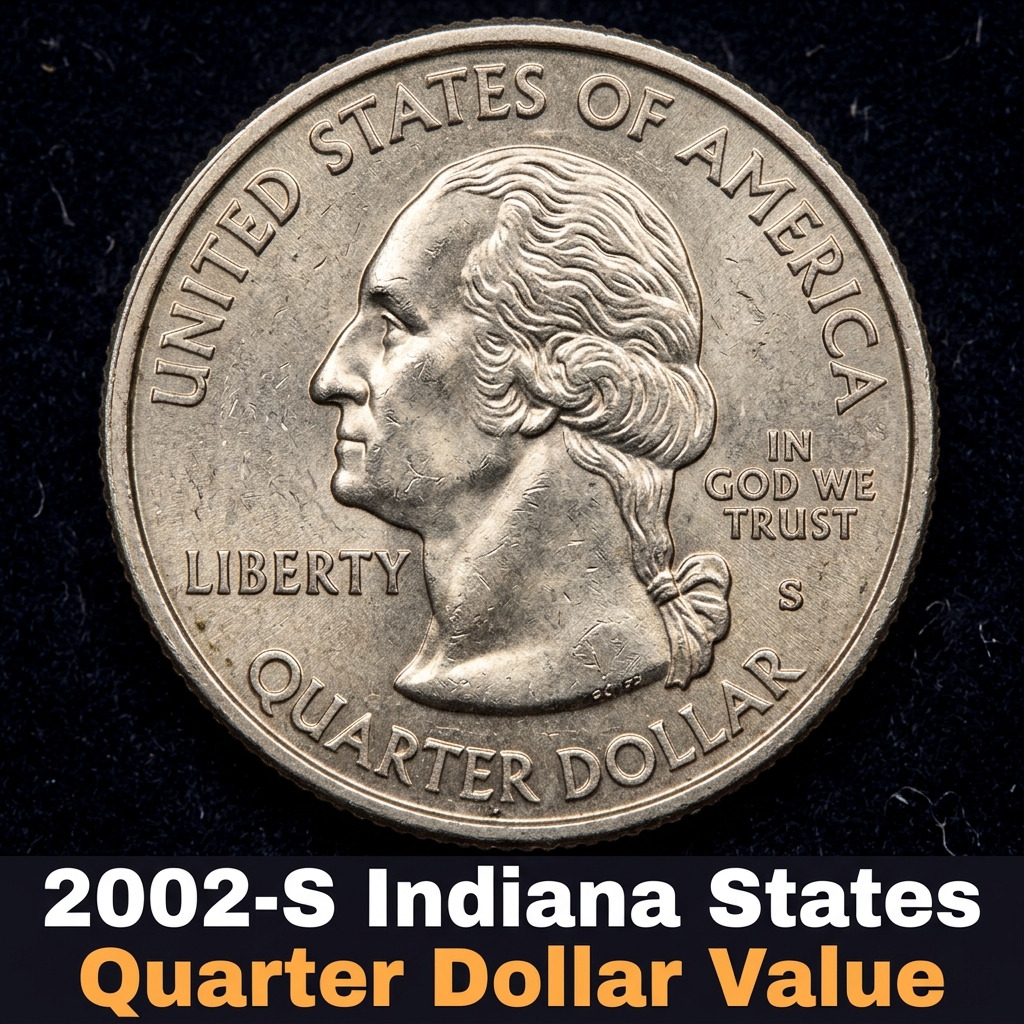
2002-S Indiana State Quarter Dollar Value Guide What Is It Worth and Why It Matters

Your Old Coin Could Be Valuable!
Identify It & Know Its Real Value — Free Download


The 2002-S Indiana State Quarter is worth anywhere from $1.50 for a basic proof example to over $15 or more for ultra-deep cameo specimens in pristine condition. If you found one tucked away in an old coin folder or inherited a proof set, you’re in the right place to find out exactly what you’ve got.
What Is the 2002-S Indiana State Quarter?
The 2002-S Indiana State Quarter was struck at the San Francisco Mint as part of the United States Mint’s hugely popular 50 State Quarters Program, which ran from 1999 to 2008. The “S” mint mark tells you right away that this coin was made specifically for collectors — not for everyday spending.
Indiana was the 19th state to be honored in the series, and its quarter features a race car on a stylized track, honoring the state’s long connection to motorsports and the famous Indianapolis 500. The design also includes an outline of Indiana with 19 stars representing its place in the Union. It’s a genuinely attractive coin, and collectors have appreciated it since day one.
Unlike the Philadelphia and Denver mint versions that circulated freely in your pocket change, the San Francisco issues were made as proof coins — struck with specially polished dies and planchets to create sharp, mirror-like finishes. This makes the 2002-S Indiana quarter distinctly collectible right out of the gate.
Your Old Coin Could Be Valuable!
Identify It & Know Its Real Value — Free Download
If you’re not sure whether your coin is a proof or a circulation strike, a good coin identifier and value app can help you confirm the details in seconds — especially useful if you’re new to coin collecting.
Your Old Coin Could Be Valuable!
Identify It & Know Its Real Value — Free Download
Understanding 2002-S Indiana Quarter Values
Proof coins are graded differently from circulation coins, and understanding the grades goes a long way in knowing what your coin is actually worth.
The standard grading scale runs from PR60 at the low end to PR70 at the perfect top. Most 2002-S Indiana quarters you’ll find in old proof sets will grade somewhere between PR65 and PR68. The biggest value jump, however, comes from the “cameo” and “deep cameo” designations — these describe the frosted, sculpted look of the coin’s design against its mirror-like background field.
Your Old Coin Could Be Valuable!
Identify It & Know Its Real Value — Free Download
Here’s a simple value table to give you a clear picture:
| Grade | Type | Estimated Value |
|---|---|---|
| PR65 | Proof | $1.50 – $3.00 |
| PR66 | Proof Cameo | $3.00 – $5.00 |
| PR67 | Proof Deep Cameo | $5.00 – $8.00 |
| PR68 | Proof Deep Cameo | $8.00 – $12.00 |
| PR69 | Proof Deep Cameo | $12.00 – $20.00 |
| PR70 | Proof Deep Cameo | $20.00 – $40.00+ |
For real-time auction data and certified sale prices for the 2002-S Indiana and other state quarters in the series, you can browse recent market prices for 2002 State Quarters across multiple grades to see how the market is trending right now.
Your Old Coin Could Be Valuable!
Identify It & Know Its Real Value — Free Download
How Condition and Certification Affect the Price
Here’s something a lot of first-time sellers overlook: the difference between a PR65 and a PR69 coin can be $15 or more, even though they might look nearly identical to the naked eye. Professional grading matters enormously when it comes to selling.
Third-party grading services like PCGS and NGC assess the coin, seal it in a tamper-evident holder, and assign an official grade. Coins that have been certified by these services almost always sell for more than raw, ungraded coins — because buyers trust the grade. If your 2002-S Indiana quarter came in an original mint proof set, it’s ungraded, but it may still be worth submitting if the coin looks especially sharp and flawless.
CoinKnow is a fantastic tool for everyday collectors who want to understand grading basics before making that decision. The app walks you through what to look for — hairlines, contact marks, cameo contrast — so you’re not going in blind.
Your Old Coin Could Be Valuable!
Identify It & Know Its Real Value — Free Download
Where to Sell and How to Get the Best Price
Once you know your coin’s approximate grade, the next question is where to sell it. Online platforms like eBay, Heritage Auctions, and Great Collections are popular options. Local coin shows and dealers are also worth considering, especially if you have multiple coins from the same proof set.
One practical tip: always sell your 2002-S Indiana quarter within its original proof set packaging if possible. Sets in original government packaging often attract buyers who want the full set experience, which can push the selling price slightly higher than selling individual coins.
For a broader look at 2002 quarter values across all mint marks and conditions, checking a dedicated coin value resource will give you comparison data that strengthens your position as a seller.
And if you want a quick estimate before you even list it, CoinKnow lets you scan and identify coins on the spot, giving you an instant value range based on current market data — a real time-saver whether you’re at home or at a coin show.
Your Old Coin Could Be Valuable!
Identify It & Know Its Real Value — Free Download
FAQ
Q: Is the 2002-S Indiana State Quarter rare?
A: Not particularly in terms of mintage — over 3 million were produced. However, high-grade examples certified PR69 or PR70 Deep Cameo are genuinely scarce and command premium prices.
Q: Can I find a 2002-S Indiana quarter in regular pocket change?
A: Very unlikely. The “S” mint mark means it was only issued in proof sets sold directly to collectors. If you find a state quarter in change, it’ll have a “P” or “D” mint mark instead.
Q: How do I know if my 2002-S Indiana quarter is worth getting professionally graded?
A: If your coin is in a sealed original proof set and shows strong cameo contrast with no visible marks or hairlines, it may be worth the grading fee. Use CoinKnow to get a preliminary assessment and help you decide before spending on professional submission.