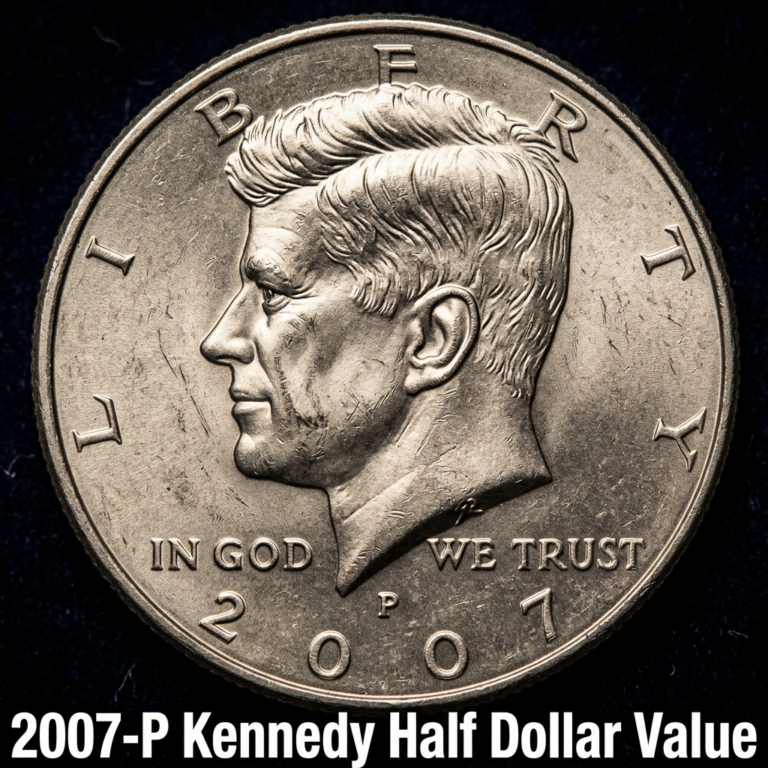
1995-S Kennedy Half Dollar Value: Price Guide for Collectors

Your Old Coin Could Be Valuable!
Identify It & Know Its Real Value — Free Download


The 1995-S Kennedy Half Dollar is worth anywhere from $5 in standard proof condition to over $150 or more for perfect Deep Cameo specimens. While it was not issued for general circulation, finding one in an old collection often sparks excitement for everyday Americans curious about its unique mirror-like finish.
| Grade / Condition | Estimated Value |
|---|---|
| PR 65 (Standard Proof) | $5 – $8 |
| PR 69 Deep Cameo (Clad) | $15 – $25 |
| PR 70 Deep Cameo (Clad) | $60 – $90 |
| PR 70 Deep Cameo (Silver) | $125 – $185 |
Why the 1995-S Kennedy Half Dollar is Special
If you have stumbled upon a half dollar dated 1995 with a small “S” mint mark, you have found a coin that was never meant to be spent at a grocery store. These coins were produced by the San Francisco Mint specifically for collectors. Unlike the 1995-P and 1995-D versions made for banks, the “S” version features a proof finish, meaning the fields are reflective like a mirror and the details are exceptionally sharp.
For many Americans holding an inherited collection, using a top coin identifier and value app is the quickest way to confirm if their coin is a standard copper-nickel version or the more desirable silver variety. Understanding the distinction is the first step in determining if your pocket change is actually a hidden treasure.
The 1995-S comes in two distinct compositions: the standard copper-nickel clad and the 90% silver version. To the untrained eye, they look very similar, but the silver version is consistently more valuable due to its precious metal content. If you aren’t sure which one you have, the CoinKnow app can help you identify visual markers and weight differences that separate the two.
Your Old Coin Could Be Valuable!
Identify It & Know Its Real Value — Free Download
Understanding the Two Types of 1995-S Half Dollars
In 1995, the Mint released two versions of the proof half dollar. The first is the “Clad” version, which is made of the same materials as a modern quarter (copper and nickel). The second is the “Silver” version, part of the special Silver Proof Sets. Knowing which one you have is vital, as the 1995 half dollar value varies significantly between these two types.
Checking the edge of the coin is the easiest DIY method. If you see a solid silver-colored stripe, it is likely the 90% silver issue. If you see a distinct copper/orange stripe, it is the clad version. Regardless of the type, both were struck with multiple high-pressure hits to ensure the portrait of John F. Kennedy stands out in frosted relief against the shiny background.
Your Old Coin Could Be Valuable!
Identify It & Know Its Real Value — Free Download
Collectors often look for “Deep Cameo” (DCAM) designations. This refers to the intense contrast between the frosted design and the polished background. Using the CoinKnow app, you can compare your coin against high-resolution photos of DCAM specimens to see how yours stacks up.
| Metal Content | Mintage Figure | Typical Value Range |
|---|---|---|
| Copper-Nickel Clad | 2,117,496 | $5 – $65 |
| 90% Silver | 679,985 | $25 – $150+ |
The Role of Grading in 1995-S Half Dollar Value
In the world of coin collecting, condition is everything. A coin that has been handled by bare fingers or wiped with a cloth will lose its “Deep Cameo” appeal and drop in value. For the 1995-S, most coins are found in PR 67 to PR 69 condition. A grade of PR 70, which denotes a “Perfect” coin under 5x magnification, is the holy grail for modern collectors.
Even a tiny hairline scratch that is invisible to the naked eye can drop the 1995 Kennedy Half Dollar price data by dozens of dollars. This is why many people choose to keep their proof coins in the original plastic lenses provided by the Mint. If you find one “loose,” it is almost certainly a lower-grade specimen worth closer to its bullion or face value.
Your Old Coin Could Be Valuable!
Identify It & Know Its Real Value — Free Download
The CoinKnow app allows users to take a photo of their Kennedy Half Dollar and receive an estimated grade. This is incredibly useful before deciding whether to spend money on professional grading services like PCGS or NGC. Since the cost of grading can exceed $30, you only want to send in coins that have a realistic shot at a PR 70 grade.
How to Identify a 90% Silver 1995-S
Identifying the silver version of the 1995-S Kennedy Half Dollar is the top priority for most people who find one. Because silver prices fluctuate, the base “melt value” of the silver version provides a floor for its price. As of current markets, the silver content alone makes it worth significantly more than its 50-cent face value.
There are three main ways to check: the edge test, the weight test, and the tissue test. A clad coin weighs roughly 11.34 grams, while a silver coin weighs approximately 12.50 grams. If you have a sensitive kitchen scale, this is a foolproof way to tell. You can also place a single layer of tissue over a clad half dollar and a silver one; the silver one will appear white through the paper, while the clad one will look dark or grey.
Your Old Coin Could Be Valuable!
Identify It & Know Its Real Value — Free Download
Finding a silver 1995-S in a random box of coins is a great win. While it isn’t “retire early” money, it is a high-quality piece of American history that holds its value well against inflation. Keeping it in a protected flip or sleeve is recommended to prevent the silver from tarnishing over time.
| Feature | Clad (Copper-Nickel) | 90% Silver |
|---|---|---|
| Edge Appearance | Copper/Red line visible | Solid silver/white |
| Weight | 11.34 grams | 12.50 grams |
| Sound | Dull “thud” | High-pitched “ring” |
Modern Proof Market Trends
The market for modern proof coins like the 1995-S Kennedy Half Dollar has remained stable over the last decade. While they don’t see the explosive price growth of rare coins from the 1800s, they are a staple in the hobby. Most buyers are looking to complete “date sets” or “registry sets,” where they aim to own the highest possible grade for every year of the Kennedy series.
One interesting trend is the rise in popularity of “error” proof coins. While very rare, errors like double dies or planchet flaws on a 1995-S can send values into the hundreds or even thousands of dollars. Always check the lettering and the date under a magnifying glass for any signs of doubling.
For the everyday person, the best way to track these market trends is through digital tools. Using an app like CoinKnow helps enthusiasts stay updated on recent auction results and “sold” listings on platforms like eBay, ensuring you never sell a coin for less than it is worth.
Your Old Coin Could Be Valuable!
Identify It & Know Its Real Value — Free Download
Is Your 1995-S Kennedy Half Dollar Worth Grading?
Determining whether to send your coin to a professional grading service is a common dilemma. If your 1995-S is the clad version and looks to be in average proof condition, the $30+ grading fee will likely be more than the coin is worth. In this case, it’s best to keep it as a “filler” or a conversation piece.
However, if you have a 90% silver 1995-S that looks flawless—meaning no fingerprints, no scratches, and heavy frosting on Kennedy’s face—it might be worth the investment. A PR 70 Deep Cameo silver specimen is a high-demand item that can easily fetch a premium at an auction or a specialized coin show.
Before making a decision, consult online guides and community forums. Seeing what other collectors have recently paid for certified versus uncertified coins will give you a clear picture of the potential return on investment for your specific 1995-S Kennedy Half Dollar.
FAQ
Q: Can I find a 1995-S Kennedy Half Dollar in my pocket change?
A: It is very unlikely but not impossible. Since these were only issued in Proof Sets for collectors, one would only be in circulation if someone broke open a set and spent it by mistake. If you do find one, it will likely be scratched and worth only a few dollars.
Your Old Coin Could Be Valuable!
Identify It & Know Its Real Value — Free Download
Q: How do I know if my 1995-S is the silver version?
A: The most reliable way is the weight (12.5g for silver) or looking at the edge. A silver coin will not have the brown/copper stripe that is visible on the edge of standard clad coins.
Q: What is the most a 1995-S Kennedy Half Dollar has ever sold for?
A: Perfect PR 70 Deep Cameo silver specimens have sold for over $200 at major auctions, though most silver proofs trade in the $30 to $50 range if they are graded PR 69.
Q: Should I clean my 1995-S half dollar to make it shinier?
A: No! Never clean a proof coin. Even the softest cloth will create micro-scratches called “hairlines” that drastically reduce its value and the grade it can receive from professional services.