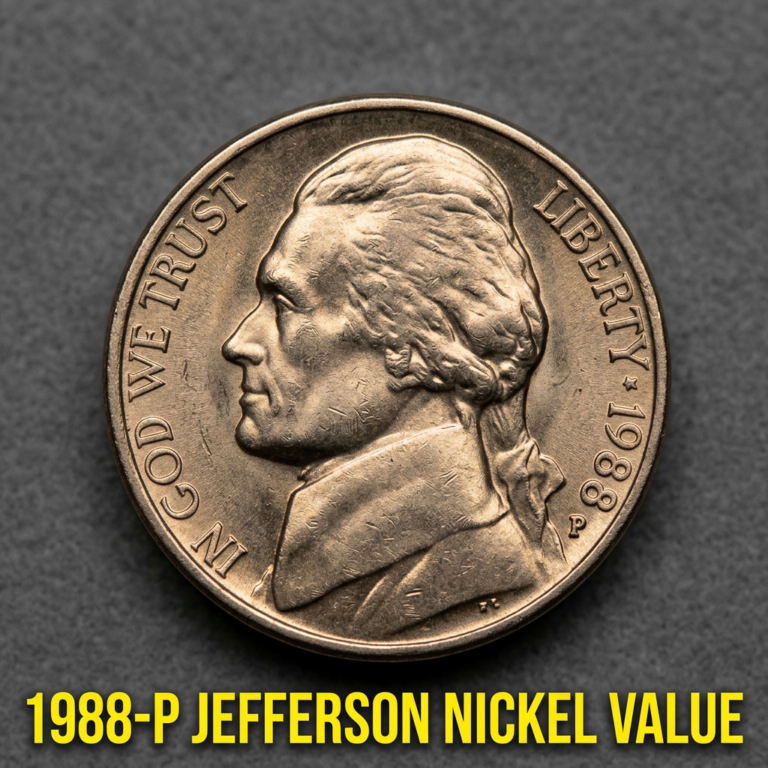
1980-D Jefferson Nickel Value: What Is Your Coin Worth?

Your Old Coin Could Be Valuable!
Identify It & Know Its Real Value — Free Download


The 1980-D Jefferson Nickel is worth anywhere from $0.05 in circulated condition to over $1,200 for rare, high-grade specimens with “Full Steps” details. Most of these coins found in pocket change today are only worth their face value, but specific minting errors and preservation levels can make them quite valuable to collectors.
| Condition / Grade | Estimated Value |
|---|---|
| Circulated (Average Wear) | $0.05 – $0.10 |
| Uncirculated (MS60 – MS64) | $0.50 – $5.00 |
| Mint State (MS65+) | $15 – $50 |
| Full Steps (FS) Gems | $100 – $1,200+ |
Understanding the 1980-D Jefferson Nickel
If you have just discovered a shiny nickel dated 1980 with a small “D” next to the year, you are looking at a product of the Denver Mint. During the early 1980s, the United States was experiencing a period of economic transition, and the Mint was pumping out billions of coins to keep up with daily commerce. Because so many were made, finding one isn’t rare, but finding one in perfect condition is a different story.
To quickly determine if your find is a common spender or a collector’s prize, many hobbyists use a top coin identifier and value app to scan the coin’s surface for subtle details. The 1980-D is composed of 75% copper and 25% nickel, weighing 5 grams. While it doesn’t contain precious silver, its numismatic value is driven entirely by its preservation and the clarity of the strikes on Thomas Jefferson’s home, Monticello.
Using tools like CoinKnow can help you distinguish between the heavy scratches of a coin that has spent decades in vending machines and the satiny luster of a coin that was tucked away in a piggy bank 40 years ago. Whether you are a casual hunter or a serious collector, understanding the Denver Mint’s specific production quality for this year is key to unlocking the potential 1980-D Jefferson Nickel value hidden in your change jar.
Your Old Coin Could Be Valuable!
Identify It & Know Its Real Value — Free Download
The Importance of the “D” Mint Mark
The “D” mint mark on your 1980 nickel signifies that it was struck at the Denver Mint in Colorado. In 1980, the Denver Mint produced exactly 514,249,152 of these nickels. This massive mintage means that the coins are incredibly common in everyday circulation. However, Denver was known for producing relatively strong strikes during this era compared to its Philadelphia counterpart.
When you look at the current 1980-D nickel value trends, you will notice that high-grade examples from Denver often carry a slight premium. This is because collectors are always looking for the “best of the best.” While millions of these coins were made, very few survived without getting scratched, dinged, or toned by moisture.
Your Old Coin Could Be Valuable!
Identify It & Know Its Real Value — Free Download
| Mint Mark | Mint Location | Mintage Quantity |
|---|---|---|
| P | Philadelphia | 595,248,000 |
| D | Denver | 514,249,152 |
| S | San Francisco (Proof) | 3,547,388 |
If you aren’t sure which mint your coin came from, look to the right of the date. If you see a “P,” it’s from Philadelphia; a “D” is for Denver, and an “S” is for the San Francisco Mint. The San Francisco coins were only sold in sets to collectors and were never meant for circulation.
Determining Grade: How Condition Affects Price
In the world of coin collecting, condition is everything. A 1980-D nickel that looks “almost new” might still only be worth five cents if it has microscopic scratches. Professional graders use a scale from 1 to 70, with 70 being perfect. Most nickels you find in the wild will grade between “Very Good” (VG) and “About Uncirculated” (AU).
Your Old Coin Could Be Valuable!
Identify It & Know Its Real Value — Free Download
For those wondering about market prices for uncirculated specimens, the real value begins at MS65 (Mint State 65). At this level, the coin must have its original mint luster and very few distracting marks. Using an app like CoinKnow can help beginners compare their coins against high-resolution images of graded examples to see where their coin falls on the spectrum.
If your coin is “Circulated,” it likely has wear on Jefferson’s cheekbone or the pillars of Monticello. If it is “Uncirculated,” it should look like it just came out of a fresh bag from the bank. Collectors pay significantly more for coins that have been protected from the elements, as these are the ones that will complete a “high-end” collection.
The “Full Steps” Phenomenon on 1980-D Nickels
Experienced Jefferson Nickel collectors look for one specific detail above all others: the “Full Steps.” On the reverse (back) of the coin, you will see Monticello, Jefferson’s Virginia home. At the base of the building are steps. In most strikes, these steps are blurry or blended together.
Your Old Coin Could Be Valuable!
Identify It & Know Its Real Value — Free Download
A 1980-D Jefferson Nickel with “Full Steps” (FS) means that at least five or six distinct horizontal lines are visible on the staircase. These coins are extremely rare because the dies used to stamp the coins often wore down, or the metal didn’t flow perfectly into the grooves. An MS65 1980-D with Full Steps can be worth hundreds of dollars, while a standard MS65 without those steps might only be worth $15.
| Grade + Full Steps Status | Market Value |
|---|---|
| MS64 (Standard) | $2 – $4 |
| MS64 (Full Steps) | $25 – $40 |
| MS66 (Standard) | $35 – $60 |
| MS66 (Full Steps) | $250 – $450 |
| MS67 (Full Steps) | $1,000+ |
Because identifying “Full Steps” requires a steady hand and a magnifying glass, many modern hunters use CoinKnow to zoom in and check if the lines are interrupted by scratches or “gashes,” which would disqualify the Full Steps designation.
1980-D Jefferson Nickel Error List
Errors are the wild cards of the coin world. Even if a 1980-D nickel is in average condition, a significant minting error can skyrocket its value. These errors happen during the production process and are often caught by quality control—but not always!
One common error to look for is the “Off-Center” strike. This happens when the coin blank isn’t properly aligned, resulting in a portion of the design being missing. Another popular find is the “Die Crack,” where the metal stamp develops a crack, leaving a raised line of metal on the coin. Some collectors also look for “Repunched Mint Marks,” though these are less common on the 1980-D than on earlier dates.
Your Old Coin Could Be Valuable!
Identify It & Know Its Real Value — Free Download
If you find a coin that looks “weird”—perhaps it’s thinner than usual, or the design is double-printed—don’t spend it! These “error coins” can fetch anywhere from $20 to $200 depending on the severity of the mistake. Always double-check your change; you never know when a mechanical glitch at the Denver Mint might have created a valuable treasure in your pocket.
Summary: Is Your 1980-D Nickel a Keeper?
To wrap up, most 1980-D Jefferson Nickels you find in your daily life are only worth their face value of five cents. However, the story changes completely if the coin is in perfect, uncirculated condition or displays the elusive “Full Steps” on the back. If your nickel looks like it was just minted yesterday, it is worth putting in a protective sleeve and investigating further.
For the everyday American, the best way to determine the 1980-D Jefferson Nickel value is to look at the luster and the steps. If both are present, you might be holding a coin worth $50 or more. If you’re lucky enough to find a major mint error, that value could go even higher. Keep hunting, and use the latest digital tools to ensure you never accidentally spend a small fortune at the grocery store.
FAQ
Q: How can I tell if my 1980-D nickel is worth more than five cents?
A: Check the condition first. If the coin has deep scratches or looks dull, it’s likely only worth face value. If it is extremely shiny and has no visible wear on Jefferson’s hair or the building on the back, it could be an uncirculated coin worth $1 to $50.
Your Old Coin Could Be Valuable!
Identify It & Know Its Real Value — Free Download
Q: What is a “Full Steps” 1980-D nickel?
A: “Full Steps” refers to the staircase on the back of the coin (Monticello). If you can see 5 or 6 clear, unbroken horizontal lines on the steps, the coin is highly desirable to collectors and can be worth $100 to over $1,200 depending on the overall grade.
Q: Are there any rare 1980-D nickel errors?
A: Yes, look for off-center strikes, clipped planchets (where the coin looks like a bite was taken out of it), or major die cracks. These errors can make even a circulated 1980-D nickel worth significantly more than its face value.
Q: Why is the “D” mint mark important?
A: The “D” stands for the Denver Mint. While Denver produced over half a billion nickels in 1980, collectors track the specific quality of strikes from each mint. High-grade Denver nickels are often prized for their strike clarity and luster.