1995-D Roosevelt Dime Value: Is Your Pocket Change Worth Money?

Your Old Coin Could Be Valuable!
Identify It & Know Its Real Value — Free Download


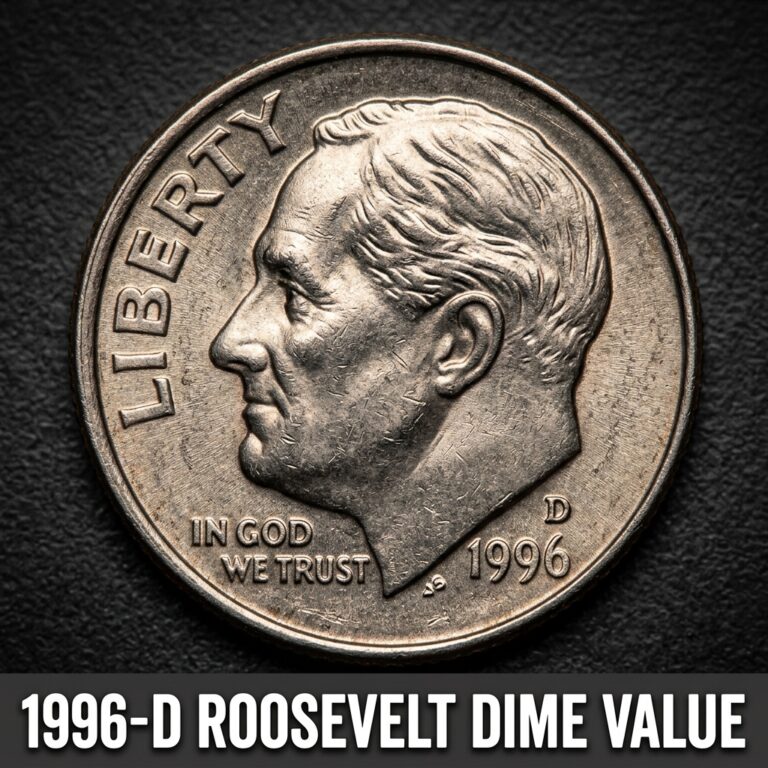
The 1995-D Roosevelt Dime is worth anywhere from $0.10 in worn condition to over $500 for high-grade specimens. While most of these dimes found in your change today are only worth their face value, certain rare errors and high-quality “Mint State” examples can fetch a significant premium from collectors.
| Condition | Estimated Value |
|---|---|
| Circulated (Average Wear) | $0.10 |
| Uncirculated (MS63 – MS65) | $2.00 – $15.00 |
| Full Torch (MS67+) | $40.00 – $550.00+ |
| Rare Errors | $20.00 – $100.00+ |
Understanding the 1995-D Roosevelt Dime History and Mintage
The 1995-D Roosevelt Dime was struck at the Denver Mint during a period of high economic activity in the United States. Because dimes are essential for daily commerce, the U.S. Mint produced them in massive quantities. In 1995, the Denver Mint alone produced over 1.2 billion dimes. Because of this high mintage, finding a 1995-D dime in your pocket change is incredibly common.
If you are unsure about a coin you just found, using a top coin identifier and value app is the fastest way to determine if you have a common spender or a collector’s item. Most of these coins have seen years of heavy use, resulting in scratches, “bag marks,” and a loss of luster.
In the world of coin collecting, rarity is the primary driver of value. Since over a billion were made, a standard 1995-D dime will almost always be worth exactly ten cents. However, collectors look for “condition rarity”—coins that survived in perfect, untouched condition. Using the CoinKnow app can help you compare your coin’s luster and strike against known high-value examples to see if yours stands out from the crowd.
Your Old Coin Could Be Valuable!
Identify It & Know Its Real Value — Free Download
Grading and 1995-D Roosevelt Dime Value Factors
When determining the value of your dime, professional graders look at the 1-70 scale. A coin graded MS60 (Mint State) has no wear but may have many scratches. A coin graded MS67 or higher is considered “Superb Gem” and is where the money starts to increase significantly. For the 1995-D, the standard 1995 dime value depends heavily on the presence of original mint luster.
Another critical factor for the Roosevelt series is the “Full Torch” (FT) or “Full Bands” (FB) designation. This refers to the horizontal lines on the torch on the reverse of the coin. If these lines are crisp, distinct, and not interrupted by the strike or wear, the value skyrockets. Most 1995-D dimes lack this detail due to worn dies or weak strikes at the Denver Mint.
Your Old Coin Could Be Valuable!
Identify It & Know Its Real Value — Free Download
Check the table below to see how the grade drastically changes the market price for these coins.
| Grade | Non-FT Price | Full Torch (FT) Price |
|---|---|---|
| MS63 | $0.50 | $3.00 |
| MS65 | $5.00 | $15.00 |
| MS67 | $20.00 | $65.00 |
| MS68 | $150.00 | $550.00 |
Identifying 1995-D Roosevelt Dime Errors
If your dime isn’t in perfect condition, don’t worry—you may still have found a “mint error.” Error coins are mistakes made during the manufacturing process. For the 1995-D, common errors include “Off-Center” strikes, where the design is pushed to one side, or “Broadstrikes,” where the coin appears flatter and wider because it wasn’t held properly in the collar.
One of the most sought-after errors is the “Die Crack.” As the steel dies used to stamp the coins wear out, they develop cracks. These cracks appear as raised lines of metal on the coin’s surface. If you see a weird line extending from Roosevelt’s head or through the word “LIBERTY,” you might have a valuable error. CoinKnow is a great tool for identifying these anomalies by magnifying your coin photos.
Your Old Coin Could Be Valuable!
Identify It & Know Its Real Value — Free Download
You should also look for “Clipped Planchets,” which occur when the metal disk was improperly cut before minting, leaving a crescent-shaped bite out of the side. While a 1995-D dime with a small clip might only be worth $10, a major error can sell for $50 to $100. Always double-check your change for these oddities.
Comparing the 1995-D to Philadelphia and Proof Mints
To understand the full context of your find, it is helpful to compare the “D” (Denver) mint mark with other dimes from the same year. The Philadelphia Mint (P) produced a similarly massive or slightly higher number of coins. In terms of market value, the 1995-P Roosevelt Dime current market data shows that values for the P and D mints are nearly identical in circulated grades.
The U.S. Mint also produced “Proof” versions of the dime in 1995 at the San Francisco Mint (S). These were not meant for circulation and were sold in sets to collectors. Proof coins have a mirror-like finish and frosted details. If you find a 1995-S dime in your change, it’s a “Proof in the Wild,” likely spent by someone unaware of its origin. These are worth significantly more than their Denver counterparts.
Your Old Coin Could Be Valuable!
Identify It & Know Its Real Value — Free Download
A quick way to check is to look for the small letter above the date. “D” is Denver, “P” is Philadelphia, and “S” is San Francisco. If there is no letter, it usually means it was minted in Philadelphia (though in 1995, most P coins have the “P” mark).
Is It Worth Getting a 1995-D Dime Certified?
Professional grading by services like PCGS or NGC can cost between $20 and $50 per coin. For most 1995-D dimes, this is not a wise investment. If a coin is only worth $0.10, spending $30 to grade it doesn’t make financial sense. For everyday Americans, the CoinKnow app is a much more cost-effective way to estimate value before deciding to ship a coin off to a professional.
Grading only becomes profitable if your coin is in “MS68” condition or better, or if it has a “Full Torch” designation. At that level, the rarity of the grade justifies the cost of the plastic slab. For the vast majority of us, keeping a nice, shiny 1995-D in a simple cardboard flip or coin folder is the best way to enjoy the hobby without overspending.
If you believe you have a “Top Pop” (one of the highest graded examples known to exist), check recent auction records. High-grade 1995-D dimes with the Full Torch characteristic have been known to sell at major auction houses like Heritage Auctions for hundreds of dollars, especially when two collectors are fighting to complete a registry set.
Your Old Coin Could Be Valuable!
Identify It & Know Its Real Value — Free Download
Where to Sell Your 1995-D Roosevelt Dime
If you’ve identified a rare error or a high-grade 1995-D dime, your next step is finding a buyer. For common errors worth $10 to $20, eBay is often the best platform. Because there are millions of potential buyers, you can start an auction and let the market determine the price. Be sure to take clear, high-resolution photos of both the front (obverse) and back (reverse).
Local coin shops are another option. However, keep in mind that a shop owner has overhead costs and needs to turn a profit. They will likely offer you 50% to 70% of the coin’s retail value. If your dime is just a regular circulated 1995-D, most shops will not be interested in buying it individually, as it is only worth face value.
Finally, coin shows are a great place to meet multiple dealers at once. You can walk the floor and ask for “appraisals” or offers. It’s an educational experience and a great way to learn more about the nuances of Roosevelt Dime collecting. Whether you sell it or keep it, finding a piece of history in your pocket is always a win!
FAQ
Q: Does the 1995-D Roosevelt Dime contain silver?
A: No, the 1995-D Roosevelt Dime is made of a “clad” composition consisting of 75% copper and 25% nickel over a pure copper core. The last silver dimes intended for circulation were minted in 1964.
Your Old Coin Could Be Valuable!
Identify It & Know Its Real Value — Free Download
Q: Where is the mint mark on a 1995-D dime?
A: The “D” mint mark is located on the front (obverse) of the coin, just above the date. It is a small letter indicating the coin was struck at the Denver Mint.
Q: What is a “Full Torch” 1995-D dime?
A: A Full Torch (FT) dime is a high-quality strike where the horizontal bands at the top and bottom of the torch on the reverse are clearly defined and separated. These are much rarer and more valuable to collectors than standard strikes.
Q: I found a 1995-D dime that looks “golden.” Is it worth more?
A: Usually, this is the result of “toning” or environmental damage. Occasionally, some coins are plated in gold by private companies as collectibles, but this actually decreases their value to serious numismatists. It is likely worth only ten cents.