1903-O Barber Half Dollar Value: What Is It Worth Today?

Your Old Coin Could Be Valuable!
Identify It & Know Its Real Value — Free Download


The 1903-O Barber Half Dollar is worth anywhere from $25 in heavily worn condition to over $15,000 for rare, high-grade mint state specimens. This historic silver coin, struck at the legendary New Orleans Mint, is a prize for collectors due to its age, precious metal content, and scarce survival rate in top condition.
| Condition | Estimated Value |
|---|---|
| Good (G-4) | $25 – $35 |
| Very Fine (VF-20) | $180 – $240 |
| Extremely Fine (XF-40) | $450 – $600 |
| Uncirculated (MS-63) | $3,500 – $4,800 |
| Gem Mint (MS-65+) | $12,000 – $22,000+ |
History and Significance of the 1903-O Barber Half Dollar
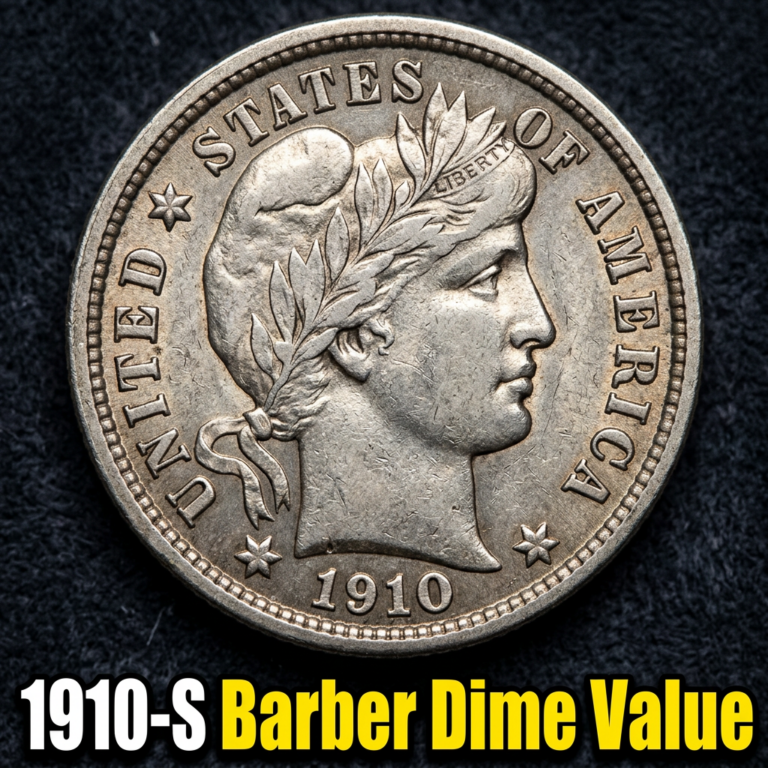
If you have stumbled upon an old silver coin featuring a profile of Liberty with a laurel wreath, you are holding a piece of American history known as the Barber Half Dollar. Designed by Charles E. Barber, these coins were produced between 1892 and 1915. To find out exactly how much your specific coin is worth, you can use the top coin identifier and value app to get an instant appraisal from your smartphone.
The “O” on your 1903 coin indicates it was minted in New Orleans, Louisiana. This mint was vital to the Southern economy at the turn of the century but ceased operations in 1909. Because the New Orleans Mint is no longer active, coins bearing the “O” mint mark often carry a premium among history buffs and serious numismatists alike.
Compared to other silver dollars and halves of the era, the 1903 series is particularly interesting for its scarcity in mid-to-high grades. While over 2 million were struck, the vast majority were used in daily commerce—buying groceries, paying rent, and circulating through the hands of early 20th-century Americans. Finding one that survived without deep scratches or heavy wear is quite a challenge today.
For those curious about how this compares to other denominations from the same year, checking the 1903 Morgan Silver Dollar price guide can provide helpful context on the market for diverse New Orleans silver coinage. Many collectors try to assemble sets from this specific year and mint location.
Your Old Coin Could Be Valuable!
Identify It & Know Its Real Value — Free Download
Determining the 1903-O Barber Half Dollar Value by Condition
When assessing the 1903-O Barber Half Dollar Value, the single most important factor is the “grade” or state of preservation. Collectors use a 70-point scale to determine quality. For an everyday person, this usually translates to seeing how much detail remains in Liberty’s hair and the word “LIBERTY” on her headband.
In “Good” condition, Liberty’s head will look like a silhouette, and the letters in “LIBERTY” might be completely worn away. At this stage, the coin is mostly valued for its 90% silver content and its status as a 120-year-old relic. However, once you move into “Fine” or “Very Fine” territory, where the headband is visible, the price jumps significantly.
Your Old Coin Could Be Valuable!
Identify It & Know Its Real Value — Free Download
If you aren’t sure where your coin falls on this scale, the CoinKnow app can help. By simply taking a clear photo of the front and back of your coin, CoinKnow uses advanced image recognition to compare your piece against thousands of graded examples, giving you a realistic estimate of its market value.
| Grade Designation | Visual Description | Price Range |
|---|---|---|
| Good (G-4) | Device is mostly an outline; heavy wear. | $25 – $30 |
| Fine (F-12) | At least 3 letters of “LIBERTY” are visible. | $90 – $120 |
| Very Fine (VF-20) | All letters of “LIBERTY” are sharp. | $180 – $250 |
| Extremely Fine (XF-40) | Only slight wear on high points (hair/leaves). | $450 – $550 |
| About Uncirculated (AU-50) | Original mint luster still present in cracks. | $900 – $1,200 |
The Rarity of New Orleans Mint Barber Halves
The New Orleans Mint (O) had a lower production capacity than the main Philadelphia Mint (no mint mark). In 1903, Philadelphia produced over 6 million half dollars, while New Orleans produced only about 2.1 million. This makes the 1903-O roughly three times rarer than the common Philadelphia version.
Furthermore, many “O” mint coins were struck with slightly weaker details than those in Philadelphia or San Francisco. This means finding a “Full Strike” 1903-O—where every feather on the eagle’s wing is crisp—is incredibly difficult. Collectors are willing to pay thousands of dollars extra for a coin that shows no “weakness” in the strike.
Your Old Coin Could Be Valuable!
Identify It & Know Its Real Value — Free Download
If you have a collection of old family coins and want to quickly sort the “junk silver” from the “collector’s gems,” CoinKnow is an essential tool. It identifies the mint mark location instantly, which is the small “O” located on the reverse (back) of the coin, right under the eagle’s tail feathers.
Why High-Grade 1903-O Barber Halves Are So Expensive
Most 1903-O Barber Half Dollars you see today will be heavily worn. This is because, in 1903, 50 cents was a significant amount of money—equivalent to about $15 to $18 today. People didn’t tuck these away in drawers; they used them to conduct business.
Because so few were saved by collectors at the time of issue, “Mint State” (uncirculated) examples are “condition rarities.” An uncirculated 1903-O is a true trophy. In 2021, a high-grade specimen (MS-67) sold for over $20,000 at a major auction house. Even a basic uncirculated MS-60 coin can fetch over $2,500.
Your Old Coin Could Be Valuable!
Identify It & Know Its Real Value — Free Download
If your coin looks shiny, like it just came from a bank yesterday, do not clean it! Cleaning a coin with soap, cloth, or chemicals can destroy up to 90% of its value instantly. Collectors want original patina and “cartwheel” luster, not a polished surface that looks like a mirror.
Modern Market Trends for Barber Silver Coinage
The market for Barber Half Dollars has remained remarkably steady over the last decade. Unlike some “hype” coins that fluctuate wildly, these silver classics are favored by older, more established collectors who value the history of the Gilded Age.
Recently, there has been a surge in interest from younger investors looking for “hard assets.” Because these coins contain 0.3617 ounces of pure silver, they have a “floor” price determined by the current spot price of silver. Even if the coin were smashed flat, it would still be worth its weight in silver.
However, the numismatic (collector) value of the 1903-O is much higher than its silver weight. When silver prices rise, the interest in all vintage silver coins tends to increase, making it a great time to evaluate your collection for hidden gems.
Your Old Coin Could Be Valuable!
Identify It & Know Its Real Value — Free Download
| Mint Mark | Mintage | Rarity Factor |
|---|---|---|
| 1903 (Philadelphia) | 6.2 Million | Common |
| 1903-O (New Orleans) | 2.1 Million | Scarce |
| 1903-S (San Francisco) | 1.1 Million | Rare |
Tips for Selling and Protecting Your 1903-O Barber Half Dollar
If you decide you want to sell your 1903-O Barber Half Dollar, you have several options. For a quick sale, a local coin shop is the easiest route, but be prepared to receive 60-70% of the retail value, as the shop needs to make a profit. For high-value coins (worth over $500), sending the coin to a professional grading service like PCGS or NGC is highly recommended.
Once a coin is “slabbed” in a plastic holder by a professional service, its grade is guaranteed, making it much easier to sell on sites like eBay or through major auction houses. To protect the coin while you decide what to do, keep it in a PVC-free “flip” or a soft cardboard holder. Avoid using tape or storing it in damp basements.
Always double-check the values using resources like CoinKnow. Knowledge is your best defense against selling a rare coin for far less than it is worth. By understanding the current market and the specific attributes of the 1903-O, you can ensure you get the best possible price for your piece of American heritage.
FAQ
Q: Where is the mint mark on a 1903-O Barber Half Dollar?
A: The mint mark is located on the reverse (back) side of the coin. Look at the bottom, just above the “D” and “O” in the word “DOLLAR.” You will see a small “O” which stands for the New Orleans Mint.
Q: Is my 1903-O Barber Half Dollar made of real silver?
A: Yes, all Barber Half Dollars minted between 1892 and 1915 are composed of 90% silver and 10% copper. Each coin contains roughly 0.36169 troy ounces of pure silver.
Your Old Coin Could Be Valuable!
Identify It & Know Its Real Value — Free Download
Q: Why is there such a big price difference between grades?
A: In the world of coin collecting, condition is everything. A “Good” coin is very common because it was used for decades. A “Mint State” coin is extremely rare because almost no one thought to save it when it was brand new in 1903. This extreme scarcity drives the price up for high-quality examples.
Q: Should I clean my old 1903 silver coin to make it look new?
A: Absolutely not! Cleaning a coin is the fastest way to ruin its collector value. Even gentle rubbing with a cloth can leave “hairline” scratches that professional graders will notice immediately, often reducing the value by more than half.
Q: How can I tell if my coin is a fake?
A: While fakes of this specific date are less common than for rare dates like the 1892-O Micro O, they do exist. Real Barber halves should weigh 12.5 grams and be non-magnetic. Using an app like CoinKnow or taking it to a reputable dealer are the best ways to verify authenticity.