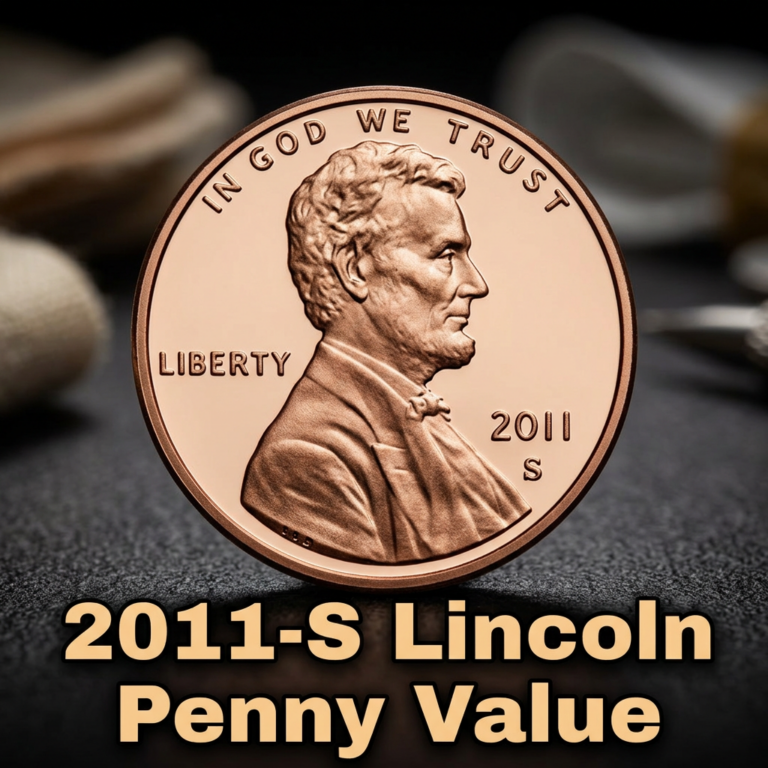
1981-S Type 1 Kennedy Half Dollar Value: Guide for Beginners

Your Old Coin Could Be Valuable!
Identify It & Know Its Real Value — Free Download


The 1981-S Type 1 Kennedy Half Dollar is worth anywhere from $3 in typical proof condition to over $1,200 for rare, high-grade specimens. While these coins were minted specifically for collectors, finding one in an old family collection can be an exciting discovery for any casual treasure hunter.
| Condition / Grade | Estimated Value |
|---|---|
| PR 65 (Cleaned/Average) | $3.00 – $5.00 |
| PR 69 Deep Cameo | $15.00 – $25.00 |
| PR 70 Deep Cameo (Perfect) | $650.00 – $1,250.00 |
Understanding the 1981-S Proof Kennedy Half Dollar
If you’ve recently inherited a coin collection or found a shiny 50-cent piece in a drawer, you might be looking at a 1981-S Kennedy Half Dollar. Unlike the coins you get at the bank, this one was struck at the San Francisco Mint specifically for “Proof Sets.”
These coins feature a mirror-like finish and were never intended to be spent at the grocery store. To get a quick check on what you have, you can use a top coin identifier and value app to scan the surface and details of your coin.
In 1981, the minting process for proof coins was in transition, which led to two distinct varieties: the Type 1 and the Type 2. The Type 1 “S” mint mark is often referred to as the “Filled S.” This is because the punch used to create the mint mark was worn down, making the “S” look blob-like or less defined.
While the Type 1 is generally more common than the Type 2, its value is still significantly higher than its face value. Using the CoinKnow app can help you distinguish between these subtle mint mark differences without needing a professional magnifying glass.
Your Old Coin Could Be Valuable!
Identify It & Know Its Real Value — Free Download
The Value Differences Between Type 1 and Type 2
When evaluating your 1981 half dollar, the “Variety” is the most important factor after the grade. The Type 1 (Filled S) was the standard for the first part of the year. Later in 1981, the Mint replaced the punch with a clearer, more defined version known as the Type 2 (Clear S).
Because fewer Type 2 coins were minted, they generally command a higher price premium. However, a Type 1 in perfect condition is still a prize for collectors. You can examine specific market data for the 1981 half dollar value to see how these two varieties stack up against each other in today’s auctions.
Your Old Coin Could Be Valuable!
Identify It & Know Its Real Value — Free Download
Condition is everything in the world of numismatics. A 1981-S Type 1 that has been handled by oily fingers or scratched will be worth close to its silver-less melt value (which is zero, as these are copper-nickel). But a “Deep Cameo” (DCAM) version, where the portrait is frosty and the background is like a black mirror, is what brings in the real money.
If you aren’t sure how to grade your coin, CoinKnow allows you to compare your coin against high-resolution images of known grades. This makes it much easier for everyday Americans to avoid getting “ripped off” by a low-ball offer from a local shop.
| Variety Type | Mint Mark Appearance | Rarity Level |
|---|---|---|
| 1981-S Type 1 | Blobby, unrecognizable “S” | Common |
| 1981-S Type 2 | Clear, distinct “S” loops | Scarce |
Factors That Influence 1981-S Kennedy Proof Prices
Several factors determine if your 50-cent piece is worth $5 or $500. First and foremost is the “Cameo” effect. In 1981, most coins produced were “Deep Cameo,” meaning there is a heavy contrast between the design and the fields. If your coin looks “flat” or the frostiness has worn off, the value drops immediately.
Your Old Coin Could Be Valuable!
Identify It & Know Its Real Value — Free Download
Professional grading by agencies like PCGS or NGC is the second biggest factor. A coin in a “slab” (a plastic protective case with a grade) is much easier to sell than a “raw” coin. Collectors look for “PR 70” which is a perfect coin with no visible flaws even under 5x magnification.
Check out the current 1981 Kennedy half dollar price trends to see how the market has shifted recently. You’ll notice that while millions were made, only a few thousand achieve that elusive perfect grade.
Finally, “Set Completeness” matters. Many people found these coins inside their original 1981 Proof Sets from the US Mint. If the set is still sealed in its original plastic and purple box, it might be worth more as a complete package than if you break the individual coins out. Tools like CoinKnow can help you value both individual coins and entire proof sets.
How to Identify a Type 1 “Filled S” Mint Mark
Identifying the Type 1 variety requires a bit of a close look. Because the San Francisco Mint used a worn-out punch, the “S” looks like a rounded blob. The center of the “S” is often completely filled with metal, making it look more like a rectangle with rounded corners than a letter.
Your Old Coin Could Be Valuable!
Identify It & Know Its Real Value — Free Download
In contrast, the Type 2 has very clear “serifs” (the little feet at the ends of the letter) and the hole in the center of the “S” is clearly visible. If you are struggling to see it with your naked eye, don’t worry. Many people use their smartphone cameras to zoom in.
| Visual Feature | Type 1 Description | Type 2 Description |
|---|---|---|
| Center of the ‘S’ | Filled or nearly filled | Clear and open |
| Overall Sharpness | Muffled, soft edges | Crisp, sharp edges |
If you find that your “S” is crystal clear and looks like a perfect letter, you have the rarer Type 2 variety. However, the Type 1 is still a valuable part of American numismatic history and a necessary piece for anyone trying to build a complete Kennedy Half Dollar collection.
Why the 1981 Half Dollar Does Not Contain Silver
A common misconception among everyday Americans is that old half dollars are made of silver. While this was true before 1964 and partially true until 1970, by 1981, the US Mint had moved entirely to a copper-nickel “clad” composition. This means the coin is made of a copper core sandwiched between layers of nickel.
If you look at the edge of the coin, you will see a copper-colored line. This confirms it is a non-silver coin. While this means the coin doesn’t have “melt value” from precious metals, its value comes entirely from its collector appeal and its condition.
Your Old Coin Could Be Valuable!
Identify It & Know Its Real Value — Free Download
This makes grading even more important. Since there is no silver to fall back on, a Type 1 coin in poor condition is essentially only worth fifty cents. Protecting your coin from fingerprints (which contain acids that eat into the nickel) and moisture is key to preserving what value it does have.
Where to Sell Your 1981-S Kennedy Half Dollar
Once you’ve identified your coin using CoinKnow and determined it is a 1981-S Type 1, you might be wondering how to turn it into cash. For lower-grade examples worth $3-$10, eBay is often your best bet. Collectors are always looking for affordable pieces to fill holes in their folders.
If you believe you have a PR 70 (perfect) coin, you should consider sending it to a grading service like PCGS. A certified PR 70 can sell for hundreds or even over a thousand dollars at a major auction house like Heritage Auctions.
Before spending money on grading fees, which can range from $20 to $50 per coin, make sure the value exceeds the cost. Use online price guides to check the latest sales for graded samples. If your coin has even a single tiny scratch visible under a magnifying glass, it likely won’t hit that “top pop” value, and selling it as a “raw” proof on a marketplace is the smarter financial move.
| Selling Channel | Best For | Potential Price |
|---|---|---|
| Local Coin Shop | Quick cash / low effort | 50% – 60% of retail |
| eBay | Average collectors | 80% – 90% of retail |
| Major Auctions | High-grade certified coins | $500+ |
FAQ
Q: Is the 1981-S Kennedy Half Dollar silver?
A: No, the 1981-S Kennedy Half Dollar is a copper-nickel clad coin. It contains no silver. The last Kennedy halves containing silver for general proof sets were made in 1970 (though some special silver sets were made in later years, 1981 was not one of them).
Your Old Coin Could Be Valuable!
Identify It & Know Its Real Value — Free Download
Q: How can I tell if I have a Type 1 or Type 2?
A: Look at the “S” mint mark above the date. The Type 1 “Filled S” looks like a blob with very little space inside the loops of the S. The Type 2 “Clear S” has distinct, sharp ends and a clear opening in the middle of the letter.
Q: Can I find a 1981-S in my pocket change?
A: It is very rare but possible. These coins were only sold in sets to collectors. If you find one in change, it means someone “broke” a proof set and spent the coin. These are called “Impaired Proofs” and are usually worth relatively little because they have been scratched and handled.
Q: What is the most ever paid for a 1981-S Type 1 Kennedy Half Dollar?
A: Auction records show that 1981-S Type 1 coins in perfect PR 70 Deep Cameo condition have sold for as much as $1,500 in past years, though current market values for perfect specimens typically hover around $600 to $900 depending on the grading service.