1902-O Barber Quarter Value: How Much Is It Worth Today?

Your Old Coin Could Be Valuable!
Identify It & Know Its Real Value — Free Download


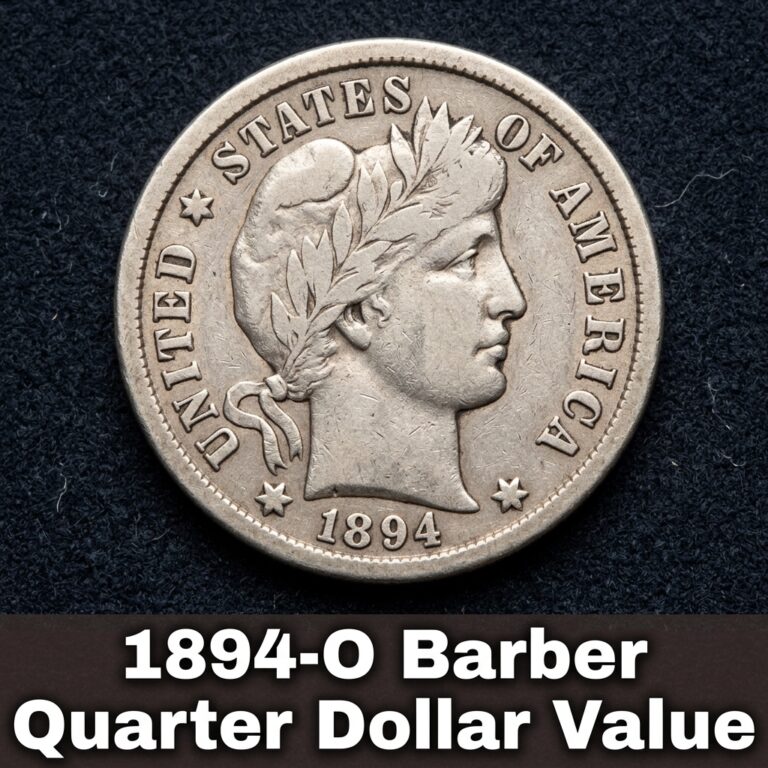
The 1902-O Barber Quarter is worth anywhere from $15 in heavily worn condition to over $1,200 in high-grade mint state. Finding this classic silver coin in your collection is an exciting discovery, as the “O” mint mark from New Orleans adds a layer of historical prestige and scarcity that collectors love.
| Condition / Grade | Estimated Value |
|---|---|
| Good (G-4) | $15 – $22 |
| Fine (F-12) | $65 – $85 |
| Extremely Fine (EF-40) | $180 – $240 |
| Uncirculated (MS-60+) | $450 – $1,200+ |
History of the 1902-O Barber Quarter Dollar
The 1902-O Barber Quarter was designed by Charles E. Barber, who served as the Chief Engraver of the United States Mint. This era of American coinage is often referred to as the “Golden Age of Silver,” where quarters, dimes, and half dollars shared a unified aesthetic. The New Orleans Mint, signified by the “O” mark, was responsible for producing 4,748,000 of these coins in 1902. While this mintage might seem high, many were lost to circulation or melted down over the last century.
If you are just starting to explore old family heirlooms, using a top coin identifier and value app can help you distinguish between common dates and rare treasures. The 1902-O is particularly interesting because the New Orleans Mint closed shortly after this decade, making “O” mint mark coins a finite piece of Southern history. Many everyday Americans find these in jars or old safes, unaware that their silver content is only the baseline of their worth.
To truly understand the market, one must look at how the 1902-O compares to other coins of the era. For example, while silver quarters are popular, many collectors also keep an eye on the 1902 Morgan Silver Dollar price trends to see how the overall market for early 1900s silver is performing. Generally, when larger silver coins go up in price, smaller denominations like the Barber Quarter follow suit.
Your Old Coin Could Be Valuable!
Identify It & Know Its Real Value — Free Download
Determining the Mint Mark and Authenticity
The “O” mint mark is the most critical feature when identifying this specific coin. You can find it on the reverse (back) of the quarter, located just below the eagle’s tail feathers and above the letters “R” and “T” in “QUARTER.” If the area is blank, the coin was minted in Philadelphia and typically carries a slightly lower premium in low grades compared to its New Orleans cousin.
Because these coins are over 120 years old, the mint mark can be worn down or obscured by dirt. Digital tools like the CoinKnow app are excellent for this situation. By taking a high-resolution photo, CoinKnow can zoom in and help you verify the mint mark’s presence, ensuring you don’t mistake a valuable New Orleans strike for a common Philadelphia one.
Your Old Coin Could Be Valuable!
Identify It & Know Its Real Value — Free Download
Authenticity is rarely an issue with low-grade Barber Quarters, but as the price climbs into the hundreds of dollars for Mint State examples, it is important to ensure the “O” hasn’t been added. Use a magnifying glass to check for any seams or discoloration around the letter. If you are unsure, the CoinKnow database can provide reference images of genuine strikes for comparison.
Grading the 1902-O Barber Quarter
The value of your 1902-O Barber Quarter is almost entirely dependent on its “grade,” or its state of preservation. Collectors use a 70-point scale, but for most people, the categories fall into “Good,” “Fine,” and “Uncirculated.” In “Good” condition, Liberty’s head will look like a silhouette with very little detail in her hair or the crown.
Your Old Coin Could Be Valuable!
Identify It & Know Its Real Value — Free Download
A “Fine” specimen will show the letters in the word “LIBERTY” on the headband clearly. This is a major value jumper; a coin where “LIBERTY” is readable is worth significantly more than one where it is worn away. At the top of the spectrum are “Uncirculated” coins, which look as though they just left the mint with a shiny luster and no visible wear on the high points of the design.
| Grade Designation | Key Visual Indicators |
|---|---|
| Good (G-4) | Outline of Liberty is clear; rims are flat. |
| Fine (F-12) | All letters in LIBERTY are visible; hair is distinct. |
| Very Fine (VF-20) | Wheat stalks on the reverse show clear separation. |
| About Uncirculated (AU-50) | Traces of wear only on the highest points; some luster. |
The Impact of Silver Content on Value
Even if your 1902-O Barber Quarter is completely “slick” (meaning almost all the detail is rubbed off), it still has a “melt value.” Barber Quarters are struck in 90% silver and 10% copper. This means that as the price of silver fluctuates on the global market, the floor price of your coin changes as well.
Each quarter contains approximately 0.1808 troy ounces of pure silver. While the collector (numismatic) value of a 1902-O is usually higher than the silver value, it is comforting to know that your coin will never be worth zero. If silver is at $25 an ounce, your quarter has at least $4.50 worth of raw precious metal inside it.
Your Old Coin Could Be Valuable!
Identify It & Know Its Real Value — Free Download
However, because the 1902-O is a “better date” from New Orleans, you should never sell it for just the silver weight. Even a heavily worn 1902-O typically sells for 3 to 4 times its melt value because of its scarcity. Always check the CoinKnow app for the most recent auction realized prices before heading to a local pawn shop or gold buyer.
Why the New Orleans Mint Matters
The New Orleans Mint (1838–1909) has a mystical status among coin collectors. It was the only U.S. Mint to be operated by three different governments: the United States, the State of Louisiana, and the Confederate States of America. Coins minted there often have “mushy” strikes compared to Philadelphia or San Francisco, but their history is unmatched.
By 1902, the New Orleans Mint was nearing the end of its life. The equipment was aging, which is why finding a 1902-O with a “sharp strike” (crisp details) is very rare and attracts high bids at auction. Collectors who specialize in “O-Mint” coins often look for specific characteristics in the eagle’s feathers on the reverse.
If you happen to find one of these in a collection, you are holding a piece of the Old South. The 1902-O Barber Quarter is a favorite for people building “Mint Mark Sets,” where they try to get one of every Barber Quarter ever made at the New Orleans facility. This consistent demand ensures that prices remain stable even during economic downturns.
Your Old Coin Could Be Valuable!
Identify It & Know Its Real Value — Free Download
| Market Factor | Effect on Value |
|---|---|
| Cleaned Surface | Reduces value by 50% or more. |
| Original Patina | Increases desirability and price. |
| High Demand | New Orleans coins have a built-in fan base. |
Tips for Selling Your 1902-O Barber Quarter
Ready to turn that old silver into cash? The first rule is: Do not clean the coin. Many beginners think a shiny coin is worth more, so they use polish or lemon juice. This actually destroys the coin’s value by removing the original surface layers. Collectors prefer a dark, “toned” coin that shows its age over a shiny, scratched-up one.
Second, get a professional opinion or use a high-tech tool. The CoinKnow app can help you categorize the grade so you don’t get low-balled by a buyer. Once you know the approximate grade, check eBay “Sold” listings—not the “Asking” prices—to see what people are actually paying.
Finally, consider the venue. Selling a 1902-O Barber Quarter at a local coin shop is fast but might net you 20% less than selling to a private collector or through an online auction. If your coin is in exceptional condition (MS-60 or higher), it may even be worth sending to a grading service like PCGS or NGC to have it “slabbed” in a plastic holder, which guarantees its grade and maximizes its resale value.
FAQ
Q: Where is the mint mark on a 1902-O Barber Quarter?
A: The “O” mint mark is located on the reverse side of the coin. Look at the bottom, just above the word “QUARTER” and below the eagle’s tail feathers.
Your Old Coin Could Be Valuable!
Identify It & Know Its Real Value — Free Download
Q: Is the 1902-O Barber Quarter rare?
A: It is considered a “semi-key” date. While not as rare as the famous 1896-S or 1901-S, it is significantly harder to find than the Philadelphia version of the same year, especially in higher grades.
Q: My 1902 quarter doesn’t have a letter on the back. Is it fake?
A: No, that just means it was minted in Philadelphia. Philadelphia coins from this era did not use a mint mark. It is still 90% silver and valuable, though usually worth slightly less than the “O” version in mid-range grades.
Q: What is the highest price ever paid for a 1902-O Barber Quarter?
A: Pristine examples in MS-67 condition have sold for over $15,000 at major heritage auctions. However, these are exceptionally rare museum-quality pieces.