1979-D Kennedy Half Dollar Value and What Collectors Are Actually Paying

Your Old Coin Could Be Valuable!
Identify It & Know Its Real Value — Free Download


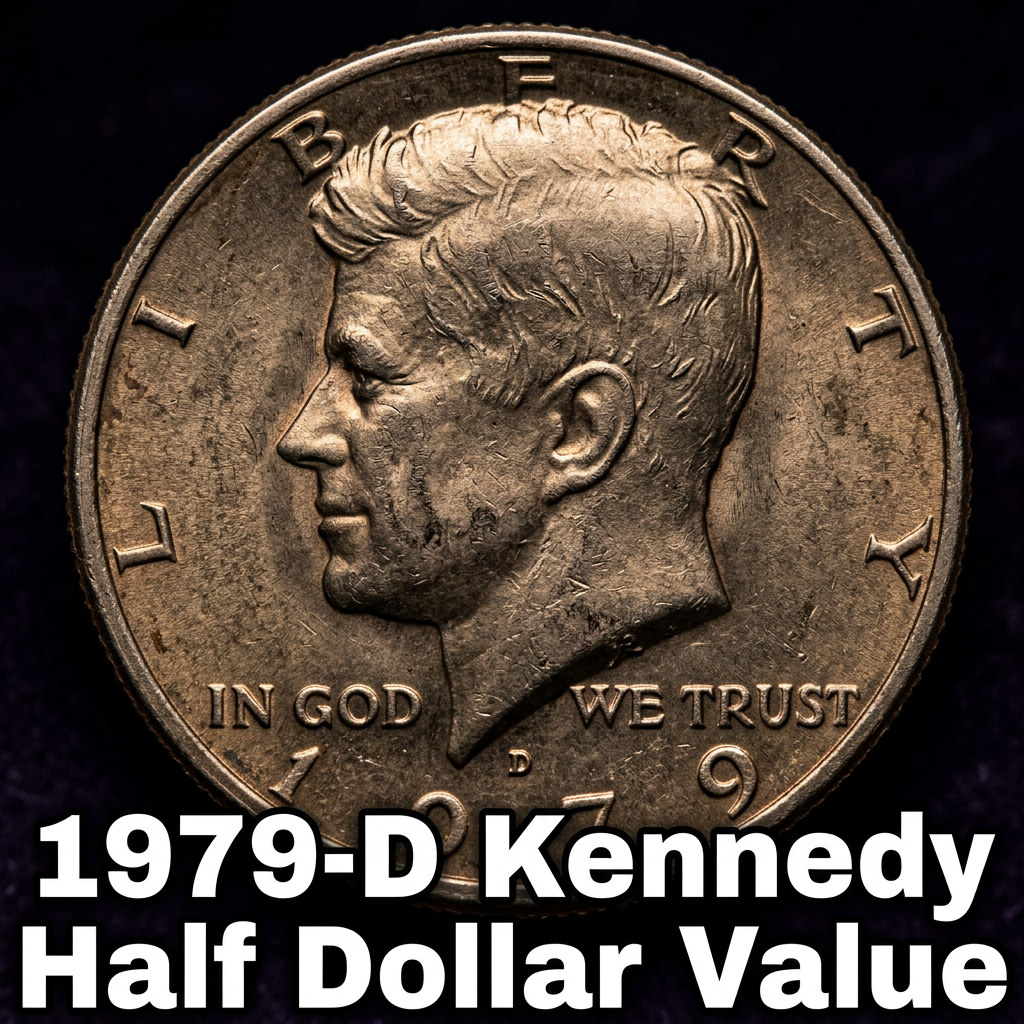
The 1979-D Kennedy Half Dollar is worth anywhere from 50 cents in heavily worn condition to over $20 or more in higher mint state grades, with some top-graded examples fetching $50 to $100 at auction. If you just found one of these coins in an old jar or inherited collection, you’re in the right place — let’s break down exactly what it’s worth and why.
If you want a quick, accurate estimate without doing all the research yourself, a coin identifier and value app can scan your coin and give you a grade and value in seconds. Tools like CoinKnow make it especially easy for everyday collectors to figure out what they’ve got. That said, let’s walk through the details so you fully understand what affects the 1979-D Kennedy Half Dollar value.
What Is the 1979-D Kennedy Half Dollar?
The 1979-D Kennedy Half Dollar was struck at the Denver Mint and bears the small “D” mintmark on the reverse side, just below the eagle. This coin is part of the long-running Kennedy Half Dollar series, which began in 1964 following President John F. Kennedy’s assassination.
By 1979, half dollars were largely absent from everyday circulation. Most were being hoarded or used in casino gaming, which means surviving examples often spent years in rolls or bags rather than being passed hand to hand.
Your Old Coin Could Be Valuable!
Identify It & Know Its Real Value — Free Download
The Denver Mint produced 15,815,422 half dollars in 1979, which is a relatively modest mintage compared to some other years in the series. That number isn’t rare enough to make common circulated examples worth a premium, but it does mean that high-grade uncirculated coins are harder to find than you might expect.
How Much Is the 1979-D Kennedy Half Dollar Worth Today?
Value depends heavily on condition. A coin that’s been passed around and shows obvious wear will only be worth face value or slightly above. But an uncirculated coin that has never been spent — one that still has its original luster — can be worth real money to the right collector.
Your Old Coin Could Be Valuable!
Identify It & Know Its Real Value — Free Download
For a detailed look at 1979-D Kennedy Half Dollar prices across multiple mint state grades, current auction records show a clear jump in value once you reach MS-65 and above.
Here’s a general value guide based on condition:
Your Old Coin Could Be Valuable!
Identify It & Know Its Real Value — Free Download
| Grade | Condition Description | Estimated Value |
|---|---|---|
| Good (G-4) | Heavy wear, major details visible | $0.50 – $1.00 |
| Fine (F-12) | Moderate wear, all lettering clear | $1.00 – $2.00 |
| Extremely Fine (EF-40) | Light wear on high points only | $2.00 – $4.00 |
| Mint State (MS-63) | Uncirculated, some bag marks | $5.00 – $12.00 |
| Mint State (MS-65) | Gem uncirculated, strong luster | $20.00 – $50.00 |
| Mint State (MS-67) | Superb gem, virtually flawless | $75.00 – $150.00+ |
Key Factors That Affect the 1979-D Half Dollar’s Value
Beyond grade, a few other things can push value up or down. Eye appeal matters — a coin with bright, original luster and no cleaning or damage is worth more than one that looks dull or was polished at some point. Cleaned coins are widely considered damaged by collectors and dealers alike, and they typically sell at a steep discount.
Strike quality also plays a role. Some 1979-D Kennedy Half Dollars came out of the mint weakly struck, particularly on Kennedy’s hair detail and the eagle’s breast feathers. A sharply struck example stands out from the crowd and commands higher prices.
Storage history matters too. Coins that spent decades in airtight holders or original mint rolls tend to grade higher and look better than ones that rattled around loose in a drawer.
Your Old Coin Could Be Valuable!
Identify It & Know Its Real Value — Free Download
Is the 1979-D Kennedy Half Dollar Rare?
In circulated grades, no — this coin is common and easy to find. Dealers and collectors generally aren’t excited by worn examples. However, in gem uncirculated grades (MS-65 and above), the coin becomes meaningfully scarcer. Population reports from PCGS and NGC show relatively few examples certified at the top end of the scale.
There’s also a Type 1 vs. Type 2 distinction for 1979 half dollars related to proof coins, but for business strike Denver examples like the 1979-D, the main thing to focus on is condition.
You can find a full breakdown of 1979 half dollar values including the Denver Mint issue if you want to dig deeper into the numbers before buying or selling.
Your Old Coin Could Be Valuable!
Identify It & Know Its Real Value — Free Download
CoinKnow is a great resource if you’re building a collection or just trying to sell a few old coins — it gives you real-time pricing data and helps you understand exactly where your coin falls on the grading scale.
How to Sell Your 1979-D Kennedy Half Dollar
If your coin is in circulated condition, your best bet is to sell it as part of a lot — grouping it with other Kennedy half dollars or clad coins and selling the whole batch. Individual worn examples rarely sell for much more than face value unless there’s something unusual about them.
For uncirculated coins, especially anything grading MS-65 or higher, consider getting it professionally graded by PCGS or NGC before selling. A certified coin in a holder commands significantly more trust and higher prices on eBay or at coin shows.
Apps like CoinKnow can help you get a ballpark value before you decide whether professional grading is worth the cost.
Your Old Coin Could Be Valuable!
Identify It & Know Its Real Value — Free Download
FAQ
Q: Is a 1979-D Kennedy Half Dollar made of silver?
A: No. The 1979-D Kennedy Half Dollar is made of a copper-nickel clad composition — 75% copper and 25% nickel. Kennedy Half Dollars were last made with silver content in 1969 (the 40% silver years ran from 1965 to 1969). The 1979-D has no silver value and is worth only its numismatic value based on condition.
Q: Where is the mintmark on a 1979-D Kennedy Half Dollar?
A: The “D” mintmark appears on the reverse (tails) side of the coin, just below the eagle’s tail feathers and above the “E” in “HALF DOLLAR.” It’s a small letter but easy to spot with a basic magnifying glass.
Q: What makes a 1979-D Kennedy Half Dollar worth more money?
A: The biggest factor is condition. Coins that are uncirculated and show original mint luster are worth the most, especially if graded MS-65 or higher by a professional grading service. Sharp strike, no cleaning, and no damage all push value upward. A coin that has been cleaned or shows heavy wear is generally only worth face value or slightly above.