
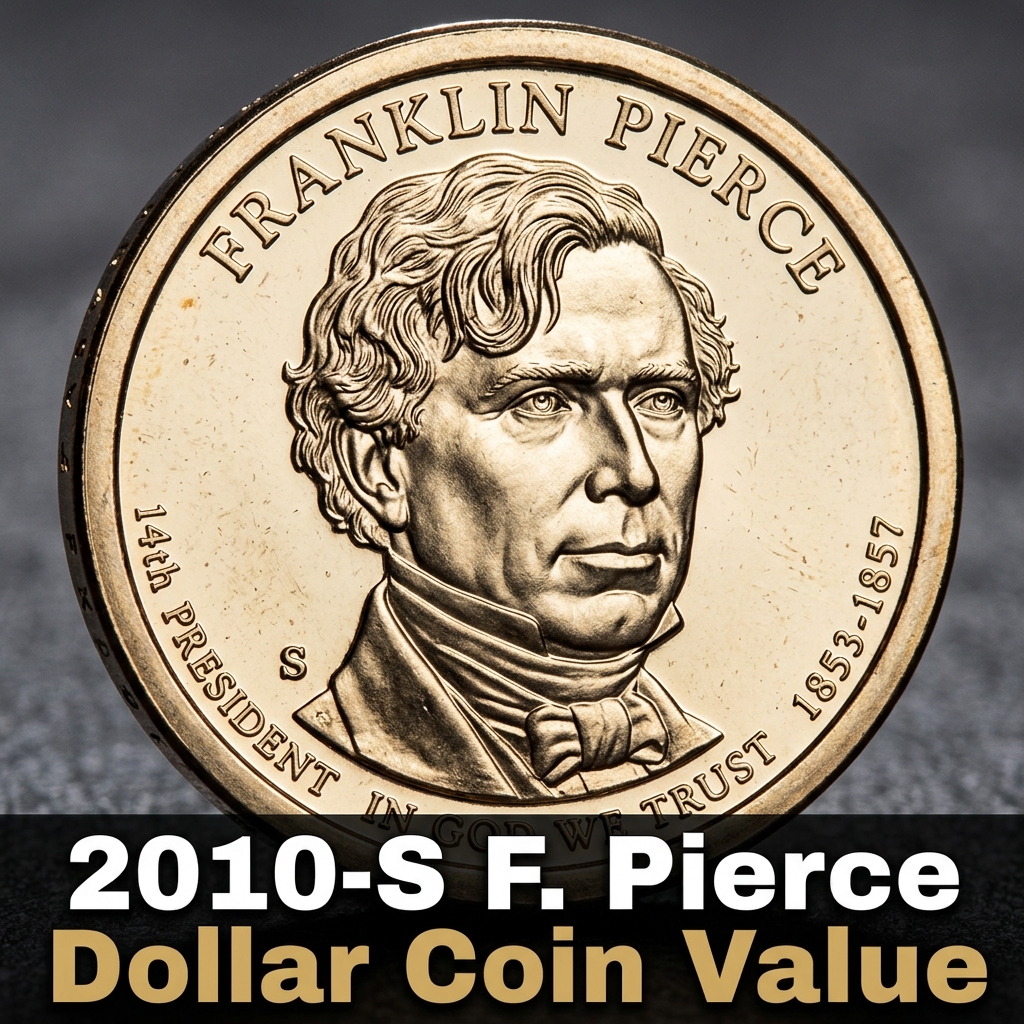
2010-S Franklin Pierce Presidential Dollar Coin Value and What Collectors Are Paying Today

Your Old Coin Could Be Valuable!
Identify It & Know Its Real Value — Free Download


The 2010-S Franklin Pierce Dollar coin is worth anywhere from $2 in average circulated condition to $10 or more in pristine proof quality, with some high-grade examples fetching even higher prices among dedicated collectors. If you found one of these coins tucked away in a drawer or inherited a collection, you’re in the right place to find out exactly what it’s worth.
What Is the 2010-S Franklin Pierce Dollar?
The 2010-S Franklin Pierce Dollar is part of the Presidential Dollar series, which the U.S. Mint launched in 2007 to honor American presidents in the order they served. Franklin Pierce was the 14th President of the United States, serving from 1853 to 1857, and his likeness was featured on coins minted in 2010.
The “S” mint mark means this coin was struck at the San Francisco Mint, which is famous for producing proof coins — coins struck with specially polished dies on polished planchets, giving them a mirror-like finish and exceptional detail. These are not coins made for everyday spending. They were sold directly to collectors in proof sets, which is why they’re often found in near-perfect condition.
If you’re not sure which version of the Presidential Dollar you have, using a coin identifier and value app can help you quickly figure out the mint mark, date, and estimated value right from your phone. It’s one of the easiest ways for everyday people to get a fast, reliable answer.
Your Old Coin Could Be Valuable!
Identify It & Know Its Real Value — Free Download
How Much Is the 2010-S Pierce Dollar Worth?
The value of the 2010-S Franklin Pierce Dollar depends heavily on its condition and whether it’s a standard proof or a deep cameo proof. Here’s a simple breakdown of typical values you’ll see in today’s market:
Your Old Coin Could Be Valuable!
Identify It & Know Its Real Value — Free Download
| Grade / Type | Estimated Value |
|---|---|
| Proof (PR65) | $3 – $5 |
| Proof Deep Cameo (PR69 DCAM) | $6 – $12 |
| Proof Deep Cameo (PR70 DCAM) | $15 – $40+ |
| Uncertified / Raw Proof | $2 – $4 |
The big jump in price happens when a coin is graded PR70, which means it’s essentially perfect with no flaws under magnification. These coins are prized by registry set collectors who compete to own the highest-graded examples of every Presidential Dollar.
For those curious about how values compare across the broader 2010 Sacagawea and Native American dollar series minted the same year, you can explore detailed price data for the 2010-P Native American Dollar in MS grades to get a fuller picture of what 2010 dollar coins are doing in today’s market.
Your Old Coin Could Be Valuable!
Identify It & Know Its Real Value — Free Download
Proof vs. Circulated — Does It Really Matter?
Yes, it matters a great deal. Since the 2010-S Pierce Dollar was only made as a proof coin, you won’t find a business-strike version with the “S” mint mark. Any 2010 Presidential Dollar you find in your change would have come from the Philadelphia (P) or Denver (D) Mint.
The San Francisco Mint struck 1,689,216 proof Pierce Dollars in 2010, which is a relatively modest number compared to circulation strikes. That said, the Presidential Dollar series never achieved massive collector demand, so even low-population proof examples don’t command huge premiums unless they hit that perfect PR70 grade.
Condition is everything with proof coins. Even a small fingerprint or hairline scratch can drop a coin from PR69 to PR65, cutting its value significantly. Always handle proof coins by the edges and store them in protective capsules or original mint packaging.
Your Old Coin Could Be Valuable!
Identify It & Know Its Real Value — Free Download
Where to Sell or Buy the 2010-S Pierce Dollar
If you’re looking to sell your 2010-S Pierce Dollar, your best options include eBay, coin shows, local coin dealers, and auction platforms like Heritage Auctions or Stack’s Bowers. For common proof examples in PR65 to PR68 grades, eBay tends to offer the most liquidity because there’s always someone completing a Presidential Dollar proof set.
For higher-grade coins — especially PR69 or PR70 examples — consider getting them certified by PCGS or NGC before selling. A certified PR70 coin can sell for two to four times what a raw coin might fetch, making the grading fee worthwhile.
CoinKnow is also a great tool if you want to research recent sales before you price your coin. CoinKnow pulls together data from major auction houses and marketplaces, so you can see what similar coins actually sold for rather than guessing based on outdated price guides.
Your Old Coin Could Be Valuable!
Identify It & Know Its Real Value — Free Download
You can also check out current 2010 Sacagawea dollar value information for context on related coins from the same year, which helps you understand market trends for 2010-dated dollar coins across the board.
Tips for Identifying Your 2010-S Pierce Dollar
Not sure if you have the right coin? Here’s what to look for. The obverse (front) features a portrait of Franklin Pierce with the inscriptions “Franklin Pierce,” “14th President,” and “2010.” The reverse shows the Statue of Liberty with “United States of America” and “$1.”
The edge of the coin carries the inscriptions “IN GOD WE TRUST,” “E PLURIBUS UNUM,” and the mint mark “S” — yes, the mint mark is on the edge, not the face of the coin. This is one of the unique features of the Presidential Dollar series. Use a magnifying glass and tilt the coin under good lighting to find it.
If you want an instant ID from a photo, CoinKnow lets you snap a picture of your coin and get a match with value data in seconds — no numismatic experience required.
Your Old Coin Could Be Valuable!
Identify It & Know Its Real Value — Free Download
FAQ
Q: Is the 2010-S Franklin Pierce Dollar rare?
A: It’s not considered rare by most standards, with nearly 1.7 million struck. However, perfect PR70 examples are genuinely scarce and can be worth $30 or more when certified.
Q: Can I spend a 2010-S Pierce Dollar as regular money?
A: Technically yes, it’s legal tender worth one dollar. But spending it would be a mistake — even a basic proof example is worth two to four times its face value to collectors.
Q: How do I know if my coin is in PR69 or PR70 condition?
A: The difference is incredibly subtle and usually requires professional grading. Submit your coin to PCGS or NGC for an official grade, especially if you believe it’s in near-perfect condition. The certification can significantly increase what a buyer is willing to pay.