
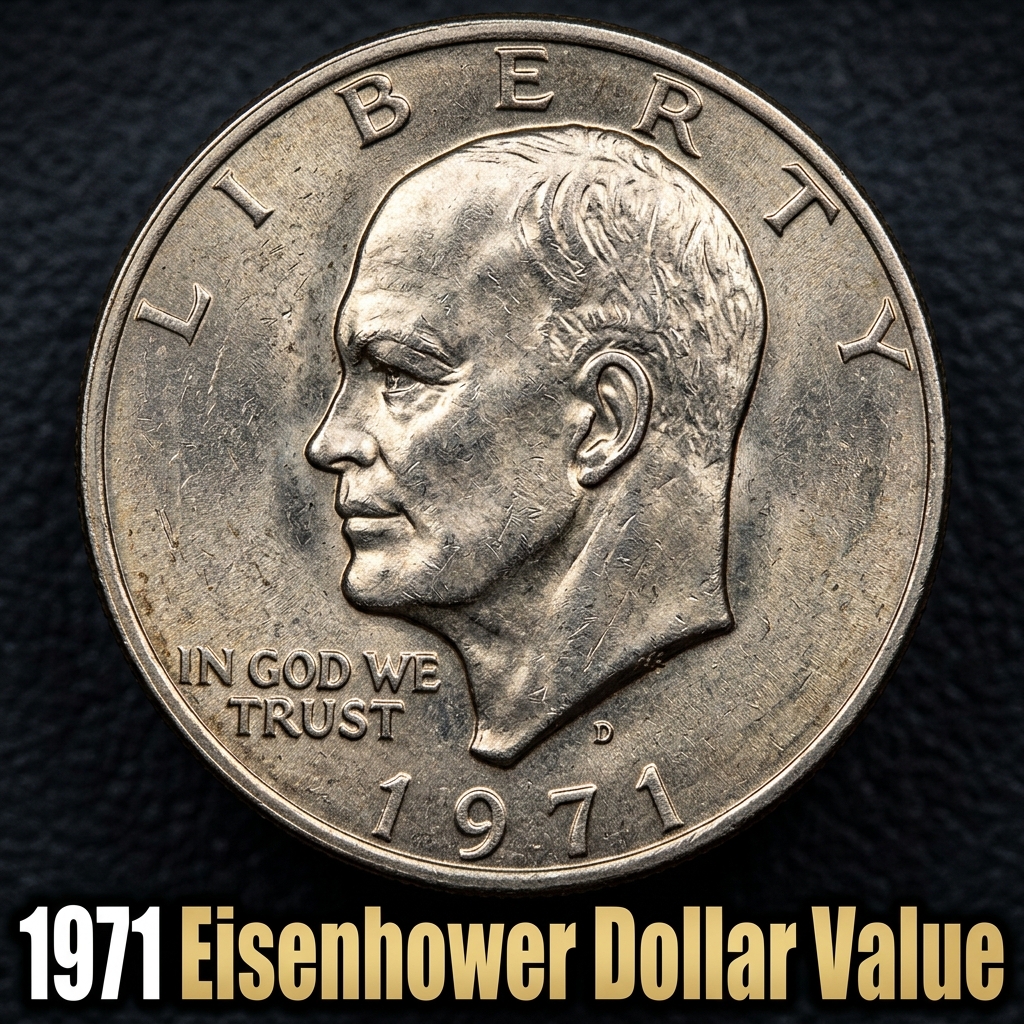
1971 Eisenhower Dollar Value What Is This Big Coin Worth Today

Your Old Coin Could Be Valuable!
Identify It & Know Its Real Value — Free Download


The 1971 Eisenhower Dollar is worth anywhere from $1 to $2 in average circulated condition, but well-preserved examples and special mint issues can fetch $15, $50, or even several hundred dollars depending on the variety and grade. If you just found one of these large, heavy coins in a drawer or old collection, you’re in the right place — let’s break down exactly what it’s worth.
What Is the 1971 Eisenhower Dollar
The Eisenhower Dollar was the first large-denomination dollar coin minted by the U.S. since the Peace Dollar series ended in 1935. It was introduced in 1971 to honor President Dwight D. Eisenhower, who had passed away in 1969, and also to commemorate the Apollo 11 moon landing — which is why the reverse features an eagle landing on the moon.
These coins were minted at two facilities: Philadelphia (no mint mark) and Denver (D mint mark). A special 40% silver version was also struck at San Francisco (S mint mark) for collectors, sold directly by the U.S. Mint. If you’re trying to figure out exactly what version you have, a coin identifier and value app can help you read the mint mark and compare your coin to known examples instantly.
The coin is large — about the size of an old Morgan Dollar — and made of a copper-nickel clad composition for circulation strikes, or 40% silver for the collector editions. Understanding which version you have is the most important first step.
Your Old Coin Could Be Valuable!
Identify It & Know Its Real Value — Free Download
1971 Eisenhower Dollar Value by Mint Mark and Grade
The value of a 1971 Eisenhower Dollar varies quite a bit depending on the mint mark, the coin’s condition, and whether it’s a silver issue. Circulated examples from Philadelphia and Denver are generally only worth face value or a small premium. But uncirculated coins — especially those graded MS65 and above — start to get genuinely exciting.
Here’s a quick reference table:
Your Old Coin Could Be Valuable!
Identify It & Know Its Real Value — Free Download
| Variety | Circulated | MS63 | MS65 | MS66+ |
|---|---|---|---|---|
| 1971 (Philadelphia) | $1–$2 | $5–$8 | $15–$25 | $100+ |
| 1971-D (Denver) | $1–$2 | $5–$10 | $18–$30 | $150+ |
| 1971-S Silver (Uncirculated) | N/A | $12–$18 | $30–$50 | $200+ |
| 1971-S Silver Proof | N/A | $15–$20 | $35–$60 | $300+ |
For the most current auction prices and dealer data, you can check out 1971 Eisenhower Dollar MS grade price records to see what certified examples are actually selling for right now.
Your Old Coin Could Be Valuable!
Identify It & Know Its Real Value — Free Download
How to Tell If Your 1971 Dollar Is Silver
This is one of the most common questions people ask — and for good reason. A silver 1971 Eisenhower Dollar is worth significantly more than the copper-nickel clad version, so it matters.
The easiest way to check is to look at the edge of the coin. A clad coin will show a visible copper-colored stripe along the edge. A 40% silver coin will have a uniform silver-gray edge with no copper stripe visible at all.
You should also look for the S mint mark on the obverse (front) of the coin, just below Eisenhower’s neck. Only San Francisco struck the silver versions, so if you see an S mint mark, you likely have a silver coin — though confirming via edge inspection is always smart. The silver coins were sold in blue (uncirculated) or brown (proof) government packaging, and many still come in those original holders today.
Your Old Coin Could Be Valuable!
Identify It & Know Its Real Value — Free Download
A reliable way to confirm silver content and get a value estimate is to use CoinKnow, which can scan your coin and pull up the exact variety details — including whether it’s silver or clad — in seconds.
What Makes a 1971 Eisenhower Dollar Worth More
Condition is everything in coin collecting. A 1971 Eisenhower Dollar that has never been in circulation — sitting in its original government packaging or a collection album — will always be worth more than one that’s been rattling around in a cash register.
Coins graded MS65 or higher by professional graders like PCGS or NGC command serious premiums. The 1971-D in particular is considered slightly more desirable among collectors in high grades. Proof versions of the 1971-S silver coin, with their mirror-like fields and sharp cameo contrast, are especially sought after.
Errors also add value. A small number of 1971 Eisenhower Dollars were struck with die varieties or doubling errors. If your coin shows any unusual doubling on the lettering or design details, it may be worth having it examined by a professional. For a deeper look at what different grades and conditions mean for your coin’s value, this complete 1971 silver dollar value breakdown is a great place to start.
Your Old Coin Could Be Valuable!
Identify It & Know Its Real Value — Free Download
Where to Sell or Get Your Coin Appraised
If you think you have a valuable example — especially a high-grade silver coin — getting it professionally graded is worth considering. Services like PCGS and NGC authenticate and grade coins, which dramatically increases buyer confidence and resale value.
For quick, everyday lookups, CoinKnow is one of the best tools available. You can photograph your coin, and the app identifies the mint mark, estimates the grade range, and shows recent market values — all without needing to visit a coin dealer first.
Local coin shops, coin shows, and established online auction platforms are all solid options for selling. If your coin is just a circulated clad example, it’s probably worth keeping as a piece of history rather than selling for face value.
—
Your Old Coin Could Be Valuable!
Identify It & Know Its Real Value — Free Download
FAQ
Q: Is a 1971 Eisenhower Dollar made of silver?
A: Most 1971 Eisenhower Dollars in circulation are made of copper-nickel clad and contain no silver. However, the 1971-S versions struck at the San Francisco Mint were made of 40% silver and sold directly to collectors in special packaging.
Q: How do I find the mint mark on my 1971 Eisenhower Dollar?
A: Look on the front (obverse) of the coin, just below President Eisenhower’s portrait near his neckline. A “D” means it was minted in Denver, an “S” means San Francisco, and no mint mark means Philadelphia.
Q: What is the most valuable 1971 Eisenhower Dollar?
A: The most valuable examples are the 1971-S silver proof coins in top grades (PR68 or higher), which have sold for several hundred dollars at auction. High-grade MS66+ clad examples from Philadelphia or Denver can also reach $100–$200 or more when certified by a professional grading service.