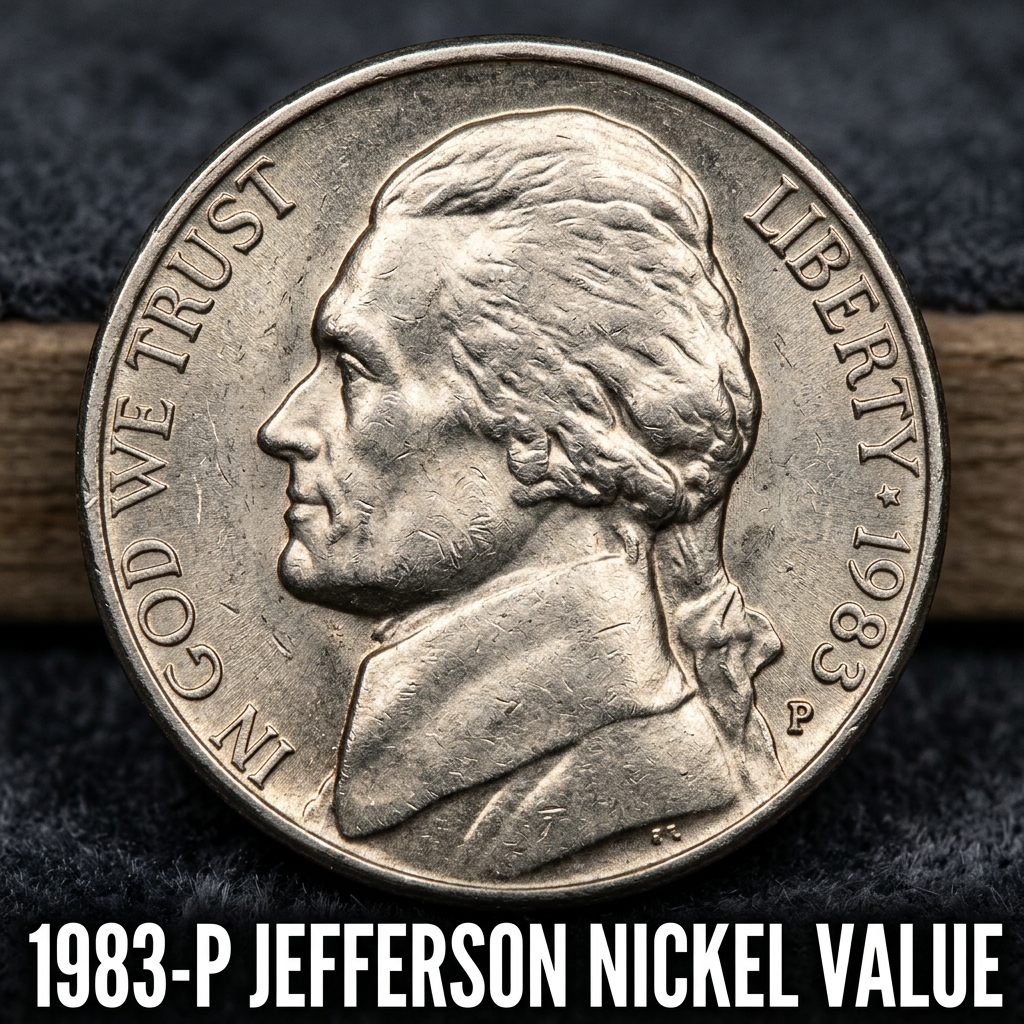
1983-P Jefferson Nickel Value What It’s Worth and How to Tell the Difference

Your Old Coin Could Be Valuable!
Identify It & Know Its Real Value — Free Download


The 1983-P Jefferson Nickel is worth anywhere from face value (5 cents) in heavily worn condition to around $15–$40 or more in uncirculated mint state grades. Most examples you’ll find in pocket change are worth only a few cents above face value, but high-grade specimens with full steps can command real collector interest. Whether you just found one in an old coin jar or pulled it from a roll, this guide will walk you through exactly what your coin might be worth.
Background on the 1983-P Jefferson Nickel
The 1983-P Jefferson Nickel was struck at the Philadelphia Mint, which is why it carries the “P” mintmark on the obverse. This was actually only the second year the Philadelphia Mint used a mintmark on Jefferson Nickels — a practice that began in 1980. Before that, Philadelphia coins had no mintmark at all.
The coin features Felix Schlag’s classic portrait of Thomas Jefferson on the front, and Monticello — Jefferson’s famous Virginia home — on the reverse. The design had been in use since 1938, making it one of the longer-running coin designs in U.S. history at that point.
Over 561 million of these coins were produced in 1983 at Philadelphia alone, which means they are extremely common in circulated grades. That high mintage is one of the main reasons most 1983-P nickels don’t carry much of a premium. But don’t toss it aside just yet — condition is everything in coin collecting.
Your Old Coin Could Be Valuable!
Identify It & Know Its Real Value — Free Download
If you want a quick and easy way to identify coins you find at home, a coin identifier and value app can scan your coin and give you an instant estimate without needing any coin expertise. Tools like CoinKnow make this process simple for everyday collectors.
Your Old Coin Could Be Valuable!
Identify It & Know Its Real Value — Free Download
1983-P Jefferson Nickel Value by Grade
Like all coins, the value of a 1983-P Jefferson Nickel depends heavily on its condition, or “grade.” Coin grading runs from Poor (P-1) at the low end to Mint State 70 (MS-70) at the perfect end. Most coins pulled from circulation fall in the Fine to Extremely Fine range.
Here’s a quick breakdown of what you can expect to find:
Your Old Coin Could Be Valuable!
Identify It & Know Its Real Value — Free Download
| Grade | Description | Estimated Value |
|---|---|---|
| Good (G-4) | Heavy wear, major details visible | $0.05 – $0.10 |
| Fine (F-12) | Moderate wear, all lettering clear | $0.10 – $0.25 |
| Extremely Fine (EF-40) | Light wear on high points only | $0.25 – $1.00 |
| About Uncirculated (AU-55) | Slight wear, most luster intact | $1.00 – $3.00 |
| Mint State (MS-63) | No wear, minor bag marks | $3.00 – $8.00 |
| Mint State (MS-65) | Gem quality, strong luster | $8.00 – $20.00 |
| MS-65 Full Steps (FS) | Gem quality with sharp Monticello steps | $20.00 – $40.00+ |
For the most current and detailed 1983-P Jefferson Nickel price data across all mint state grades, it helps to check a live pricing database that tracks recent auction results.
What Are Full Steps and Why Do They Matter?
You may have noticed the “Full Steps” designation in the table above. This refers to the steps at the base of Monticello on the reverse of the coin. When struck perfectly and preserved without contact marks, these steps appear as sharp, fully separated horizontal lines.
Your Old Coin Could Be Valuable!
Identify It & Know Its Real Value — Free Download
A coin that qualifies as “Full Steps” (FS) is considered a superior strike and is significantly rarer — even among uncirculated examples. That’s why an MS-65 Full Steps coin can be worth several times more than a regular MS-65.
Achieving the Full Steps designation requires a well-struck coin that has never been rubbed or damaged on that specific area. Because Monticello’s steps are a high point on the design, they’re one of the first places to show wear or contact marks. Most 1983-P nickels, even those pulled from original mint bags, don’t qualify.
If you’re trying to evaluate whether your coin has Full Steps, you’ll want a loupe or magnifier and good lighting. Better yet, apps like CoinKnow can help you assess strike quality right from your phone.
Your Old Coin Could Be Valuable!
Identify It & Know Its Real Value — Free Download
Where to Sell Your 1983-P Jefferson Nickel
If your coin grades MS-65 or higher — especially with Full Steps — it may be worth getting it professionally graded by PCGS or NGC. A certified grade adds credibility and can significantly increase resale value on platforms like eBay or at coin shows.
For average circulated examples, selling individually isn’t practical since values are so low. You’d be better off saving them as part of a type set or bulk lot.
For an easy-to-use overview of 1983 Jefferson Nickel values across different mint marks and conditions, there are several solid online resources that break down pricing clearly for everyday collectors.
If you’re just starting out and unsure where to begin, CoinKnow is a great tool that walks beginners through the basics of coin identification, grading, and valuation — all in one place.
Your Old Coin Could Be Valuable!
Identify It & Know Its Real Value — Free Download
Frequently Asked Questions
Q: Is the 1983-P Jefferson Nickel rare?
A: No, it is not rare. With over 561 million minted, it’s one of the more common modern nickels. However, high-grade examples — especially those with Full Steps — are genuinely scarce and worth collecting.
Q: How do I know if my 1983 nickel is the Philadelphia version?
A: Look for a small “P” mintmark on the obverse (front) of the coin, just to the right of Jefferson’s portrait. If you see a “D,” your coin was made in Denver. No mintmark would suggest a proof or an older Philadelphia issue, but for 1983 the P mintmark should be present.
Q: What makes one 1983-P nickel worth more than another?
A: Condition is the biggest factor. A coin with no wear, strong luster, and sharp design details — particularly the steps on Monticello — will always be worth more than a worn example. Eye appeal, original skin, and professional certification also play a role in maximizing value.