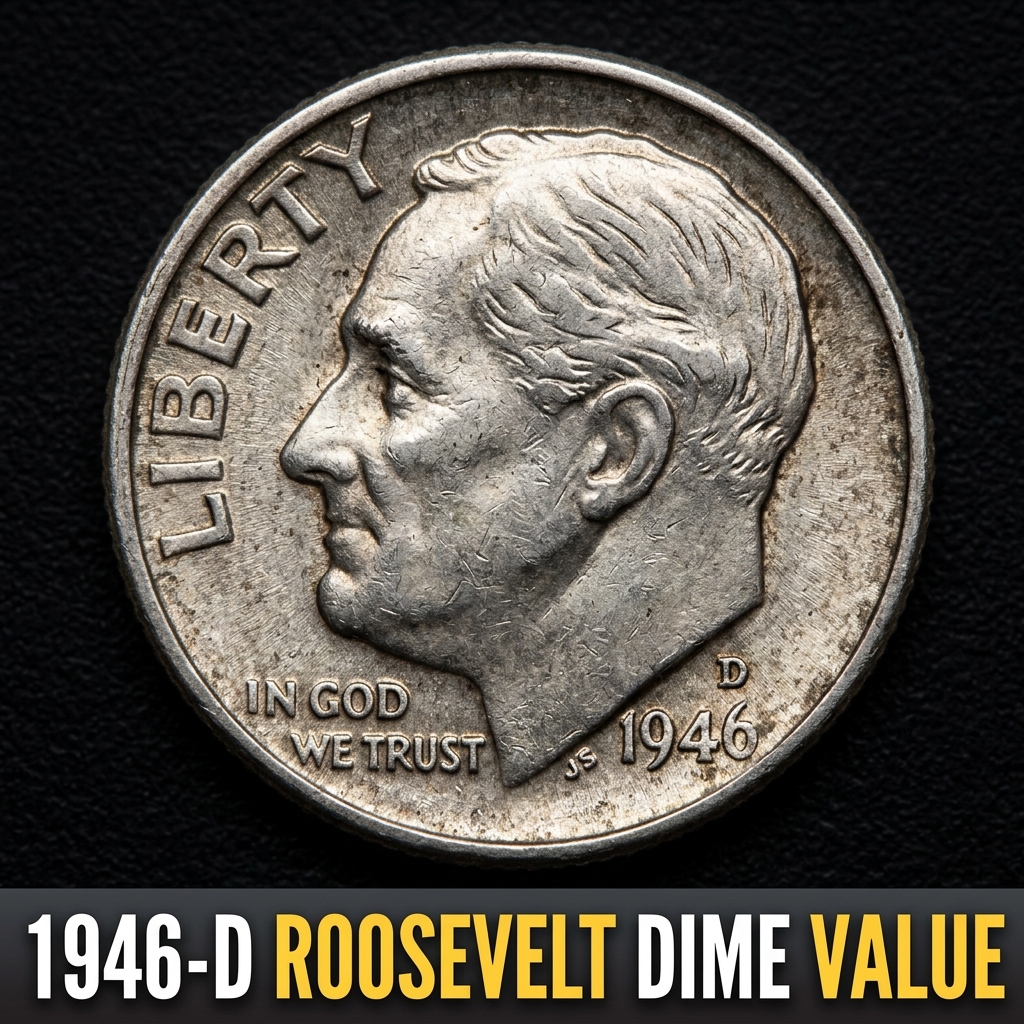
1946-D Roosevelt Dime Value What It’s Worth and Why Collectors Love It

Your Old Coin Could Be Valuable!
Identify It & Know Its Real Value — Free Download


The 1946-D Roosevelt Dime is worth anywhere from $2 in heavily worn condition to over $30 or more in uncirculated grades — and top-tier specimens can fetch well above $100 at auction. If you found one of these silver dimes in an old jar, a coin roll, or a family collection, you’re holding a piece of American history that’s definitely worth a closer look.
What Makes the 1946-D Roosevelt Dime Special
The 1946-D Roosevelt Dime was struck at the Denver Mint and carries the small “D” mintmark on the reverse, just to the left of the torch. It was the very first year the Roosevelt Dime was minted — introduced to honor President Franklin D. Roosevelt, who had passed away in April 1945.
This dime is composed of 90% silver, which means even a worn example has real melt value. With silver prices fluctuating, the coin’s intrinsic silver content alone makes it worth holding onto. Collectors and everyday folks alike have good reason to pay attention to this coin.
The Denver Mint produced 61,043,500 dimes in 1946, making the 1946-D a relatively available coin. But availability doesn’t mean all examples are equal — condition plays a huge role in determining what your coin is actually worth.
Your Old Coin Could Be Valuable!
Identify It & Know Its Real Value — Free Download
If you’re not sure what you’ve got, using a coin identifier and value app can help you quickly figure out the mint year, mintmark, and estimated grade right from your phone — no coin shop trip required.
How Condition Affects the 1946-D Dime Value
Coin grading can sound intimidating, but it really just comes down to how much wear a coin has. Numismatists use a scale from 1 to 70, where higher numbers mean better condition. For the 1946-D Roosevelt Dime, here’s a general breakdown of what you might expect:
Your Old Coin Could Be Valuable!
Identify It & Know Its Real Value — Free Download
| Grade | Condition Description | Estimated Value |
|---|---|---|
| Good (G-4) | Heavy wear, major details visible | $2 – $3 |
| Fine (F-12) | Moderate wear, lettering clear | $3 – $5 |
| Extremely Fine (EF-40) | Light wear on high points | $5 – $10 |
| Uncirculated (MS-63) | No wear, some minor contact marks | $15 – $30 |
| Gem Uncirculated (MS-65) | Sharp strike, strong luster | $30 – $80+ |
| MS-67 or Higher | Near-perfect, exceptional eye appeal | $100 – $500+ |
For the most up-to-date pricing across grades, you can check current 1946-D Roosevelt Dime auction prices and certified coin sales data to see what real buyers are paying right now.
Silver Content and Melt Value
One thing many people don’t realize is that pre-1965 dimes — including the 1946-D — are 90% silver. Each dime contains approximately 0.07234 troy ounces of pure silver. That means even a beat-up 1946-D has inherent precious metal value beyond its face value of ten cents.
Your Old Coin Could Be Valuable!
Identify It & Know Its Real Value — Free Download
When silver trades around $25–$30 per ounce, the melt value of a single Roosevelt Dime comes out to roughly $1.80 to $2.20. It doesn’t sound like much, but if you’ve got a roll of old silver dimes, the numbers add up fast.
This is why it’s always worth checking silver dimes before spending them or tossing them in a change jar. Even pocket change could be silver if it was minted before 1965.
CoinKnow is a great resource if you want a quick reference for silver coin melt values alongside historical pricing — it’s built for everyday collectors who want real answers without wading through pages of technical jargon.
Your Old Coin Could Be Valuable!
Identify It & Know Its Real Value — Free Download
Full Band Designations and Key Varieties
If your 1946-D Roosevelt Dime looks especially sharp under a magnifier, pay attention to the horizontal bands on the reverse torch. When all three bands are fully struck and distinctly separated, the coin can earn a “Full Bands” (FB) designation from grading services like PCGS or NGC.
Full Bands examples are considerably rarer and command noticeable premiums. An MS-65 Full Bands 1946-D, for instance, can easily be worth two to three times more than a standard MS-65.
There are no major error coins widely documented for the 1946-D, but always check for doubling on the lettering or date using a loupe. Repunched mintmarks and minor die varieties do exist and can add small but meaningful premiums to collector value.
For a thorough look at 1946 Roosevelt Dime values across all mint marks and grades, dedicated coin value guides break everything down in an easy-to-follow format — perfect if you’re just getting started.
Your Old Coin Could Be Valuable!
Identify It & Know Its Real Value — Free Download
How to Get the Best Price for Your 1946-D Dime
If you think you have a high-grade 1946-D Roosevelt Dime, consider having it professionally graded by PCGS or NGC. A certified coin in a tamper-evident slab sells for more and gives buyers confidence in the grade.
For circulated examples worth a few dollars, selling to a local coin dealer or at a coin show is typically the easiest route. Online marketplaces like eBay are also an option — just search completed sales to get a realistic sense of what buyers are paying.
CoinKnow and similar apps can give you an instant ballpark before you walk into any negotiation, so you don’t leave money on the table. Knowledge really is the best tool for any collector or seller.
—
Your Old Coin Could Be Valuable!
Identify It & Know Its Real Value — Free Download
FAQ
Q: Is the 1946-D Roosevelt Dime made of silver?
A: Yes. The 1946-D Dime is composed of 90% silver and 10% copper, just like all Roosevelt Dimes minted before 1965. Its silver content gives it real intrinsic value above and beyond face value.
Q: How do I find the mintmark on a 1946-D Dime?
A: Flip the coin over to the reverse side. Look to the left of the torch design, just above the “E” in “ONE.” You’ll see a small “D” — that’s the Denver Mint mark.
Q: What makes a 1946-D Roosevelt Dime more valuable than average?
A: The biggest value drivers are condition (higher grades are worth much more), Full Bands designation on the torch, and overall eye appeal. Coins in MS-65 FB or better grades fetch the highest premiums. CoinKnow can help you understand these distinctions quickly if you’re new to coin grading.