Franklin Half Dollars Worth the Most Money and What Yours Might Be Worth Today

Your Old Coin Could Be Valuable!
Identify It & Know Its Real Value — Free Download


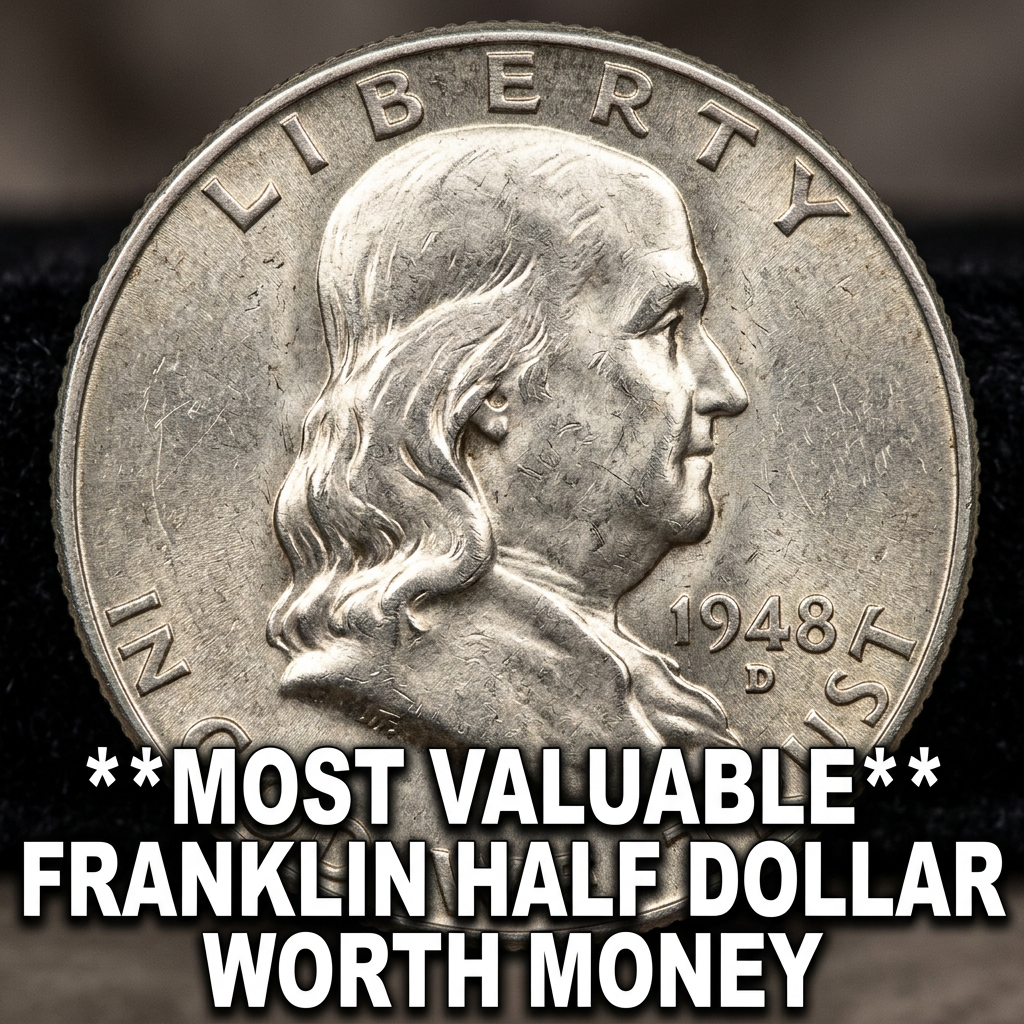
The Franklin Half Dollar is worth anywhere from $10 in heavily worn condition to over $15,000 or more for rare mint-state examples — and if you’ve got a few of these silver coins sitting in a drawer, you might be holding onto real money without even knowing it. Minted from 1948 to 1963, these 90% silver coins are beloved by collectors and valuable to anyone who finds them.
If you’re not sure what you’ve got, a coin identifier and value app can help you quickly scan and identify your coins at home before you decide what to do with them. It’s one of the easiest first steps any coin finder can take.
—
Why Franklin Half Dollars Are Worth Collecting
The Franklin Half Dollar series ran for just 16 years, from 1948 to 1963, making it one of the shorter-lived U.S. coin series. Each coin contains 0.3617 troy ounces of pure silver, which alone gives every Franklin Half a baseline “melt value” of around $8–$10 depending on the silver spot price.
But silver content is just the floor, not the ceiling. Condition, mint mark, and the presence of what collectors call “Full Bell Lines” (FBL) — crisp, unbroken lines on the Liberty Bell on the reverse — can dramatically push values higher.
Your Old Coin Could Be Valuable!
Identify It & Know Its Real Value — Free Download
Collectors love this series because it’s old enough to be genuinely historic, short enough to be completable, and silver enough to always hold value. Whether you found one in grandma’s coin jar or dug it out of an estate sale box, you could be looking at a coin worth far more than face value.
—
Your Old Coin Could Be Valuable!
Identify It & Know Its Real Value — Free Download
The Most Valuable Franklin Half Dollars You Should Know
Not all Franklin Half Dollars are equal. Some dates and mint marks are significantly rarer than others, and condition is everything when it comes to top dollar values.
Here’s a look at the most valuable Franklin Half Dollars by date, mint mark, and grade:
| Year & Mint Mark | Circulated Value | MS63 Value | MS65 FBL Value |
|---|---|---|---|
| 1948 (Philadelphia) | $10–$15 | $50–$80 | $400+ |
| 1949-S | $12–$18 | $80–$120 | $2,500+ |
| 1950 (Philadelphia) | $10–$14 | $40–$60 | $15,000+ |
| 1955 (Philadelphia) | $12–$20 | $100–$200 | $4,500+ |
| 1963-D | $10–$13 | $30–$50 | $300+ |
The 1950 Philadelphia Franklin Half Dollar in MS65 FBL is arguably the king of the series. With relatively few surviving in top grade with full bell lines, this coin regularly sells for five figures at major auctions.
You can explore detailed Franklin Half Dollar price data by year and grade to see how your specific coin stacks up in today’s market.
Your Old Coin Could Be Valuable!
Identify It & Know Its Real Value — Free Download
—
What “Full Bell Lines” Means and Why It Matters So Much
If you’ve done any research on Franklin Half Dollars, you’ve almost certainly seen the abbreviation FBL — and it’s not just collector jargon. Full Bell Lines is one of the most important value factors in the entire series.
The Liberty Bell on the reverse of the coin has a series of horizontal lines near its base. On most struck coins, the dies wore down quickly, causing those lines to appear faint, broken, or missing entirely. A coin with Full Bell Lines means those lines are sharp, complete, and unbroken — proof of a strong, early die strike.
Your Old Coin Could Be Valuable!
Identify It & Know Its Real Value — Free Download
The difference in value between a regular MS65 and an MS65 FBL can be 10x or even 20x. That’s not a typo. A coin worth $150 in regular MS65 might fetch $1,500 or more with the FBL designation. This is exactly the kind of detail that separates a casual find from a real discovery. CoinKnow can help you identify key markers like this quickly so you don’t accidentally undersell a premium coin.
—
How to Check the Condition and Grade of Your Franklin Half Dollar
Grading coins accurately takes experience, but you can get a general idea at home with a few simple steps. First, look at the coin under good lighting — natural light or a focused lamp works well. The high points of Franklin’s portrait (cheekbone, hair above the ear) and the bell surface are the first areas to show wear.
A coin in “Good” condition will have flat, worn features and little detail remaining. “Very Fine” coins show moderate wear with most detail visible. Anything in “Mint State” means the coin was never circulated and retains its original luster.
If you want a ballpark value based on condition, apps like CoinKnow make grading accessible for beginners — just photograph the coin and let the app guide you through its features. For anyone serious about selling, professional grading through PCGS or NGC is worth the cost, especially for coins that might carry the FBL premium.
Your Old Coin Could Be Valuable!
Identify It & Know Its Real Value — Free Download
—
Where to Sell Your Franklin Half Dollars
Once you know what you have, you’ll want to get the best price for it. For lower-grade circulated coins, silver buyers and coin dealers will typically pay close to melt value. For higher-grade pieces — especially anything MS63 and above — you’re better off going through a coin auction platform or direct sale to a serious collector.
eBay remains one of the most active markets for Franklin Half Dollars, and completed sales give you a real-time sense of what buyers are actually paying. You can also find a full breakdown of which half dollars are worth the most money to help you prioritize which coins in your collection deserve closer attention.
For rare, high-grade pieces with FBL designation, consider submitting to a major numismatic auction house like Heritage Auctions or Stack’s Bowers, where serious collectors actively compete for top-tier examples. CoinKnow users often use the app to document and organize their coins before going to market — a smart step before any sale.
Your Old Coin Could Be Valuable!
Identify It & Know Its Real Value — Free Download
—
FAQ
Q: Are all Franklin Half Dollars made of silver?
A: Yes. Every Franklin Half Dollar minted from 1948 to 1963 is composed of 90% silver and 10% copper. This means even a heavily worn example is worth at least its silver melt value, which fluctuates with the silver spot price but is typically around $8–$12 per coin.
Q: What does FBL mean on a Franklin Half Dollar?
A: FBL stands for Full Bell Lines. It refers to the sharpness of the horizontal lines at the base of the Liberty Bell on the coin’s reverse. Coins with complete, unbroken bell lines are rare and often worth significantly more than coins without this designation — sometimes 10 to 20 times as much.
Q: How do I know if my Franklin Half Dollar is valuable?
A: Start by checking the date and mint mark (look for a small D or S below the Liberty Bell for Denver or San Francisco mint). Then assess the condition — the better the detail and luster, the higher the value. Key dates like 1950-P, 1955-P, and 1949-S in high grades command the strongest premiums. A coin identifier app or professional grader can give you a more precise answer.