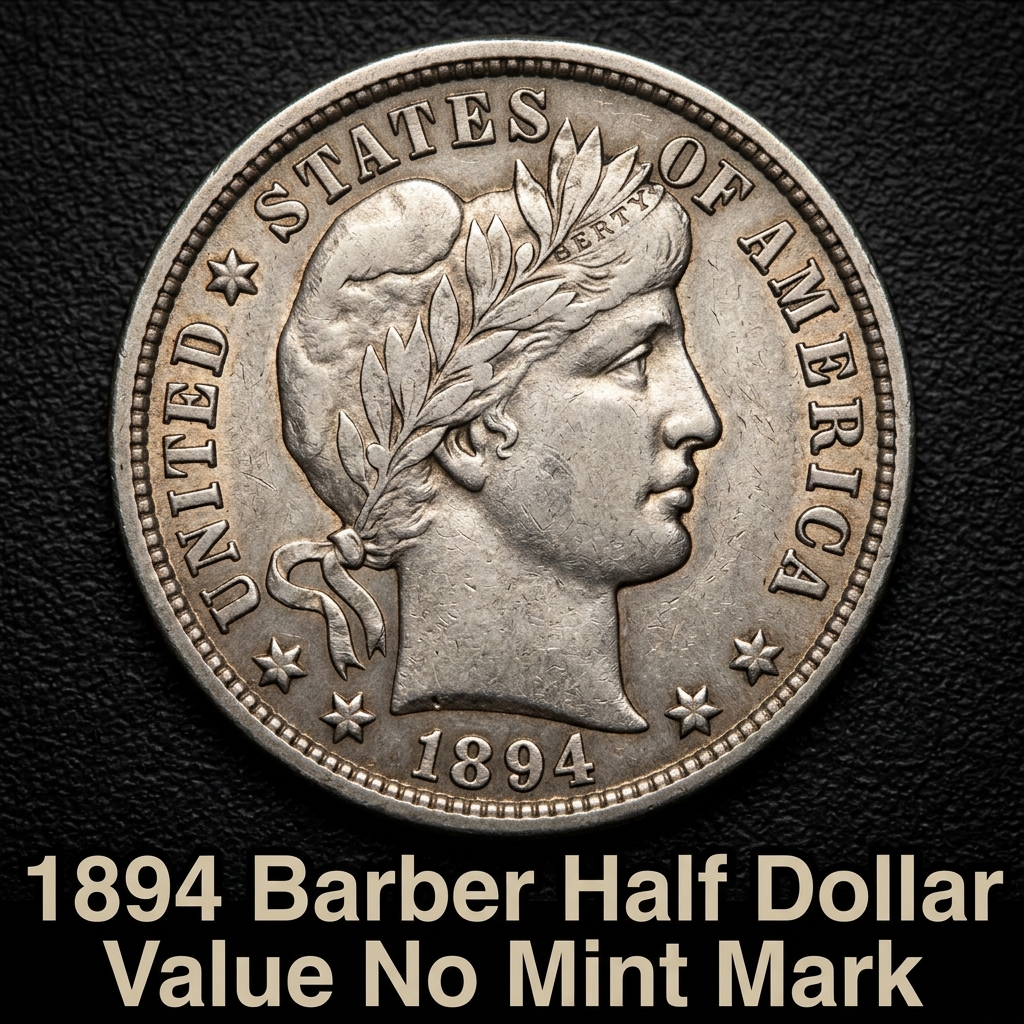
1894 Barber Half Dollar Value No Mint Mark What Is It Worth Today

Your Old Coin Could Be Valuable!
Identify It & Know Its Real Value — Free Download


The 1894 Barber Half Dollar with no mint mark is worth anywhere from $20 in heavily worn condition to over $1,500 or more in high mint state grades. If you’ve found one of these silver coins tucked away in an old collection or inherited from a relative, you’re holding a piece of American history that could be worth a meaningful amount of money.
What Is the 1894 Barber Half Dollar No Mint Mark
The 1894 Barber Half Dollar was struck at the Philadelphia Mint, which is why it carries no mint mark. Designed by Chief Engraver Charles E. Barber, this coin features Lady Liberty in a Greco-Roman helmet on the obverse and a heraldic eagle on the reverse.
Philadelphia was the main mint of the era, and it produced 1,148,972 Barber Half Dollars in 1894. While that sounds like a lot, most of these coins entered circulation and got worn down over the decades. Finding one in decent condition today is rarer than you might think.
If you want a quick way to identify and value old coins like this one, a coin identifier and value app can help you scan your coin and get an instant estimate right from your phone.
Your Old Coin Could Be Valuable!
Identify It & Know Its Real Value — Free Download
How Much Is the 1894 Barber Half Dollar Worth by Grade
The value of a Barber Half Dollar depends heavily on its condition, or “grade” in coin collector terms. Coins are graded on a scale from Poor (P-1) all the way to Mint State 70 (MS-70). Here’s a breakdown of estimated values for the 1894 Philadelphia issue:
Your Old Coin Could Be Valuable!
Identify It & Know Its Real Value — Free Download
| Grade | Description | Estimated Value |
|---|---|---|
| G-4 (Good) | Heavily worn, design visible | $20 – $30 |
| VG-8 (Very Good) | Moderate wear, major details clear | $35 – $55 |
| F-12 (Fine) | Even wear, lettering sharp | $70 – $90 |
| VF-20 (Very Fine) | Light wear on high points | $120 – $160 |
| EF-40 (Extremely Fine) | Slight wear, bold detail | $250 – $350 |
| AU-50 (About Uncirculated) | Trace wear, most luster intact | $400 – $550 |
| MS-60 (Mint State) | No wear, possible bag marks | $700 – $900 |
| MS-63 and above | Sharp strike, strong luster | $1,200 – $1,800+ |
Keep in mind these are retail estimates. Actual sale prices can vary depending on eye appeal, originality of the surfaces, and demand at the time of sale.
What Makes a 1894 Barber Half Dollar More Valuable
Not all 1894 Barber Half Dollars are created equal. Several factors can push the value of your coin higher than the averages shown above.
Your Old Coin Could Be Valuable!
Identify It & Know Its Real Value — Free Download
Original luster is one of the most important factors. A coin that has never been cleaned and retains its original silver surfaces will always command a premium. Unfortunately, many Barber Half Dollars were cleaned by well-meaning previous owners, which actually reduces their value significantly to experienced collectors.
Strike quality also matters. Some Philadelphia coins from this era were weakly struck, showing soft details in the hair above Liberty’s ear or in the eagle’s feathers. A sharply struck example stands out and attracts stronger bids at auction.
Eye appeal — a term dealers use for the overall look of the coin — can add or subtract value in ways that aren’t fully captured by grade alone. If your coin has pleasant, original toning and no distracting marks, it’s worth more than a technically similar coin that looks flat or unappealing.
Your Old Coin Could Be Valuable!
Identify It & Know Its Real Value — Free Download
Silver Melt Value and Why It Matters
The 1894 Barber Half Dollar is made of 90% silver and contains 0.3617 troy ounces of pure silver. Even the most worn example has a floor in value tied to the silver market.
With silver prices fluctuating around $25–$30 per troy ounce in recent times, the melt value alone sits around $9 to $11. This means even a heavily worn 1894 Barber Half Dollar is worth at least twice its melt value as a collectible, and often much more.
For more context on how silver coin values from this period compare to other late 19th-century issues, check out this guide to 1894 Morgan Dollar value, which was struck the same year and also carries strong collector demand.
Your Old Coin Could Be Valuable!
Identify It & Know Its Real Value — Free Download
How to Get an Accurate Value for Your Coin
If you’re serious about knowing what your 1894 Barber Half Dollar is worth, there are a few reliable steps to take.
First, compare your coin’s details to photos in a grading guide or reference book. Look at the high points — Liberty’s cheek, the top of the helmet, and the eagle’s breast feathers — to assess wear. Next, consider submitting your coin to a professional grading service like PCGS or NGC if it appears to be in EF or better condition. A certified grade can significantly increase buyer confidence and final sale price.
CoinKnow is a great tool to start with if you want a quick, no-hassle estimate at home. The CoinKnow app lets you photograph your coin and get an instant value range based on current market data, making it one of the easiest ways for everyday collectors to get oriented before heading to a dealer or auction.
—
Your Old Coin Could Be Valuable!
Identify It & Know Its Real Value — Free Download
Frequently Asked Questions
Q: How do I know if my 1894 Barber Half Dollar is from Philadelphia if there’s no mint mark?
A: That’s actually the point — the absence of a mint mark confirms it was made in Philadelphia. Only coins from branch mints like New Orleans (O), San Francisco (S), or New Orleans carried mint marks during this period.
Q: Is a cleaned 1894 Barber Half Dollar still worth collecting?
A: Yes, but it’s worth less than an uncleaned example of the same grade. Cleaning removes original luster and surface metal, which experienced collectors and graders can easily detect. A cleaned coin in VF condition might sell for 30–50% less than a problem-free example.
Q: Where is the best place to sell a 1894 Barber Half Dollar no mint mark?
A: Options include eBay, local coin shops, estate auction houses, and major coin shows. For higher-grade examples (EF-40 and above), a certified coin (PCGS or NGC slabbed) sold through auction typically brings the strongest price. CoinKnow can also help you understand your coin’s value before you commit to selling anywhere.