1897-O Morgan Dollar Value: Worth More Than You Think?

Your Old Coin Could Be Valuable!
Identify It & Know Its Real Value — Free Download


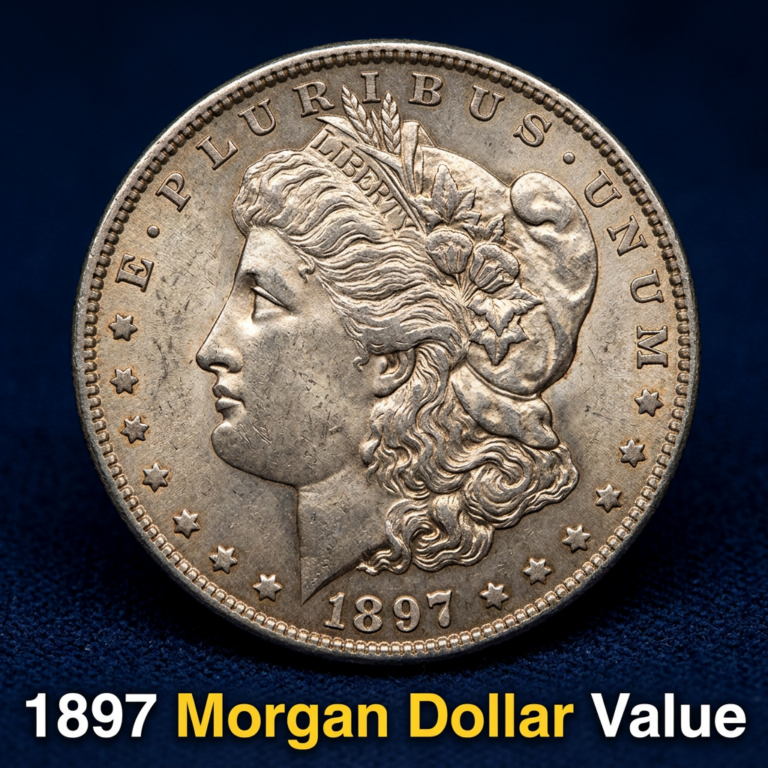
The 1897-O Morgan Dollar is worth anywhere from $35 in worn condition to over $35,000 in rare, high-grade mint state. Finding this New Orleans minted silver dollar in your attic or a family collection is an exciting discovery because it is considered a classic “condition rarity” among collectors.
| Condition | Estimated Value |
|---|---|
| Good (G-4) | $35 – $40 |
| Very Fine (VF-20) | $65 – $80 |
| Extremely Fine (XF-40) | $150 – $250 |
| About Uncirculated (AU-50) | $550 – $800 |
| Mint State (MS-60+) | $2,000 – $35,000+ |
Understanding the 1897-O Morgan Silver Dollar
If you have just inherited an old silver dollar or found one in a drawer, you might be holding a piece of American history. The 1897-O Morgan Dollar was struck at the legendary New Orleans Mint, identifiable by the small “O” mint mark on the reverse side. During the late 19th century, these large silver coins were the workhorses of the American economy. While millions were minted, most went directly into circulation, meaning they were passed from hand to hand, suffering wear and tear for decades.
For modern-day finders, the biggest question is always about the price. To get an instant estimate, many people turn to a top coin identifier and value app which can help distinguish a common circulated coin from a rare high-grade specimen. Using an app like CoinKnow allows you to snap a photo and immediately see if your coin has those sharp details that collectors crave.
The 1897-O is particularly famous in the numismatic world because it is relatively common in low grades but incredibly difficult to find in “Mint State” (perfect, uncirculated condition). This makes it a “condition rarity.” While a heavily worn 1897-O might only buy you a nice dinner, a pristine version could potentially pay off a car loan or contribute to a house down payment.
Your Old Coin Could Be Valuable!
Identify It & Know Its Real Value — Free Download
Key Identification and the New Orleans Mint Mark
The first step in valuing your coin is confirming it was actually made in New Orleans. Flip the coin over to the “tails” side. Look just above the letters “DO” in the word “DOLLAR.” If you see a small, round “O,” it was minted in Louisiana. If it’s blank, it was minted in Philadelphia; an “S” signifies San Francisco. The “O” is what makes this specific year so volatile in the market.
Collectors often look for specific strike qualities. Historically, the New Orleans Mint was notorious for producing coins with “weak strikes.” This means that even if a coin wasn’t used much, the details—like the hair above Lady Liberty’s ear or the feathers on the eagle’s breast—might look a bit flat. Because of this, finding a sharp, well-struck 1897-O is like finding a needle in a haystack.
Your Old Coin Could Be Valuable!
Identify It & Know Its Real Value — Free Download
To check the current market trends, you can look up the 1897-O Morgan Dollar price guide to see how recent auctions have performed. Often, the difference between a grade of AU-58 and MS-60 is just a few tiny scratches, but that difference can represent thousands of dollars in market value.
| Mint Mark | Mintage Total | Rarity Level |
|---|---|---|
| 1897 (Plain – Philly) | 2,822,000 | Common |
| 1897-S (San Francisco) | 4,000,000 | Common |
| 1897-O (New Orleans) | 4,004,000 | Rare in High Grade |
How Grading Affects the 1897-O Price
When determining value, “grading” is the most important factor. Grading is a scale from 1 to 70 used by professionals to describe a coin’s condition. For the everyday American who found a coin, you don’t need to be an expert to get a general idea. If Liberty’s face is smooth and the eagle’s wings are worn flat, the coin is likely in “Good” or “Very Fine” condition. These are worth roughly $35 to $80.
However, if you see original mint luster—that “spinning” light effect when you rotate the coin under a lamp—you might have something special. Once a 1897-O reaches the “Uncirculated” level, the price jumps exponentially. This is where using CoinKnow can be a lifesaver, as it helps you identify if the luster is original or if the coin has been “cleaned.” Never clean your coins! Cleaning a rare dollar actually destroys its numismatic value.
Your Old Coin Could Be Valuable!
Identify It & Know Its Real Value — Free Download
High-grade examples (MS-63 and above) are so rare that they are mostly sold at major auction houses. For a more detailed breakdown of these tiers, you can review the 1897 Morgan Silver Dollar value chart, which highlights how the New Orleans version stays ahead of its Philadelphia and San Francisco counterparts in high grades.
Is Your 1897-O Dollar a Proof-Like or Deep Mirror Proof-Like?
One of the “hidden gems” of the Morgan series is the Proof-Like (PL) or Deep Mirror Proof-Like (DMPL) designation. Though these weren’t special “proof” coins made for collectors, some of the very first coins struck from brand-new, polished dies came out with reflective, mirror-like backgrounds.
For an 1897-O, a DMPL coin is the ultimate prize. Because the New Orleans mint usually had lower quality control, finding surfaces that look like a black-and-white mirror is extremely uncommon. If your coin looks exceptionally shiny and you can see a clear reflection in the “fields” (the flat parts), it might be worth double or triple the standard price for that grade.
Your Old Coin Could Be Valuable!
Identify It & Know Its Real Value — Free Download
Using an app like CoinKnow can help you compare your coin’s surface to known examples of Proof-Like 1897-Os. If you think you have one, it is definitely worth sending to a professional grading service like PCGS or NGC. A certified MS-63 DMPL 1897-O can easily fetch over $10,000 at auction.
| Grade Designation | Bonus Value |
|---|---|
| Standard (No special finish) | Base Market Value |
| Proof-Like (PL) | +50% to 100% Value |
| Deep Mirror Proof-Like (DMPL) | +200% to 500% Value |
Common Errors and Varieties to Watch For
While the 1897-O doesn’t have a famous “doubled die” like some other years, there are various VAM varieties (named after researchers Van Allen and Mallis) that can add value. VAM varieties involve small differences in the date, the mint mark, or the “clashing” of dies.
Some 1897-O coins show a “pitted” reverse or “doubled stars” on the front. While these usually interest only specialized collectors, they can occasionally push the price up by 10-20% for a motivated buyer. Most everyday finders should focus on the condition first, as a high-grade 1897-O without errors is already worth more than most error coins from other years.
The most important thing to “look for” is actually what not to see: signs of damage. Holes, deep scratches (graffiti), or harsh cleaning will significantly lower the price, regardless of how rare the New Orleans mint mark is. Always handle your silver dollars by the edges to prevent oils from your skin from tarnishing the surface.
Your Old Coin Could Be Valuable!
Identify It & Know Its Real Value — Free Download
Where to Sell Your 1897-O Morgan Dollar
If you’ve determined that your coin is in the “Good” to “About Uncirculated” range, you have several options for selling. A local coin shop is the fastest way to get cash. However, keep in mind that a dealer needs to make a profit, so they will likely offer you about 60-70% of the retail value.
For high-end 1897-O dollars, especially those that look uncirculated, professional auction houses like Heritage Auctions or Stacks Bowers are better routes. These venues reach serious collectors who are willing to pay top dollar for the “New Orleans rarity.”
Before you sell, make sure you have a firm grasp of the value. Utilize tools and apps to get multiple opinions. The 1897-O remains one of the most respected coins in the Morgan series because of its grit and history. Whether it’s a $40 treasure or a $40,000 lottery ticket, it is a significant piece of the American story.
FAQ
Q: Why is the 1897-O so much more expensive than the 1897-P in high grades?
A: While the 1897-P (Philadelphia) was often stored in bank vaults in bags, keeping them pristine, the 1897-O was mostly released into circulation. Additionally, the New Orleans Mint had quality issues that year, making high-grade, well-struck examples incredibly scarce today.
Your Old Coin Could Be Valuable!
Identify It & Know Its Real Value — Free Download
Q: How can I tell if my 1897-O silver dollar is real?
A: Real Morgan Dollars are made of 90% silver and 10% copper. They should weigh approximately 26.73 grams and have a diameter of 38.1mm. If your coin is magnetic, it is definitely a fake. Using a reputable identification app can also help flag common counterfeits.
Q: I cleaned my coin with silver polish; did I ruin it?
A: Yes, in the eyes of a collector, cleaning a coin with chemicals or abrasives is considered “damage.” It strips away the original “skin” and luster of the metal. If the coin was worth $1,000 before, it might only be worth its silver weight ($25-$30) after cleaning.
Q: What is the “O” mint mark exactly?
A: It is a small letter “O” located on the back of the coin, below the eagle’s tail feathers and above the “DO” in Dollar. It stands for the New Orleans Mint, which operated in Louisiana from 1838 to 1909.