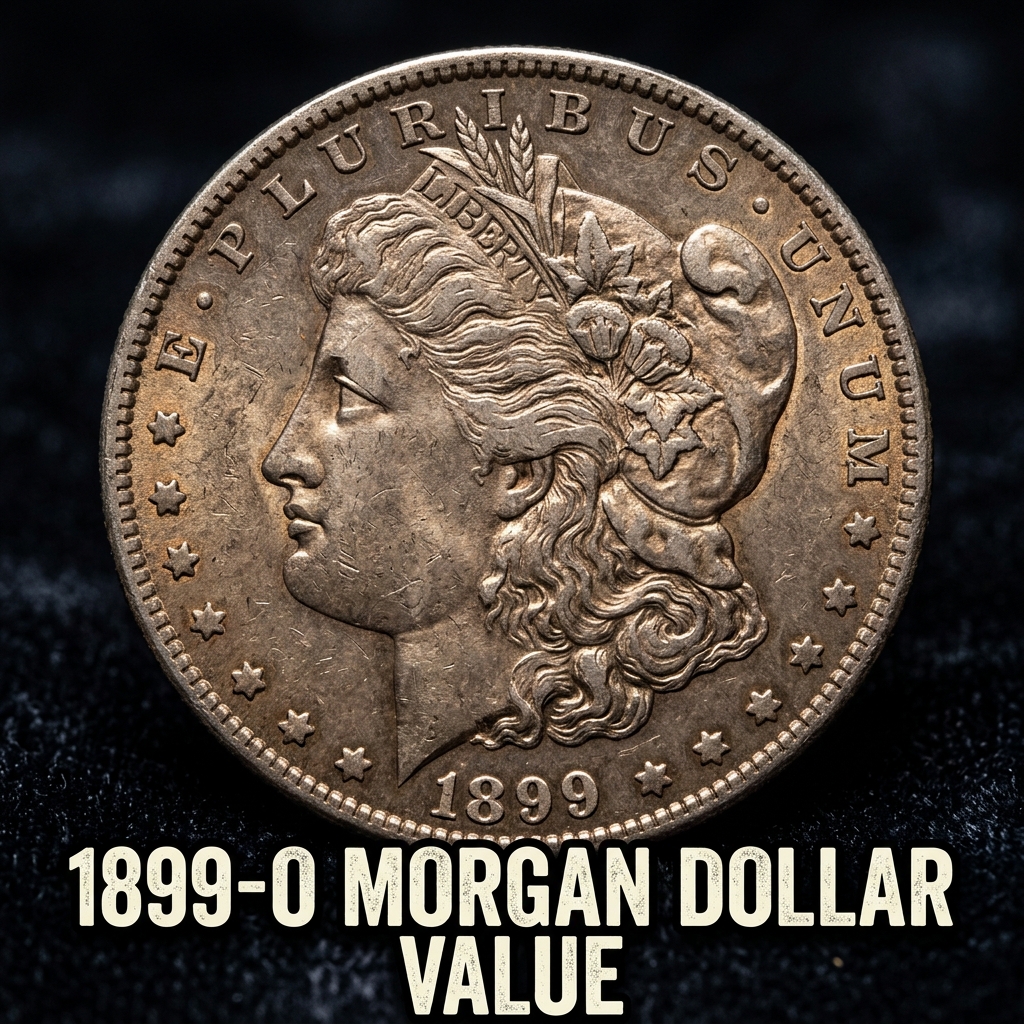
1899-O Morgan Dollar Value Guide What It’s Worth and Why Collectors Care

Your Old Coin Could Be Valuable!
Identify It & Know Its Real Value — Free Download


The 1899-O Morgan Dollar is worth anywhere from $30 in heavily worn condition to well over $1,000 or more in high mint state grades — and rare varieties can push that number even higher. If you found one of these silver coins in an old drawer or inherited collection, you’re holding something genuinely interesting. Let’s break down exactly what you have and what it might be worth.
What Is the 1899-O Morgan Dollar?
The 1899-O Morgan Dollar was struck at the New Orleans Mint, which is what the “O” mintmark stands for. You’ll find that mintmark on the reverse side of the coin, just above the “DO” in “DOLLAR.” This coin is part of the famous Morgan Dollar series, designed by George T. Morgan and minted from 1878 to 1904, then again briefly in 1921.
New Orleans was a major mint during this era, and the 1899-O had a healthy mintage of around 12,290,000 coins. That’s not a rare coin by mintage alone, but surviving examples in good condition — especially uncirculated ones — are far less common than you’d expect.
If you want a quick estimate without doing all the research yourself, a coin identifier and value app can scan your coin and give you an instant grade estimate and market value range right from your phone. Tools like CoinKnow make this process remarkably simple for everyday collectors and first-time finders alike.
Your Old Coin Could Be Valuable!
Identify It & Know Its Real Value — Free Download
How Much Is the 1899-O Morgan Dollar Worth?
Value depends heavily on the coin’s condition, which is graded on a scale from Poor (P-1) all the way to Perfect Mint State (MS-70). A coin that’s been circulated and shows heavy wear is worth far less than one that looks like it just left the mint.
Here’s a general value table to give you a clear picture:
Your Old Coin Could Be Valuable!
Identify It & Know Its Real Value — Free Download
| Grade | Description | Approximate Value |
|---|---|---|
| Good (G-4) | Heavy wear, flat details | $30 – $40 |
| Fine (F-12) | Moderate wear, some detail visible | $40 – $55 |
| Very Fine (VF-20) | Light to moderate wear | $55 – $75 |
| Extremely Fine (EF-40) | Slight wear on high points | $75 – $100 |
| About Uncirculated (AU-50) | Trace wear, original luster | $100 – $150 |
| Mint State (MS-63) | Uncirculated, minor marks | $175 – $350 |
| Mint State (MS-65) | Gem uncirculated | $600 – $1,200+ |
For the most up-to-date auction results and dealer prices, you can check current 1899-O Morgan Dollar mint state price data to see how recent sales are trending in today’s market.
Your Old Coin Could Be Valuable!
Identify It & Know Its Real Value — Free Download
What Affects the 1899-O Morgan Dollar’s Value Most?
Beyond grade, a few other factors can move the needle significantly on what your coin is worth.
Strike quality matters a lot with New Orleans Mint coins. The “O” mint was known for producing coins with weaker strikes compared to Philadelphia or San Francisco. A sharply struck 1899-O is considered a premium coin and can command higher prices even within the same grade.
Luster and eye appeal also play a major role. Coins with original mint luster — that brilliant, cartwheel-like shine you see when you tilt the coin — are worth more than dull or cleaned examples. Never clean a coin, as it will permanently damage the surface and reduce its value.
Your Old Coin Could Be Valuable!
Identify It & Know Its Real Value — Free Download
VAM varieties (varieties attributed by Van Allen and Mallis) are another factor for serious collectors. Some 1899-O VAMs with die doubling or unusual die characteristics are actively sought and can fetch premiums. If you suspect you have a VAM variety, it’s worth getting a closer look through a magnifier or submitting to a grading service like PCGS or NGC.
Is the 1899-O a Good Coin to Hold Onto?
For most people, the 1899-O Morgan Dollar is more than just a silver coin — it’s a piece of American history. With 90% silver content, even a well-worn example carries real melt value (currently around $20–$25 depending on silver prices). That puts a natural floor on what the coin is worth.
In higher grades, the coin has shown steady collector demand over the decades. Morgan Dollars remain one of the most collected American coin series, and the New Orleans issues have a loyal following.
If you’re not sure whether to sell or hold, you can explore detailed 1899 silver dollar value information to compare your coin’s condition against sold examples. Apps like CoinKnow are also a great resource for tracking market trends and getting a second opinion on what your coin is worth right now.
Your Old Coin Could Be Valuable!
Identify It & Know Its Real Value — Free Download
How to Get the Most Accurate Value for Your 1899-O Morgan Dollar
If you want to know the true value of your coin, the best steps are straightforward. First, examine the coin carefully under good lighting to assess wear. Look at Lady Liberty’s cheek, hair above the ear, and the eagle’s breast feathers — those are the first areas to show wear.
Second, check if the coin has been cleaned. A dull, washed-out look or hairline scratches under magnification are telltale signs of cleaning, which hurts value significantly.
Third, consider professional grading through PCGS or NGC if your coin appears to be uncirculated. The grading fee pays off quickly on a coin that grades MS-63 or better. Certified coins sell for more and are easier to sell with confidence.
Finally, don’t overlook free tools. CoinKnow and similar apps can help you quickly identify your coin, check comparable sales, and decide whether professional grading makes financial sense for what you have.
Your Old Coin Could Be Valuable!
Identify It & Know Its Real Value — Free Download
FAQ
Q: How do I know if my 1899-O Morgan Dollar is genuine?
A: A genuine 1899-O Morgan Dollar weighs 26.73 grams, measures 38.1mm in diameter, and contains 90% silver. You should see a clear “O” mintmark on the reverse above “DOLLAR.” If the coin feels unusually light or the details look mushy, consult a professional or use a coin identification app to cross-reference the design details.
Q: What does the “O” mintmark mean on a Morgan Dollar?
A: The “O” stands for the New Orleans Mint in Louisiana, which operated from 1838 to 1909. New Orleans Mint coins are historically significant and generally popular with collectors, though strike quality from this mint was sometimes inconsistent, which affects individual coin values.
Q: Is it worth getting my 1899-O Morgan Dollar professionally graded?
A: If your coin appears uncirculated or close to it, professional grading is often worth the cost. A coin graded MS-63 or higher by PCGS or NGC can sell for two to three times more than an ungraded example. For circulated coins in Good to Very Fine condition, the grading fee may not be justified unless you suspect a rare VAM variety.