
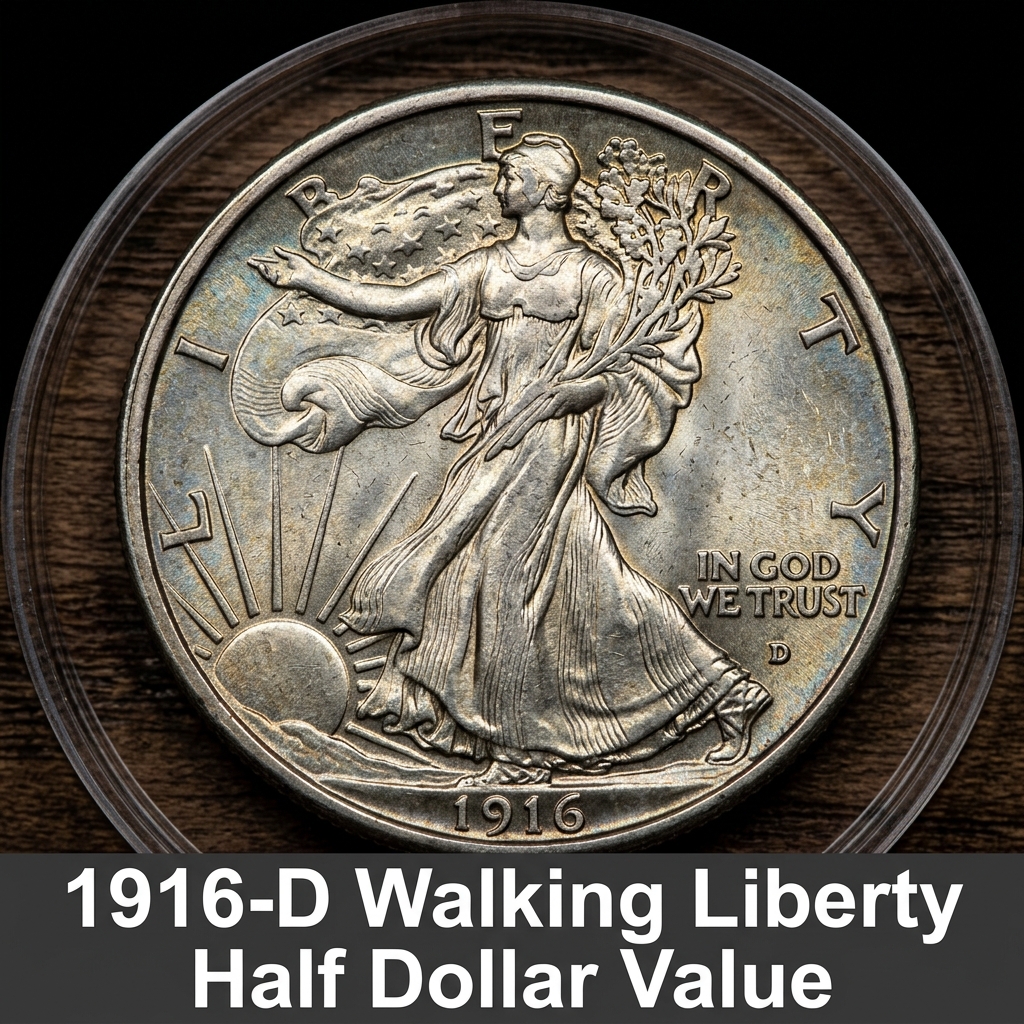
1916-D Walking Liberty Half Dollar Value and What Collectors Are Paying Today

Your Old Coin Could Be Valuable!
Identify It & Know Its Real Value — Free Download


The 1916-D Walking Liberty Half Dollar is worth anywhere from $50 in heavily worn condition to well over $50,000 in top mint state grades — making it one of the most valuable coins from the entire Walking Liberty series. If you’ve come across one of these beautiful silver coins, you’re in for an exciting discovery.
—
What Makes the 1916-D So Special
The Walking Liberty Half Dollar was first struck in 1916, and the Denver Mint version — identified by the “D” mintmark — is one of the key dates in the entire series. Only 1,014,400 examples were produced at the Denver Mint that year, a relatively modest mintage that has kept collector demand high for over a century.
The coin features one of the most celebrated designs in American numismatic history. Adolph Weinman’s depiction of Liberty draped in an American flag, walking toward the sunrise, remains a masterpiece of coin art. The reverse shows a proud eagle perched on a mountain pine — bold, symbolic, and breathtaking even after more than 100 years.
Your Old Coin Could Be Valuable!
Identify It & Know Its Real Value — Free Download
Because of its low mintage and stunning design, the 1916-D Half Dollar attracts serious attention from both beginning collectors and seasoned numismatists alike. If you found one in a grandfather’s old coin collection or tucked away in an estate sale box, it’s worth taking a very close look.
—
How to Check the Value of Your 1916-D Half Dollar
The first thing to do is identify your coin properly. The mintmark “D” appears on the obverse (front) of the coin, near the bottom hem of Liberty’s gown — not on the reverse as on later issues. This is a small but important detail.
Your Old Coin Could Be Valuable!
Identify It & Know Its Real Value — Free Download
Once you’ve confirmed you have a 1916-D, condition (or “grade”) is everything. A coin that looks barely recognizable will be worth far less than one with sharp details and original luster. Using a coin identifier and value app can help you get a quick read on your coin’s grade and estimated worth before you take it to a dealer.
CoinKnow is one popular option — the app lets you photograph your coin and get instant identification and value estimates right from your phone. It’s a great starting point for everyday people who aren’t professional graders.
Your Old Coin Could Be Valuable!
Identify It & Know Its Real Value — Free Download
—
1916-D Walking Liberty Half Dollar Value by Grade
Here’s a general breakdown of what these coins sell for across different grades. Keep in mind that certified coins (graded by PCGS or NGC) typically command higher prices than raw, ungraded examples.
| Grade | Description | Estimated Value |
|---|---|---|
| G-4 (Good) | Heavily worn, major details visible | $50 – $80 |
| VG-8 (Very Good) | Moderate wear, some detail visible | $100 – $160 |
| F-12 (Fine) | Even wear, most details clear | $175 – $250 |
| VF-20 (Very Fine) | Light wear on high points | $300 – $500 |
| EF-40 (Extremely Fine) | Slight wear on highest points | $700 – $1,200 |
| AU-50 (About Uncirculated) | Trace wear, most luster intact | $1,500 – $3,000 |
| MS-60 to MS-63 (Mint State) | No wear, varying contact marks | $5,000 – $20,000 |
| MS-64 and above | Sharp strike, near-perfect surfaces | $25,000 – $55,000+ |
For the most current auction prices and dealer listings, you can review real-time 1916-D Walking Liberty Half Dollar price data by grade to see what coins are actually selling for right now.
Your Old Coin Could Be Valuable!
Identify It & Know Its Real Value — Free Download
—
Silver Content and Melt Value
Even in poor condition, the 1916-D Half Dollar is 90% silver and contains 0.3617 troy ounces of pure silver. That gives it a base melt value that moves with the silver market — typically somewhere between $8 and $15 depending on the current spot price of silver.
That said, never melt a 1916-D. Even the most worn examples carry a significant numismatic premium above their melt value. The coin’s rarity and collector demand make it worth far more than its metal content alone.
If you’re unsure whether your coin is genuine or a later-date Walking Liberty Half, a good reference point is detailed 1916 Half Dollar value information broken down by mint and condition — a helpful resource that covers all three mint varieties from that year.
Your Old Coin Could Be Valuable!
Identify It & Know Its Real Value — Free Download
—
How to Get the Best Price for Your Coin
If you’re thinking about selling, a few tips can help you get top dollar. First, do not clean your coin — even gently wiping it can reduce its value by 30% or more in a collector’s eyes. Leave it exactly as you found it.
Second, consider getting it graded by PCGS or NGC before selling. A certified “slider” in AU-55 or better can sell for significantly more than a raw coin of the same quality, simply because buyers trust the third-party grade.
Finally, use CoinKnow or similar tools to get an independent value estimate before walking into a coin shop. Knowing your coin’s approximate worth ahead of time puts you in a much stronger negotiating position.
—
Your Old Coin Could Be Valuable!
Identify It & Know Its Real Value — Free Download
FAQ
Q: How do I know if my coin is a 1916-D and not a regular 1916?
A: Look for the “D” mintmark on the obverse side of the coin, just above the “1916” date along the lower edge of Liberty’s gown. If there’s no mintmark, it’s the Philadelphia issue. If it shows an “S,” it’s from San Francisco. The Denver “D” is the key date and the most valuable of the three.
Q: Is a 1916-D Walking Liberty Half Dollar worth getting professionally graded?
A: Absolutely, if the coin appears to be in VF condition or better. The cost of PCGS or NGC grading is typically $30–$50 per coin, but a certified AU or Mint State example can sell for thousands more than an ungraded one. It’s well worth the investment for a coin of this caliber.
Q: Where can I sell a 1916-D Half Dollar for the best price?
A: Your best options are major auction houses like Heritage Auctions or Stack’s Bowers, online platforms like eBay (with a strong seller reputation), or established coin dealers who specialize in early American silver. Avoid pawn shops and general antique stores — they rarely offer fair numismatic value for key-date coins like the 1916-D.