
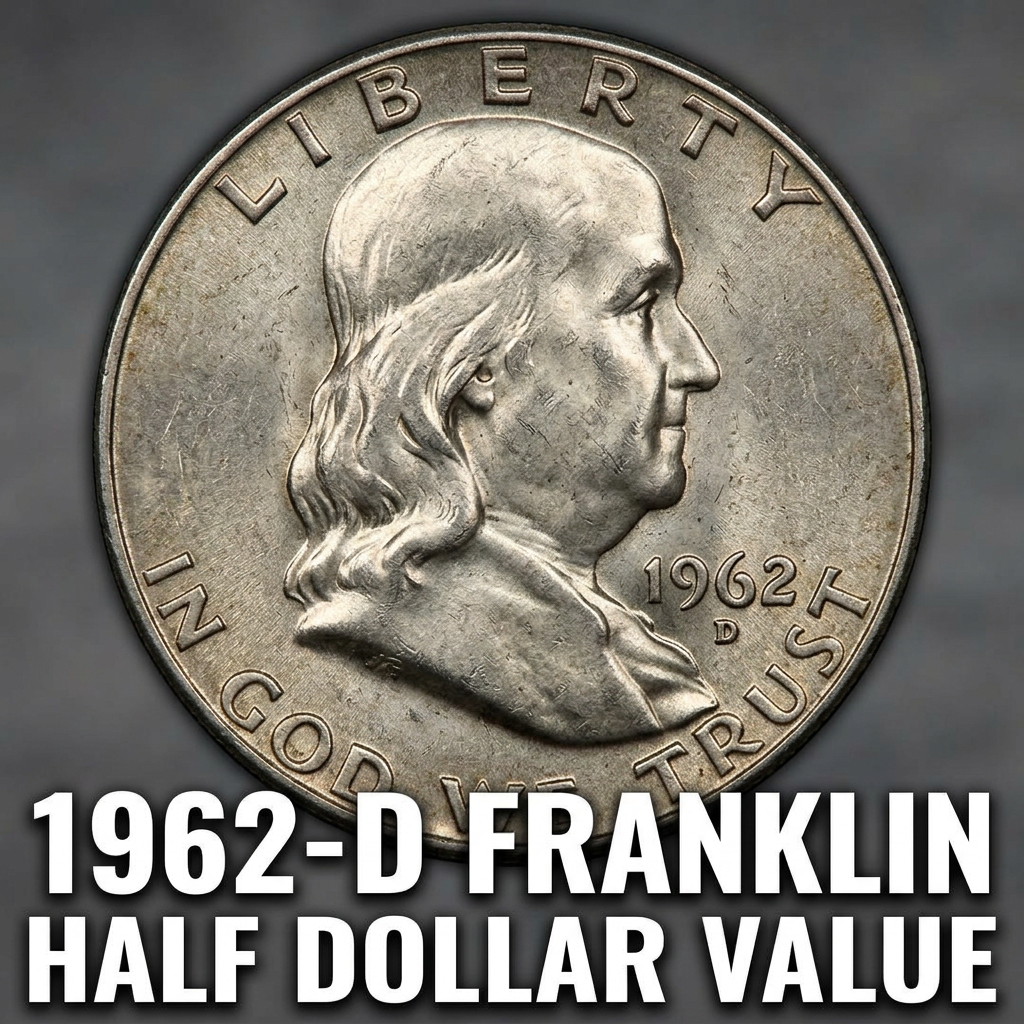
1962-D Franklin Half Dollar Value Guide What This Denver Mint Silver Coin Is Worth Today

Your Old Coin Could Be Valuable!
Identify It & Know Its Real Value — Free Download


The 1962-D Franklin Half Dollar is worth anywhere from $9 to $15 in well-worn condition, but high-grade mint state examples can fetch $50, $100, or even several hundred dollars depending on the quality of the strike and eye appeal. If you found one of these silver beauties tucked away in a drawer or inherited coin collection, you’re in the right place to find out exactly what you’ve got.
What Makes the 1962-D Franklin Half Dollar Special
The 1962-D Franklin Half Dollar was struck at the Denver Mint and carries the small “D” mintmark on the reverse, just above the Liberty Bell. This coin is part of the Franklin Half Dollar series, which ran from 1948 to 1963 — making it one of the final years of production before the Kennedy Half Dollar took over in 1964.
These coins are composed of 90% silver and 10% copper, giving each one an intrinsic metal value regardless of collector grade. With silver prices fluctuating, even a heavily circulated 1962-D is worth something just for the silver content alone.
The Denver Mint produced approximately 35,473,281 of these coins in 1962, making it a relatively common date. That said, condition is everything in the coin world, and a well-struck, lustrous example can still command a solid premium. If you want to quickly check what you have, a coin identifier and value app can be a great first step before you visit a dealer or submit to a grading service.
Your Old Coin Could Be Valuable!
Identify It & Know Its Real Value — Free Download
How Much Is the 1962-D Franklin Half Dollar Worth by Grade
Coin values vary dramatically based on wear, luster, and strike quality. Here’s a breakdown of typical retail values you’d expect to see for the 1962-D Franklin Half Dollar across different grades:
Your Old Coin Could Be Valuable!
Identify It & Know Its Real Value — Free Download
| Grade | Description | Estimated Value |
|---|---|---|
| Good (G-4) | Heavy wear, major details visible | $9 – $10 |
| Very Fine (VF-20) | Moderate wear, design clear | $10 – $12 |
| Extremely Fine (EF-40) | Light wear on high points | $12 – $14 |
| About Uncirculated (AU-55) | Slight wear, most luster intact | $15 – $20 |
| Mint State (MS-63) | No wear, some minor bag marks | $25 – $45 |
| Mint State (MS-65) | Gem quality, strong luster | $60 – $120 |
| MS-65 FBL (Full Bell Lines) | Sharp strike, complete bell lines | $150 – $400+ |
For the most current auction results and certified coin pricing, you can check out the latest 1962-D Franklin Half Dollar MS price data to see what these coins are actually selling for in today’s market.
Your Old Coin Could Be Valuable!
Identify It & Know Its Real Value — Free Download
The Full Bell Lines Designation and Why It Matters
One of the most important factors in valuing a 1962-D Franklin Half Dollar is whether the coin has what graders call “Full Bell Lines” or FBL. This refers to the horizontal lines at the bottom of the Liberty Bell on the reverse — when a coin is struck with full die pressure and the dies are fresh, these lines come through crisp and complete.
FBL coins are significantly rarer than regular uncirculated examples because many 1962-D coins suffered from weak strikes, especially in this area of the design. A standard MS-65 coin might sell for around $60–$80, but the same coin graded MS-65 FBL can leap to $200–$400 or more.
When examining your coin, use a magnifying loupe or a quality photo app. CoinKnow offers an easy way to scan your coin and check strike quality details right from your phone, which can help you decide if it’s worth submitting for professional grading at PCGS or NGC.
Your Old Coin Could Be Valuable!
Identify It & Know Its Real Value — Free Download
Silver Melt Value and Why Even Worn Coins Have Worth
Because the 1962-D Franklin Half Dollar is made of 90% silver, it contains approximately 0.3617 troy ounces of pure silver. With silver prices typically hovering between $25 and $32 per ounce, the base melt value of each coin runs roughly $9 to $12.
This means that even the most heavily worn, barely-readable example isn’t worth face value — it’s worth real silver money. Dealers often buy these coins in bulk as “junk silver,” and collectors use them as an affordable way to own tangible silver.
That silver floor also makes Franklin Half Dollars a popular coin to stack for precious metals investors. Whether you’re a collector or someone who just wants to know what a bag of old half dollars is worth, you can explore detailed 1962 half dollar value breakdowns including silver content estimates to get a clearer picture. And if you have several to assess at once, CoinKnow makes it simple to catalog and value multiple coins quickly.
Your Old Coin Could Be Valuable!
Identify It & Know Its Real Value — Free Download
Tips for Selling or Holding Your 1962-D Franklin Half Dollar
If you’ve got a circulated coin in average condition, you have a few reasonable options. Local coin shops will usually buy junk silver coins at or slightly above melt value, which makes for a quick and easy transaction. Online platforms like eBay or Facebook Marketplace are also popular choices, especially if your coin is in nicer condition.
If your coin looks uncirculated — meaning no visible wear under magnification and original mint luster is present — it’s worth considering professional grading. A PCGS or NGC certified MS-65 FBL example is a very different animal from a raw coin in a 2×2 flip, and slabbed coins typically sell for significantly more.
Before you sell, do a little research. Run the coin through CoinKnow to get an instant ballpark, compare recent sold listings online, and consider getting a second opinion from a reputable dealer. A few minutes of homework can make a real difference in what you walk away with.
—
Your Old Coin Could Be Valuable!
Identify It & Know Its Real Value — Free Download
Frequently Asked Questions
Q: How do I know if my 1962 half dollar is a Denver Mint coin?
A: Look at the reverse of the coin, just above the Liberty Bell. If you see a small “D” mintmark, it was struck at the Denver Mint. No mintmark means it came from Philadelphia.
Q: Is the 1962-D Franklin Half Dollar rare?
A: Not in general circulation grades — the Denver Mint struck over 35 million of them. However, high-grade examples with Full Bell Lines (FBL) are genuinely scarce and are considered key coins for serious Franklin Half Dollar collectors.
Q: Should I clean my 1962-D Franklin Half Dollar before selling it?
A: Absolutely not. Cleaning a coin — even with gentle soap and water — removes the natural patina and can cause microscopic scratches that dramatically reduce its collector value. Always present coins in their original, unaltered condition.