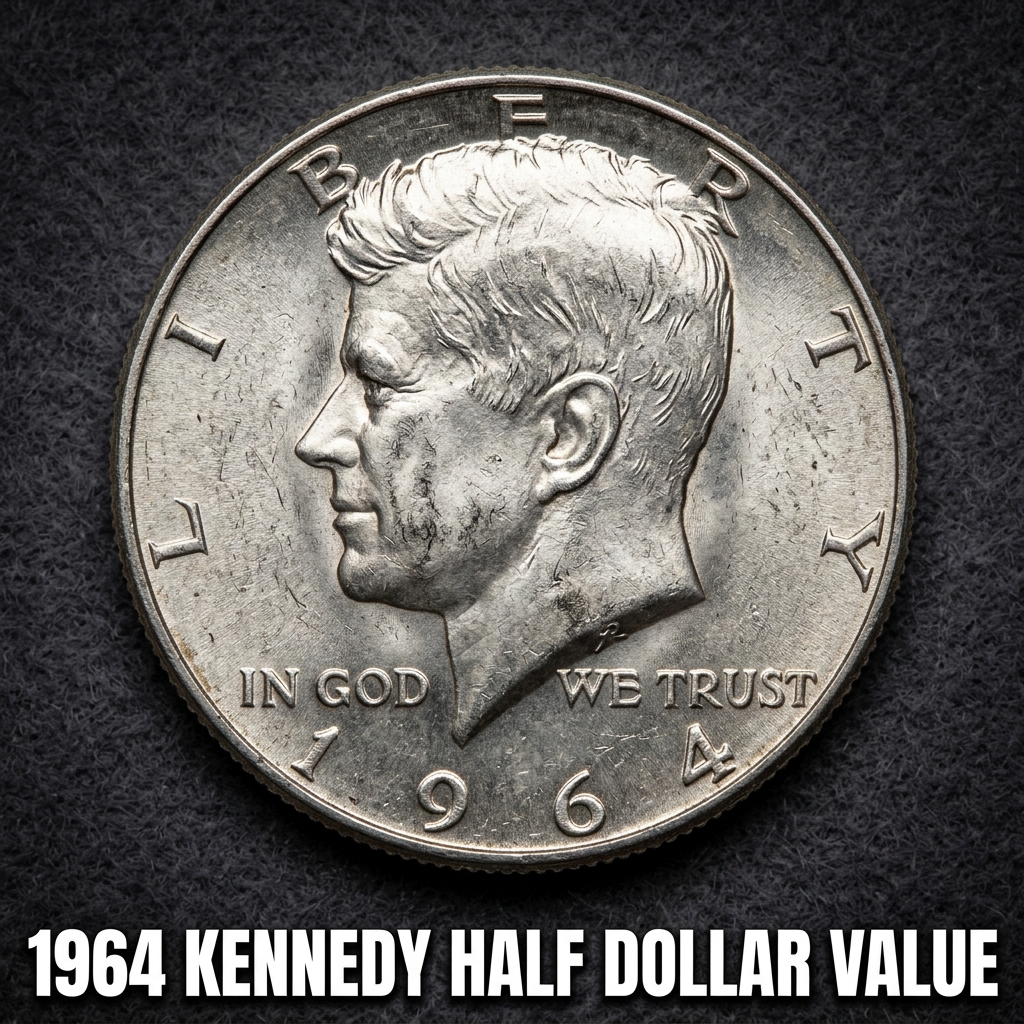
1964 Kennedy Half Dollar Value – What This Classic Silver Coin Is Worth Today

Your Old Coin Could Be Valuable!
Identify It & Know Its Real Value — Free Download


The 1964 Kennedy Half Dollar is worth anywhere from $8 in heavily worn condition to well over $100 in pristine, uncirculated grades — and rare varieties can fetch even more. If you found one of these coins in an old collection or tucked away in a drawer, you’re in luck. This guide will walk you through everything you need to know about its value, silver content, and what makes certain examples especially desirable.
Why the 1964 Kennedy Half Dollar Is Special
The 1964 Kennedy Half Dollar holds a unique place in American coin history. It was struck just months after President John F. Kennedy’s assassination in November 1963, issued as a tribute to the beloved president. The public rushed to collect them, and many were pulled from circulation immediately — which is why so many survive today in relatively good condition.
What makes this coin financially significant is its silver content. The 1964 issue is 90% silver, containing approximately 0.3617 troy ounces of pure silver. That alone gives every single one a base “melt value” tied directly to the silver market. Even if your coin is scratched or worn, it’s still worth more than face value just for the metal inside.
If you’re not sure what you have, a coin identifier and value app can help you quickly figure out the exact date, mint mark, and estimated value before you sell or trade.
Your Old Coin Could Be Valuable!
Identify It & Know Its Real Value — Free Download
1964 Kennedy Half Dollar Value by Grade and Mint Mark
The 1964 Kennedy Half Dollar was produced at two mints: Philadelphia (no mint mark) and Denver (D mint mark). Both are common, but condition is everything when it comes to determining real-world value.
Take a look at how values typically break down:
Your Old Coin Could Be Valuable!
Identify It & Know Its Real Value — Free Download
| Coin | Good (G-4) | Fine (F-12) | MS-63 | MS-65 |
|---|---|---|---|---|
| 1964 (Philadelphia) | $8–$10 | $10–$12 | $18–$25 | $40–$80 |
| 1964-D (Denver) | $8–$10 | $10–$12 | $18–$25 | $40–$80 |
| 1964 Proof | — | — | $15–$20 | $25–$50+ |
For a deeper look at 1964 Kennedy Half Dollar prices across all Mint State grades, you can explore certified sale records and population data to see exactly where your coin falls in the market.
The Silver Melt Value Factor
One thing that often surprises people is that even a beat-up 1964 Kennedy Half Dollar has real monetary value. Because it’s made of 90% silver, its melt value fluctuates with the silver spot price. When silver trades around $28 per troy ounce (a common range in recent years), the melt value of a single 1964 half dollar comes to roughly $10.
Your Old Coin Could Be Valuable!
Identify It & Know Its Real Value — Free Download
This means the coin’s “floor” value is never going to be 50 cents — it’s always tied to precious metals. When silver prices rise, these coins become even more sought after by both collectors and silver stackers. Many everyday Americans hold rolls of these coins as a simple silver investment without even realizing it.
CoinKnow is a great tool for checking real-time silver melt values alongside collector premiums, so you always know what your coin is worth on any given day.
Rare Varieties and What Makes Some Worth More
While most 1964 Kennedy Half Dollars are common coins, there are a few special varieties that attract serious collector attention.
Your Old Coin Could Be Valuable!
Identify It & Know Its Real Value — Free Download
The most talked-about is the 1964 Accented Hair variety. On normal Kennedy Half Dollars, the hair above Kennedy’s ear appears smooth and polished. On the Accented Hair version — found only in proof coins — the hair lines are more detailed and prominent. This was actually the original design, later modified at Jacqueline Kennedy’s request. Today, an Accented Hair proof in PR-65 condition can sell for $100 or more.
There are also SMS (Special Mint Set) examples that collectors debate, along with a handful of error coins and doubled die varieties that surface from time to time. These can carry significant premiums if authenticated.
For a complete breakdown of 1964 Kennedy Half Dollar value information including varieties and error coins, it’s worth reviewing a dedicated coin value resource before making any selling decisions.
How to Get the Best Price for Your 1964 Kennedy Half Dollar
If you’re thinking about selling, knowing your coin’s condition is the first step. Coins in circulated grades (Good through About Uncirculated) are typically bought by dealers at or near silver melt value. Uncirculated coins — especially those grading MS-64 and above — can command a collector premium well beyond melt.
Your Old Coin Could Be Valuable!
Identify It & Know Its Real Value — Free Download
Getting your coin graded by a professional service like PCGS or NGC adds credibility and often unlocks higher sale prices. For high-grade examples, third-party grading is almost always worth the cost.
CoinKnow makes it easy to photograph your coin, compare it against reference images, and get an estimated grade before you commit to having it professionally slabbed. It’s a practical first step for any new collector or seller.
When selling, consider all your options: local coin dealers offer quick cash but lower prices, while auction platforms like eBay or Heritage Auctions can connect you with buyers who’ll pay full collector value for nicer examples.
—
Your Old Coin Could Be Valuable!
Identify It & Know Its Real Value — Free Download
FAQ
Q: Is the 1964 Kennedy Half Dollar made of real silver?
A: Yes. The 1964 Kennedy Half Dollar is composed of 90% silver and 10% copper, giving it a silver weight of approximately 0.3617 troy ounces. Starting in 1965, the composition changed to 40% silver, and by 1971, circulating Kennedy Half Dollars contained no silver at all.
Q: How do I know if my 1964 half dollar is worth more than melt value?
A: Check the coin’s condition carefully. Coins with sharp details, no heavy wear, and original luster will carry collector premiums above melt. Also check for the Accented Hair variety on proofs, and look for any doubling or errors under magnification. Apps like CoinKnow can help you compare your coin to known varieties quickly.
Q: Where is the mint mark on a 1964 Kennedy Half Dollar?
A: The mint mark is located on the reverse (tails) side of the coin, just below the eagle and to the left of the “E” in HALF DOLLAR. A “D” means it was struck at the Denver Mint. Philadelphia-minted coins from 1964 have no mint mark.