1999-S Delaware State Quarter Value and What Collectors Are Paying Today

Your Old Coin Could Be Valuable!
Identify It & Know Its Real Value — Free Download


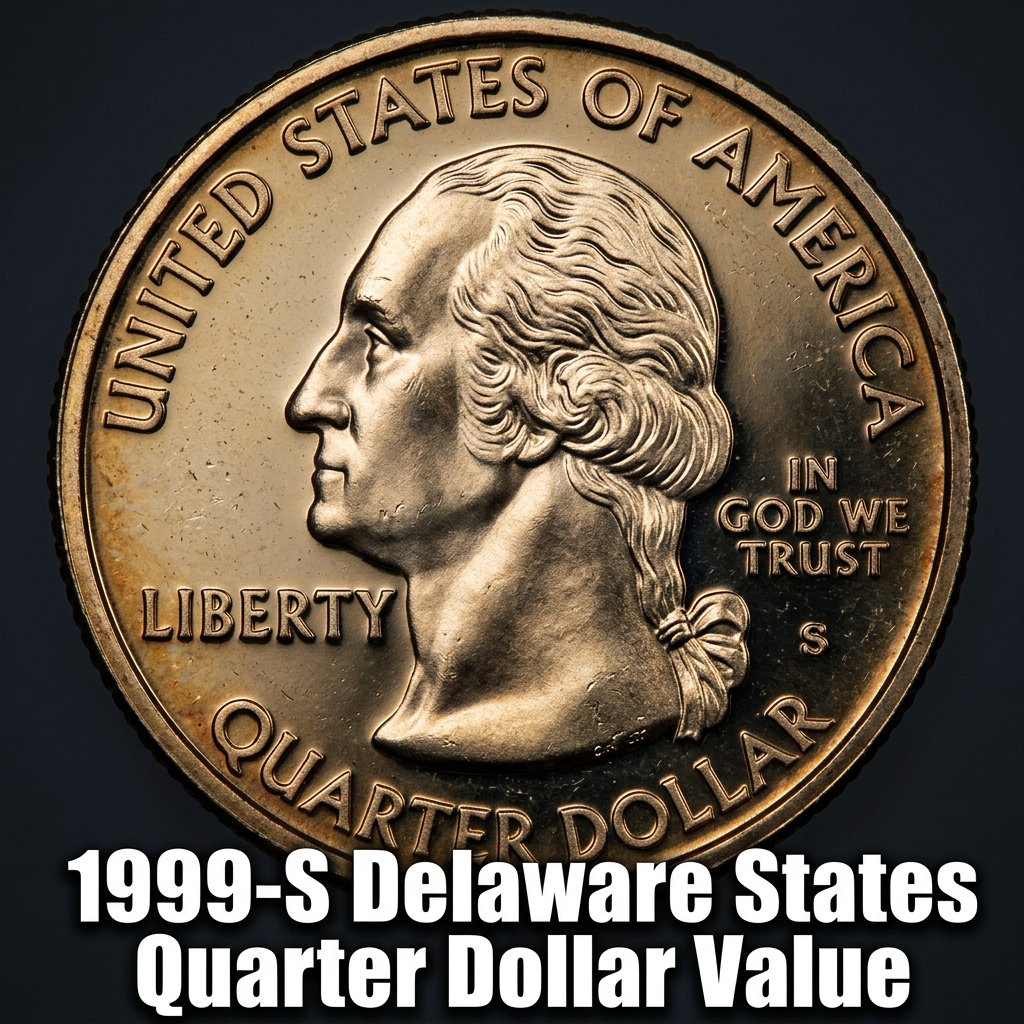
The 1999-S Delaware State Quarter is worth anywhere from $3 in lightly circulated condition to over $15 or more for high-grade proof examples — and certain cameo proof specimens can fetch even higher prices among dedicated collectors. If you’ve come across one of these coins in your collection or in an old folder, you’re in the right place to find out exactly what it’s worth.
What Is the 1999-S Delaware State Quarter?
The 1999-S Delaware State Quarter holds a special place in American coinage history. It was the very first coin released under the 50 State Quarters Program, honoring Delaware’s nickname as “The First State.” The “S” mint mark tells you it was struck at the San Francisco Mint, which produced proof versions of these quarters exclusively for collectors — not for everyday circulation.
Because these coins were made as proof strikes, they feature sharp, mirror-like fields and finely detailed designs. The reverse shows Caesar Rodney on horseback, commemorating his famous midnight ride to vote for independence.
If you’re not sure whether the coin in your hand is a proof or a regular strike, using a coin identifier and value app can help you quickly identify the type and condition without needing expert knowledge. These tools are especially useful for everyday people who aren’t seasoned numismatists.
Your Old Coin Could Be Valuable!
Identify It & Know Its Real Value — Free Download
How Much Is the 1999-S Delaware Quarter Worth?
The value of a 1999-S Delaware State Quarter depends heavily on its condition and variety. San Francisco produced two main proof versions: the standard clad proof and the silver proof. Silver proof examples are naturally more sought after and command higher prices.
Here’s a general breakdown of current market values:
Your Old Coin Could Be Valuable!
Identify It & Know Its Real Value — Free Download
| Variety | Grade | Estimated Value |
|---|---|---|
| Clad Proof | PR-65 | $3 – $6 |
| Clad Proof Deep Cameo | PR-69 DCAM | $8 – $15 |
| Silver Proof | PR-65 | $8 – $12 |
| Silver Proof Deep Cameo | PR-69 DCAM | $15 – $30+ |
| Silver Proof (Perfect Grade) | PR-70 DCAM | $50 – $100+ |
For the most current auction results and dealer pricing, you can check out up-to-date 1999 Delaware Quarter price data that tracks real market trends across different grades.
Factors That Affect the Value of Your 1999-S Delaware Quarter
Not every 1999-S Delaware Quarter is worth the same amount. Several key factors influence what a collector or dealer will be willing to pay.
Your Old Coin Could Be Valuable!
Identify It & Know Its Real Value — Free Download
Cameo contrast is one of the biggest value drivers. Proof coins with frosted devices set against mirror-like backgrounds earn “Cameo” or “Deep Cameo” designations from grading services, and these coins are significantly more valuable than standard proof examples.
Silver vs. clad composition also matters a great deal. Silver proof quarters contain 90% silver, which not only adds intrinsic metal value but also tends to display better contrast and detail — both things collectors love.
Professional grading can dramatically increase buyer confidence. A coin slabbed and graded by PCGS or NGC in PR-69 or PR-70 Deep Cameo can sell for several times the price of an ungraded example. If you believe your coin is in exceptional condition, it may be worth the cost of having it professionally evaluated.
Your Old Coin Could Be Valuable!
Identify It & Know Its Real Value — Free Download
The original packaging also helps. Many 1999-S proof coins were sold in U.S. Mint proof sets, and coins that remain in their original holders with the accompanying set tend to retain collector interest.
How to Check Your 1999-S Delaware Quarter’s Value at Home
You don’t need to be an expert to get a ballpark value for your coin. Start by looking at the coin under good lighting and examining the surfaces for any scratches, cloudiness, or fingerprints — all of which lower value.
Apps like CoinKnow make this process much more accessible. With CoinKnow, you can photograph your coin, get an instant identification, and see current market values without leaving your home. It’s a fantastic starting point for anyone who just found an old proof quarter in a drawer or inherited a coin collection.
For additional pricing details specific to 1999 quarters, you can also explore detailed 1999 quarter value information that covers all mint marks and varieties from that year.
Your Old Coin Could Be Valuable!
Identify It & Know Its Real Value — Free Download
If you want to go a step further, consider joining online coin forums or visiting a local coin show, where dealers can physically examine your coin and give you a precise offer.
Is the 1999-S Delaware State Quarter Worth Collecting?
Absolutely — and not just for its dollar value. This coin represents a landmark in modern American numismatics. As the first coin in the 50 State Quarters Program, the 1999-S Delaware quarter is a piece of history that any collection of U.S. coinage should include.
From a financial standpoint, the silver proof versions in particular represent solid value for their silver content alone, independent of any collector premium. And since proof sets from 1999 are still widely available, building a high-quality example of this coin is quite achievable for new and experienced collectors alike.
CoinKnow is a great companion for anyone looking to track their collection’s value over time, identify unknown coins, and stay up to date on market movements — all in one easy-to-use platform.
—
Your Old Coin Could Be Valuable!
Identify It & Know Its Real Value — Free Download
FAQ
Q: How many 1999-S Delaware State Quarters were minted?
A: The U.S. Mint produced approximately 3.7 million clad proof versions and around 804,000 silver proof versions of the 1999-S Delaware State Quarter. The lower mintage of the silver proof makes it more desirable to collectors.
Q: Is my 1999-S Delaware Quarter made of silver?
A: It depends on which proof set it came from. If your coin came from a standard clad proof set, it contains no silver. If it came from the Silver Proof Set, it is composed of 90% silver. You can check the edge of the coin — a silver proof will show a uniform silver edge with no copper stripe.
Q: Should I clean my 1999-S Delaware Quarter before selling it?
A: No — never clean a coin before selling or having it graded. Cleaning removes the original surface and almost always lowers the coin’s value significantly in the eyes of collectors and grading services. Keep your coin as-is and store it in a protective holder instead.