2003-S Alabama State Quarter Dollar Value and What Collectors Are Paying Today

Your Old Coin Could Be Valuable!
Identify It & Know Its Real Value — Free Download


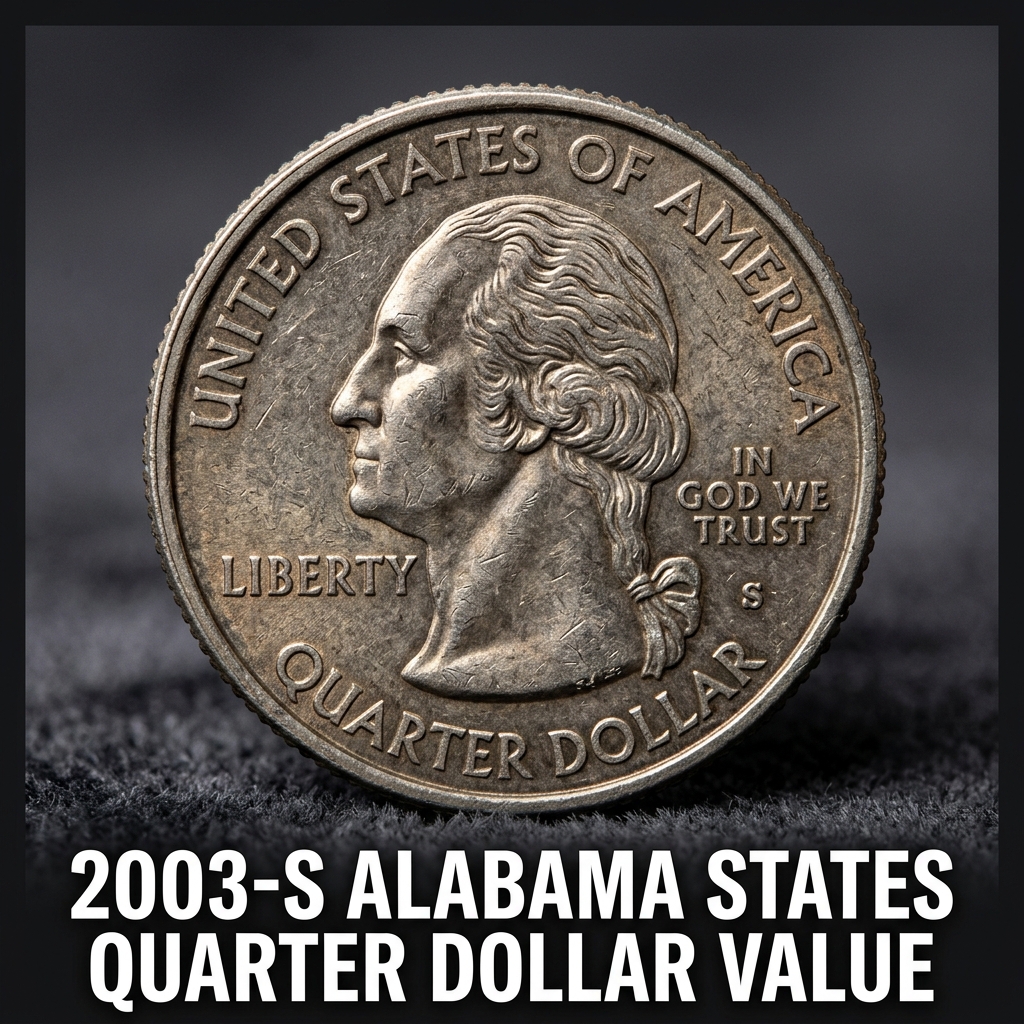
The 2003-S Alabama State Quarter is worth anywhere from $1 in circulated condition to $10 or more in pristine proof grades, with some high-grade specimens fetching even higher prices among dedicated collectors. If you found one of these in a drawer or inherited a coin collection, you’re in the right place to find out exactly what it’s worth.
What Is the 2003-S Alabama State Quarter?
The 2003-S Alabama State Quarter was struck at the San Francisco Mint as part of the United States Mint’s 50 State Quarters Program, which ran from 1999 to 2008. The “S” mint mark stands for San Francisco, and coins from this facility were produced specifically as proof coins for collectors — not for everyday circulation.
The reverse design features Helen Keller, the famous Alabama-born author and activist who overcame blindness and deafness to become one of the most inspiring figures in American history. She is depicted seated, and her name appears in both English and Braille — a truly unique and meaningful design among all 50 state quarters.
Because these were made as proof coins, they typically come in higher quality than coins you’d find in pocket change. If you’re just getting started identifying coins, a coin identifier and value app can help you quickly figure out what you have and whether it’s worth something significant.
Your Old Coin Could Be Valuable!
Identify It & Know Its Real Value — Free Download
How Much Is the 2003-S Alabama Quarter Worth?
The value of the 2003-S Alabama State Quarter depends heavily on its grade and condition. Since it’s a proof coin, grading follows a slightly different scale than regular circulation coins. Most 2003-S Alabama quarters you’ll encounter are standard silver or clad proof issues.
Your Old Coin Could Be Valuable!
Identify It & Know Its Real Value — Free Download
Here’s a simple breakdown of current market values:
| Coin Type | Grade | Estimated Value |
|---|---|---|
| 2003-S Clad Proof | PR65 | $1 – $3 |
| 2003-S Clad Proof | PR69 Deep Cameo | $8 – $15 |
| 2003-S Silver Proof | PR65 | $5 – $8 |
| 2003-S Silver Proof | PR69 Deep Cameo | $20 – $40 |
| 2003-S Silver Proof | PR70 Deep Cameo | $50 – $100+ |
The silver proof version is naturally more desirable to collectors because of its 90% silver composition and mirror-like finish. For up-to-date pricing data on similar issues from the same year, you can check out current market prices for 2003 state quarters to get a broader sense of how the series is trending.
Your Old Coin Could Be Valuable!
Identify It & Know Its Real Value — Free Download
Clad vs. Silver Proof — Which Do You Have?
One of the most important things to figure out is whether your 2003-S Alabama quarter is a clad proof or a silver proof. This distinction can easily mean the difference between a $2 coin and a $50+ coin.
The easiest way to tell is by looking at the edge of the coin. A clad proof will show a thin copper-colored stripe along the edge, while a silver proof will show a pure silver-white edge with no copper layer at all.
Silver proof versions were sold as part of the U.S. Mint’s Silver Proof Sets, while clad proofs came in the standard annual proof sets. If you still have the original Mint packaging, that will confirm which version you own. If not, that edge test is your best quick method — or you can use CoinKnow to scan the coin and get an instant identification.
Your Old Coin Could Be Valuable!
Identify It & Know Its Real Value — Free Download
What Makes a 2003-S Alabama Quarter More Valuable?
Not all proof coins are created equal. Even among coins produced at the San Francisco Mint for collector purposes, there’s a wide range of quality. Professional grading services like PCGS and NGC assign scores from PR60 to PR70, and the difference between a PR67 and a PR70 can dramatically affect value.
Deep Cameo (DCAM) designation is another factor that significantly boosts value. This refers to the frosted devices (raised design elements) contrasting against a mirror-like field — it’s the classic “proof look” that collectors love.
Coins that have been graded and encapsulated in professional slabs tend to sell for premium prices on auction platforms. For a full picture of what the 2003-S Alabama quarter and other 2003 issues are selling for right now, reviewing detailed 2003 quarter value data by type and grade is a great starting point.
Your Old Coin Could Be Valuable!
Identify It & Know Its Real Value — Free Download
You can also use CoinKnow to quickly scan and assess your coin before deciding whether to invest in professional grading.
Is the 2003-S Alabama Quarter Worth Keeping?
For most casual finders, the 2003-S Alabama State Quarter is a fun piece of American history more than a high-value treasure. Standard clad proof examples in average grades are fairly common because millions were sold in Mint sets. That said, top-graded silver proofs and PR70 DCAM examples are legitimately collectible and can sell for real money.
If you have a full proof set from 2003 still in its original Mint packaging, that set as a whole may hold more value than individual coins.
Whether you’re a beginner or a seasoned collector, CoinKnow makes it simple to evaluate any coin in your collection — just scan it and let the app do the work.
Your Old Coin Could Be Valuable!
Identify It & Know Its Real Value — Free Download
FAQ
Q: How do I know if my 2003-S Alabama quarter is silver or clad?
A: Check the edge of the coin. A silver proof will have a solid white/silver edge with no visible copper stripe. A clad proof will show a reddish-brown copper layer between the outer silver-colored layers. Silver proofs were only available in special Silver Proof Sets sold directly by the U.S. Mint.
Q: Is the 2003-S Alabama quarter rare?
A: Not particularly. The U.S. Mint produced several million proof sets in 2003, making these coins relatively easy to find. However, high-grade examples — especially PR70 Deep Cameo silver proofs — are scarce and do carry a meaningful premium among serious collectors.
Q: Should I get my 2003-S Alabama quarter graded professionally?
A: It depends on what you think you have. If your coin appears to be a silver proof in exceptional, flawless condition, professional grading by PCGS or NGC could increase its market value significantly. For standard clad proof examples in typical grades, the grading fee may outweigh the added value.