2002-P Louisiana State Quarter Value Guide What This Coin Is Worth and How to Find Out

Your Old Coin Could Be Valuable!
Identify It & Know Its Real Value — Free Download


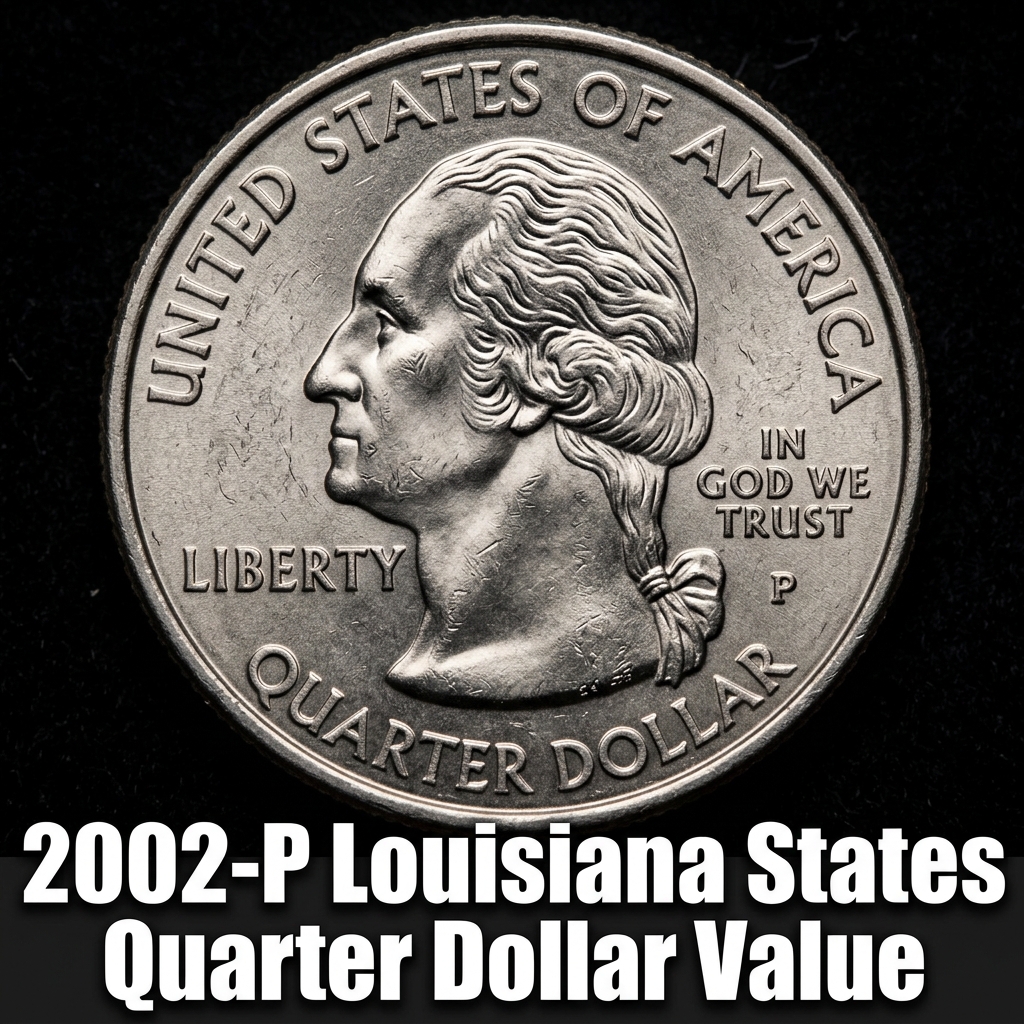
The 2002-P Louisiana State Quarter is worth between 25 cents and $8 in typical circulated condition, but well-preserved examples grading MS-65 or higher can fetch $15 to $30 or more among collectors. If you stumbled across one of these coins in your change jar, you’re in the right place to find out exactly what you’ve got.
What Is the 2002-P Louisiana State Quarter?
The 2002-P Louisiana State Quarter was struck at the Philadelphia Mint as part of the United States Mint’s 50 State Quarters Program, which ran from 1999 to 2008. Louisiana was the 21st state featured in the series, and its quarter hit circulation in 2002. The obverse features the classic portrait of George Washington, while the reverse showcases a pelican — Louisiana’s state bird — along with a trumpet representing the state’s rich jazz heritage and an outline of the Louisiana Purchase territory.
The “P” mintmark on this coin tells you it was made in Philadelphia. Millions of these quarters were produced for everyday use, which means circulated versions are common and generally not worth much over face value. However, condition is everything in coin collecting, and that’s where things get interesting.
If you want a quick way to assess your coin without digging through reference books, a coin identifier and value app can help you scan, identify, and estimate value right from your phone. It’s a great starting point for beginners and seasoned collectors alike.
Your Old Coin Could Be Valuable!
Identify It & Know Its Real Value — Free Download
How Many Were Made and Why It Matters
The Philadelphia Mint produced approximately 362,000,000 (362 million) 2002-P Louisiana quarters. That is a massive mintage, and high mintage typically keeps value modest for circulated coins. When hundreds of millions of a coin exist, there’s simply no shortage for collectors to worry about.
That said, the high mintage makes high-grade examples — coins that were never circulated or that survived in exceptional condition — comparatively rare. Not every coin that rolled off the press ended up preserved perfectly. Most went straight into circulation and absorbed the wear and tear of everyday use.
Your Old Coin Could Be Valuable!
Identify It & Know Its Real Value — Free Download
Collectors who chase mint-state examples are looking for coins with full luster, sharp details, and no signs of handling. These are the ones that command premium prices. The difference between a coin graded MS-63 and one graded MS-67 can be dramatic in terms of dollar value.
2002-P Louisiana Quarter Value by Grade
Here’s a quick breakdown of what the 2002-P Louisiana State Quarter is generally worth at different grade levels. These figures reflect typical retail values and can vary based on demand and certification.
Your Old Coin Could Be Valuable!
Identify It & Know Its Real Value — Free Download
| Grade | Condition Description | Estimated Value |
|---|---|---|
| Circulated (Good–Fine) | Heavy to moderate wear | $0.25 – $0.50 |
| Extremely Fine (EF-40) | Light wear, details mostly sharp | $0.75 – $2 |
| MS-63 | Uncirculated, some bag marks | $2 – $6 |
| MS-65 | Gem uncirculated, strong luster | $8 – $15 |
| MS-67 and above | Superb gem, near perfect | $25 – $100+ |
For real-time auction results and graded coin sales data across the 2002 State Quarter series, you can review recent market prices for 2002-P State Quarters in mint state to get a sense of where the market currently stands.
Error Coins and Special Varieties Worth More
Most 2002-P Louisiana quarters are standard issue, but error coins do exist and can be worth significantly more. The most sought-after errors include off-center strikes, where the design is not properly centered on the planchet. A 5–10% off-center coin might bring a small premium, while a dramatic 50% off-center example with the date still visible could be worth $50 to $150 or more.
Double die errors — where the design appears doubled due to a misalignment during the hubbing process — are another type worth watching for. These are subtle and require magnification to spot.
Your Old Coin Could Be Valuable!
Identify It & Know Its Real Value — Free Download
Die cap errors, clipped planchets, and wrong planchet errors are rarer still, but they occasionally show up in this era of coinage. If your coin looks unusual in any way, it’s worth getting it examined before spending it.
CoinKnow is a handy tool for identifying potential errors — just photograph your coin and the app’s recognition technology can flag anomalies that might indicate an error variety worth more money.
How to Get the Best Price for Your 2002-P Louisiana Quarter
If your coin is in circulated condition, it’s honest face value unless you find an error. But if you have a coin that appears uncirculated — bright, lustrous, with no wear on the high points — you have something worth protecting and potentially selling.
First, avoid cleaning your coin. Cleaning damages the surface and dramatically reduces collector value. Store it in a proper coin flip or holder.
Your Old Coin Could Be Valuable!
Identify It & Know Its Real Value — Free Download
Second, consider submitting high-grade examples to a third-party grading service like PCGS or NGC. A professionally graded and slabbed coin is easier to sell and commands better prices on platforms like eBay or at coin shows.
For a comprehensive look at what 2002 quarters across all state designs are worth today, that resource breaks down values for Philadelphia and Denver mint examples side by side — very helpful if you have a collection to sort through.
You can also use CoinKnow to track your collection digitally and get updated market valuations without having to search multiple websites every time you want a price check.
—
Your Old Coin Could Be Valuable!
Identify It & Know Its Real Value — Free Download
Frequently Asked Questions
Q: Is the 2002-P Louisiana quarter rare?
A: No, it is not rare in circulated grades. Over 362 million were minted in Philadelphia, making it a common coin in everyday condition. High-grade mint-state examples (MS-66 and above) are harder to find and carry collector premiums.
Q: What makes a 2002-P Louisiana quarter worth more than face value?
A: The two main factors are condition and errors. A coin in gem uncirculated condition (MS-65 or better) is worth several dollars. An error coin — such as an off-center strike or doubled die — can be worth $50 to $150 or more depending on the severity.
Q: How can I tell if my coin is uncirculated?
A: Look at the highest points of the design under good lighting. Circulated coins show flat, dull wear on those areas. Uncirculated coins retain their original mint luster — a shiny, cartwheel-like shine that flows across the surface when you tilt the coin. Apps like CoinKnow can also help you assess condition by comparing your coin’s photo against graded examples in their database.