1972-D Jefferson Nickel Value Guide What It’s Worth Today and How to Find Out

Your Old Coin Could Be Valuable!
Identify It & Know Its Real Value — Free Download


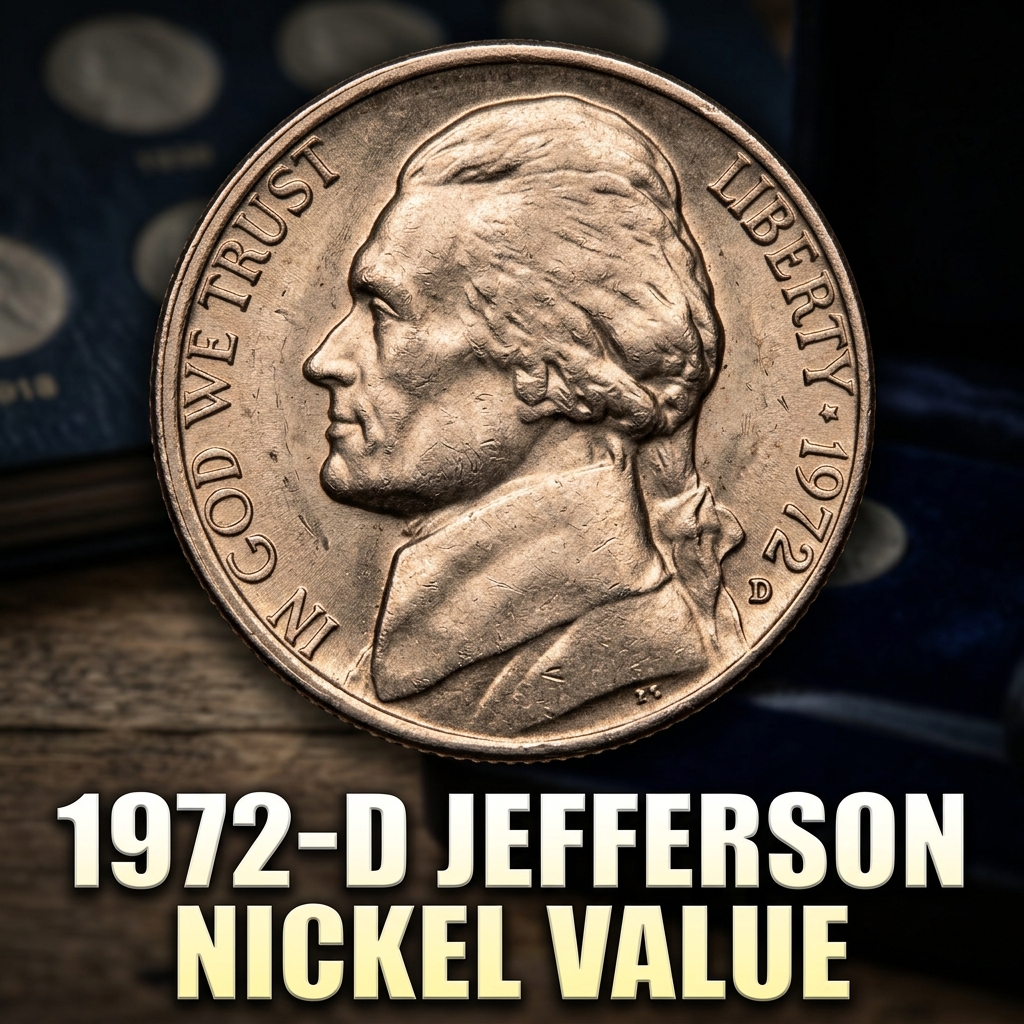
The 1972-D Jefferson Nickel is worth anywhere from 5 cents in heavily circulated condition to over $20 or more in pristine mint state — and a few exceptional examples have sold for significantly higher at auction. If you pulled one of these out of an old coin jar or found it tucked in a drawer, you’re in the right place to find out exactly what you’ve got.
What Is the 1972-D Jefferson Nickel?
The “D” in 1972-D stands for Denver, meaning this coin was struck at the Denver Mint. In 1972, the Denver Mint produced over 351 million Jefferson Nickels — making this a fairly common date in the series. But just because a coin is common doesn’t mean it’s worthless.
The condition your coin is in makes all the difference. A nickel that’s been rattling around in pockets and piggy banks for 50 years will show heavy wear and is worth face value or just a few cents over. But a coin that was carefully preserved and shows sharp details, original luster, and no distracting marks? That’s a different story entirely.
If you’re not sure what condition your coin is in, a coin identifier and value app can help you get a quick and reliable starting point right from your smartphone. Apps like CoinKnow are designed for exactly this kind of everyday discovery — just snap a photo and get an instant assessment.
Your Old Coin Could Be Valuable!
Identify It & Know Its Real Value — Free Download
How Much Is the 1972-D Jefferson Nickel Worth by Grade?
Coin values are based on a grading scale that runs from 1 (Poor) to 70 (Perfect Mint State). Here’s a simple breakdown of what you might expect for a 1972-D Jefferson Nickel at different grade levels:
Your Old Coin Could Be Valuable!
Identify It & Know Its Real Value — Free Download
| Grade / Condition | Description | Estimated Value |
|---|---|---|
| Good (G-4) | Heavy wear, major details visible | $0.05 – $0.10 |
| Fine (F-12) | Moderate wear, all lettering clear | $0.10 – $0.25 |
| Extremely Fine (EF-40) | Light wear on high points only | $0.50 – $1.00 |
| About Uncirculated (AU-55) | Slight wear, good luster remaining | $1.00 – $3.00 |
| Mint State (MS-63) | Uncirculated, some contact marks | $3.00 – $8.00 |
| Mint State (MS-65) | Gem uncirculated, strong luster | $10.00 – $25.00+ |
For a deeper look at 1972-D Jefferson Nickel prices across mint state grades, including recent auction records and certified sales data, it’s worth doing a quick search before assuming your coin is only worth face value.
What Makes a 1972-D Nickel More Valuable?
Most 1972-D Jefferson Nickels are common coins, but a few factors can push the value up considerably.
Your Old Coin Could Be Valuable!
Identify It & Know Its Real Value — Free Download
Full Steps (FS) designation is one of the biggest value boosters in Jefferson Nickel collecting. On the reverse side, Monticello’s front steps are depicted — and if all five or six steps are fully struck and clearly separated with no weakness or merging, a coin can qualify for the Full Steps designation from PCGS or NGC.
A certified MS-65 Full Steps 1972-D nickel can be worth $100 or more, sometimes considerably higher depending on current market demand. That’s a big leap from the typical uncirculated example.
Errors and varieties also matter. Keep an eye out for doubled die obverse or reverse examples, off-center strikes, or die cap errors. These are rare but they do exist — and they can be worth many times the standard value.
Your Old Coin Could Be Valuable!
Identify It & Know Its Real Value — Free Download
Should You Get Your 1972-D Jefferson Nickel Graded?
If your coin looks like it’s never been used — sharp details, original shine, no major marks — it might be worth having it professionally graded by PCGS or NGC.
Professional grading costs money, typically $20–$50 or more per coin depending on the service level. So it only makes financial sense if your coin is likely to grade MS-65 or higher, especially with Full Steps. For most circulated examples, the cost of grading outweighs the coin’s value.
Not sure where your coin stands? Try CoinKnow first. It’s a fast, free way to get a preliminary sense of your coin’s condition and potential value before spending money on professional services. You can also check out detailed 1972 nickel value information by date and mint mark to compare your coin against known price guides.
Your Old Coin Could Be Valuable!
Identify It & Know Its Real Value — Free Download
Tips for Finding and Storing 1972-D Jefferson Nickels
If you’re just getting into coin collecting or you’ve inherited a collection, here are a few quick tips to protect what you have.
Never clean your coins. This is the number one mistake beginners make. Cleaning a coin — even gently — removes the original surface and destroys value. A naturally toned or dirty coin is almost always worth more than a cleaned one.
Store your coins in a cool, dry place. Coin flips, holders, or albums made specifically for coin storage will protect your coins from humidity, oils, and scratches.
Use CoinKnow or a similar app to catalog and track your collection over time. Knowing what you have and what it’s worth is the first step to building something meaningful — even from a simple jar of old change.
Your Old Coin Could Be Valuable!
Identify It & Know Its Real Value — Free Download
Frequently Asked Questions
Q: Is the 1972-D Jefferson Nickel rare?
A: No, it’s not considered rare. The Denver Mint struck over 351 million of them in 1972, making it one of the more common dates in the Jefferson Nickel series. However, high-grade examples — especially those with Full Steps designation — are much harder to find and significantly more valuable.
Q: What does the “D” mint mark mean on a 1972 nickel?
A: The “D” stands for Denver and indicates the coin was minted at the Denver Mint in Colorado. You can find the mint mark on the reverse side of the coin, to the right of Monticello. Philadelphia-minted 1972 nickels have no mint mark, and there’s also a 1972-S proof version from San Francisco.
Q: How can I tell if my 1972-D nickel has Full Steps?
A: Look at the reverse side and examine the steps in front of Monticello. If you can see five or six clearly separated, fully struck horizontal lines with no blending or weakness, your coin may qualify for Full Steps. A magnifying glass helps. For a definitive answer, submit the coin to PCGS or NGC for grading — or use an app like CoinKnow to get a quick visual assessment first.