1906 Barber Half Dollar Value With No Mint Mark What Is It Worth

Your Old Coin Could Be Valuable!
Identify It & Know Its Real Value — Free Download


The 1906 Barber Half Dollar (no mint mark) is worth anywhere from $15 in heavily worn condition to over $500 or more in higher mint state grades. If you found one of these silver coins tucked away in an old jar or inherited it from a relative, you’re holding a piece of American history that’s over 100 years old — and it’s worth real money.
—
What Is the 1906 Barber Half Dollar?
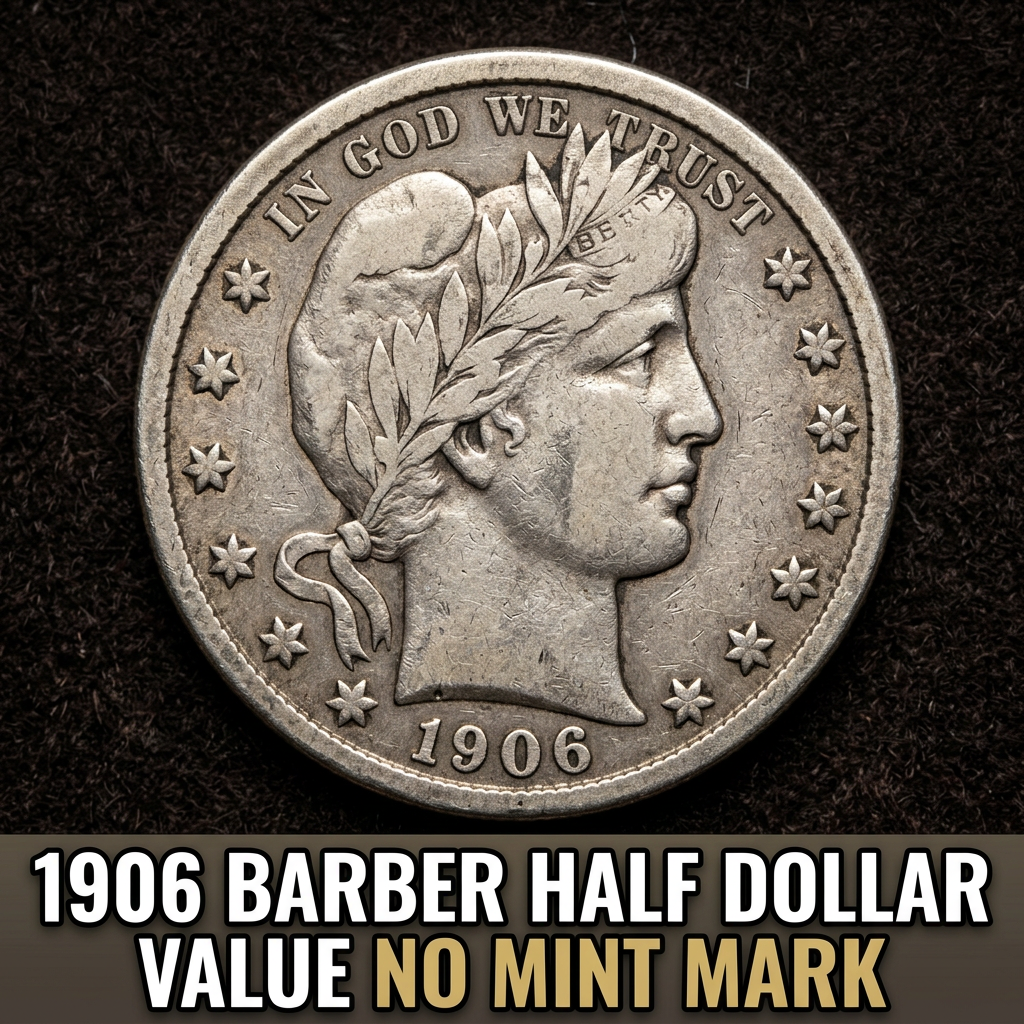
The Barber Half Dollar was designed by U.S. Mint Chief Engraver Charles E. Barber and minted from 1892 to 1915. The obverse features a classic portrait of Liberty wearing a Phrygian cap and laurel wreath, while the reverse shows a heraldic eagle. These coins were made for everyday circulation, which means most survivors show significant wear.
The 1906 no mint mark version was struck at the Philadelphia Mint. Philadelphia was the main U.S. Mint facility and did not place a mint mark on its coins during this era, so the absence of a letter under the eagle on the reverse is actually your indicator that it came from Philadelphia.
Using a coin identifier and value app can help you quickly confirm what you have and get an instant value estimate right from your phone — especially useful if you’re not sure whether your coin is a Barber Half or something else entirely.
Your Old Coin Could Be Valuable!
Identify It & Know Its Real Value — Free Download
—
1906 Barber Half Dollar Value by Grade
The condition of your coin makes a huge difference in its value. Coin collectors use a grading scale from 1 (Poor) to 70 (Perfect Uncirculated). Most circulated 1906 Barber Half Dollars fall somewhere between Good (G-4) and Very Fine (VF-30).
Your Old Coin Could Be Valuable!
Identify It & Know Its Real Value — Free Download
The date and the word “LIBERTY” on the headband are the first things that wear away on these coins. If LIBERTY is fully readable, your coin grades higher and is worth noticeably more.
Here’s a general value breakdown for the 1906 Barber Half Dollar with no mint mark:
| Grade | Description | Estimated Value |
|---|---|---|
| G-4 (Good) | Heavy wear, major details visible | $15 – $20 |
| VG-8 (Very Good) | Moderate wear, LIBERTY partially visible | $22 – $35 |
| F-12 (Fine) | Even wear, LIBERTY mostly visible | $40 – $60 |
| VF-30 (Very Fine) | Light wear on high points | $70 – $110 |
| EF-40 (Extremely Fine) | Slight wear, sharp details | $130 – $175 |
| AU-50 (About Uncirculated) | Trace wear only | $200 – $275 |
| MS-63 (Mint State) | Uncirculated, minor blemishes | $450 – $600+ |
—
Silver Content and Melt Value
Even if your coin is heavily worn with barely readable details, it still contains real silver. The 1906 Barber Half Dollar is composed of 90% silver and 10% copper, with a total weight of 12.5 grams. That means each coin contains approximately 0.3617 troy ounces of pure silver.
Your Old Coin Could Be Valuable!
Identify It & Know Its Real Value — Free Download
With silver prices fluctuating around $27–$30 per troy ounce in recent years, the melt value of a 1906 Barber Half Dollar sits at roughly $9 to $11. In most grades, the numismatic (collector) value far exceeds this melt value, so you should never melt these coins.
If you want to track both the silver melt value and the collector value for your specific coin, CoinKnow makes it easy by giving you real-time price data and grade-based valuations all in one place.
—
Your Old Coin Could Be Valuable!
Identify It & Know Its Real Value — Free Download
What Makes a 1906 Barber Half Dollar More Valuable
Not all 1906 Barber Half Dollars without a mint mark are worth the same amount. Several factors push the value higher:
Strike quality plays a big role. Philadelphia Mint coins from this era sometimes show weak strikes, especially on the eagle’s feathers and Liberty’s hair details. A sharply struck example commands a premium among serious collectors.
Eye appeal and luster matter enormously in mint state coins. An uncirculated 1906 Barber Half Dollar with full original mint luster and no significant bag marks can easily cross the $600–$800 threshold at auction.
Proof versions also exist for 1906. The Philadelphia Mint struck 675 proof Barber Half Dollars that year specifically for collectors. These mirrored, specially prepared coins are rare and valued at $1,500 or more depending on condition.
For a deeper dive into which half dollars are worth the most money, it’s worth exploring how the Barber series compares to other historic half dollar types — some of which can be worth thousands.
Your Old Coin Could Be Valuable!
Identify It & Know Its Real Value — Free Download
—
How to Check Your 1906 Barber Half Dollar Value at Home
You don’t need to be a professional numismatist to get a good sense of what your coin is worth. Start by examining the coin under good lighting and a magnifying glass. Look at the LIBERTY inscription on the headband — this is your first grading clue.
Compare your coin to reference images online to estimate its grade. Once you have a rough grade in mind, cross-reference it against auction records on major platforms or use CoinKnow to get a fast, reliable value estimate right from your smartphone. The app is especially handy if you’re sorting through a collection and need quick answers without spending hours researching each coin.
If your coin looks uncirculated or particularly well-preserved, consider submitting it to a third-party grading service like PCGS or NGC. A professionally graded and slabbed coin can sell for significantly more than a raw, ungraded example.
Your Old Coin Could Be Valuable!
Identify It & Know Its Real Value — Free Download
—
FAQ
Q: How do I know my 1906 half dollar is a Barber and not another type?
A: Look at the obverse (heads side). A Barber Half Dollar shows a profile of Liberty facing right, wearing a laurel wreath and small cap, with the word “LIBERTY” on the headband. The reverse displays a heraldic eagle with a shield. If those elements match, you have a Barber Half Dollar.
Q: My 1906 Barber Half Dollar has no mint mark — does that lower its value compared to mint marked versions?
A: Not necessarily. The 1906 Philadelphia (no mint mark) issue had a relatively high mintage of about 2.6 million coins, making it one of the more common dates in the Barber series. However, the New Orleans (O) and San Francisco (S) mint mark versions from 1906 had lower mintages and can be worth more in higher grades. A CoinKnow search can show you side-by-side comparisons of all three 1906 Barber Half Dollar varieties.
Q: Is it worth getting my 1906 Barber Half Dollar professionally graded?
A: It depends on the condition. If your coin appears to be About Uncirculated (AU) or better — meaning it has very little wear and strong luster — professional grading from PCGS or NGC is likely worth the cost. A certified MS-63 or higher example can sell for hundreds more than an ungraded coin. For circulated coins in Good to Fine condition, the grading fee may exceed the added value, so it’s generally not necessary for those grades.