
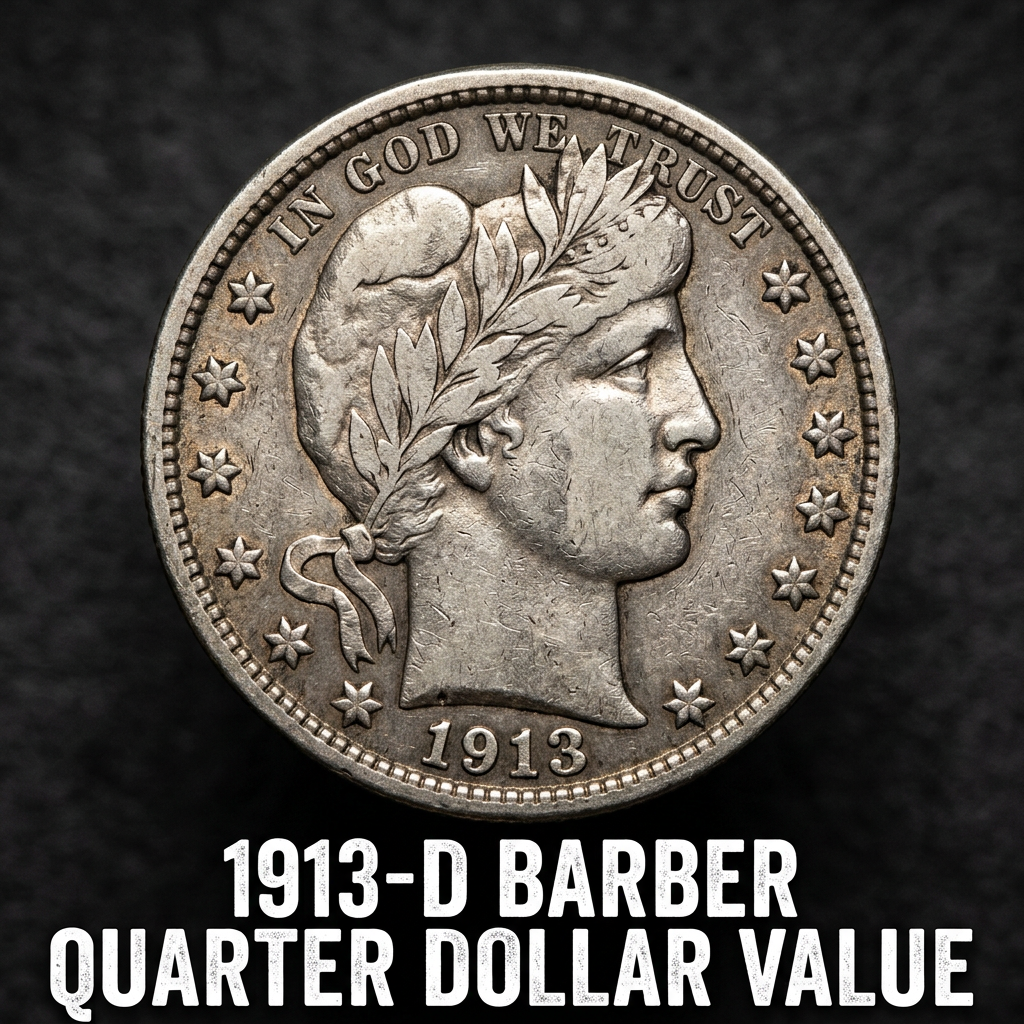
1913-D Barber Quarter Dollar Value Guide What It’s Worth and Why Collectors Care

Your Old Coin Could Be Valuable!
Identify It & Know Its Real Value — Free Download


The 1913-D Barber Quarter Dollar is worth anywhere from $8 in heavily worn condition to well over $500 in higher mint state grades — and some certified examples have sold for thousands at auction. If you found one of these old silver coins tucked away in a drawer or jar, you may be sitting on a genuinely valuable piece of American history.
What Is the 1913-D Barber Quarter?
The 1913-D Barber Quarter was struck at the Denver Mint and features the classic portrait of Liberty designed by Charles E. Barber, who served as Chief Engraver of the U.S. Mint for decades. These coins were made of 90% silver, giving them intrinsic metal value on top of their numismatic appeal.
The “D” mint mark on the reverse side, just below the eagle, tells you this coin was made in Denver. Barber Quarters were produced from 1892 to 1916, and the 1913-D issue had a mintage of just 1,450,800 — a relatively modest number that contributes to its value today.
If you’re trying to identify old coins you’ve found, a coin identifier and value app can help you quickly confirm what you have and get an instant estimate of its worth before visiting a dealer.
Your Old Coin Could Be Valuable!
Identify It & Know Its Real Value — Free Download
How Much Is the 1913-D Barber Quarter Worth Today
Value depends heavily on condition, also called “grade” in coin collecting. A coin that has been circulating for decades will show heavy wear — the fine details of Liberty’s hair and the eagle’s feathers will be almost completely flat. That’s called a “Good” or “AG” grade. In better condition, where you can still see hair strands and feather detail, the value rises significantly.
Your Old Coin Could Be Valuable!
Identify It & Know Its Real Value — Free Download
Here’s a general value table for the 1913-D Barber Quarter based on grade:
| Grade | Description | Estimated Value |
|---|---|---|
| AG-3 / G-4 | Heavy wear, date visible | $8 – $15 |
| VG-8 / F-12 | Moderate wear, major details visible | $20 – $45 |
| VF-20 / XF-40 | Light wear, most details sharp | $65 – $150 |
| AU-50 / AU-58 | Slight wear, nearly uncirculated | $200 – $400 |
| MS-60 and above | Full mint state, no wear | $500 – $2,500+ |
These figures reflect recent market trends, but prices can shift. CoinKnow is a great tool to check up-to-date coin values right from your phone.
Your Old Coin Could Be Valuable!
Identify It & Know Its Real Value — Free Download
Key Factors That Affect the Value of Your 1913-D Quarter
Beyond grade, a few other factors can significantly impact what your coin is worth. Luster is one of them — a mint state coin with original, unaltered surface shine will always command more than one that has been cleaned or polished. Coin collectors strongly dislike cleaned coins, and a coin that appears artificially bright may actually sell for less than a more worn but original piece.
Eye appeal matters too. A coin with attractive, even toning from natural aging can actually be more desirable to collectors. Strike quality — how sharply the design was pressed into the coin — also plays a role with Barber Quarters, as many were weakly struck at Denver during this era.
Your Old Coin Could Be Valuable!
Identify It & Know Its Real Value — Free Download
Certification from a grading service like PCGS or NGC adds credibility and can significantly boost buyer confidence and resale value. If you believe your 1913-D Barber Quarter is in AU or mint state condition, professional grading is worth considering.
Is the 1913-D Barber Quarter Rare
In the context of Barber Quarter collecting, the 1913-D is considered a semi-key date. It’s not the rarest coin in the series, but its lower mintage compared to Philadelphia issues of the same year makes it harder to find in decent condition.
Interestingly, 1913 was a fascinating year in U.S. coin history. While the Barber Quarter continued its long run, other remarkable coins were being struck — including the legendary 1913 Liberty Head Nickel, one of the most valuable and mysterious coins ever produced in America. Comparing these two coins from the same year gives you a fascinating window into early 20th-century American coinage.
Finding a well-preserved 1913-D Barber Quarter is genuinely exciting, and the semi-key status means collector demand remains steady year after year.
Your Old Coin Could Be Valuable!
Identify It & Know Its Real Value — Free Download
How to Check Your Coin’s Value at Home
Before heading to a coin shop or listing your coin online, take a few minutes to assess it yourself. Use a magnifying glass or loupe to look at the hair detail above Liberty’s ear — if individual strands are visible, you likely have at least a Fine grade coin.
Check for any scratches, cleaning marks, or discoloration that could lower the value. Then use CoinKnow to scan your coin and get a fast, reliable estimate based on its condition and current market data. It’s a smart first step before making any buying or selling decisions.
Knowing what you have before you walk into a dealer’s shop means you’re less likely to undersell a valuable coin. Whether your 1913-D Barber Quarter is worth $10 or $1,000, you deserve to know its real value — and CoinKnow makes that easy.
Your Old Coin Could Be Valuable!
Identify It & Know Its Real Value — Free Download
FAQ
Q: How do I know if my Barber Quarter is the 1913-D version?
A: Look at the date on the obverse (front) of the coin — it should clearly read “1913.” Then flip it over and look below the eagle on the reverse for a small “D” mint mark. If both are present, you have a 1913-D Barber Quarter.
Q: Is it worth getting my 1913-D Barber Quarter professionally graded?
A: If your coin appears to be in AU (Almost Uncirculated) or better condition, professional grading from PCGS or NGC is likely worth the cost. It can significantly increase both the credibility and resale value. For coins in lower grades, the cost of grading may not be justified.
Q: Can I clean my 1913-D Barber Quarter to make it look better?
A: No — cleaning a coin almost always reduces its value in the eyes of collectors. Even gentle polishing removes the natural surface and luster that experienced buyers look for. Always leave old coins as-is and let a professional assess their original condition.