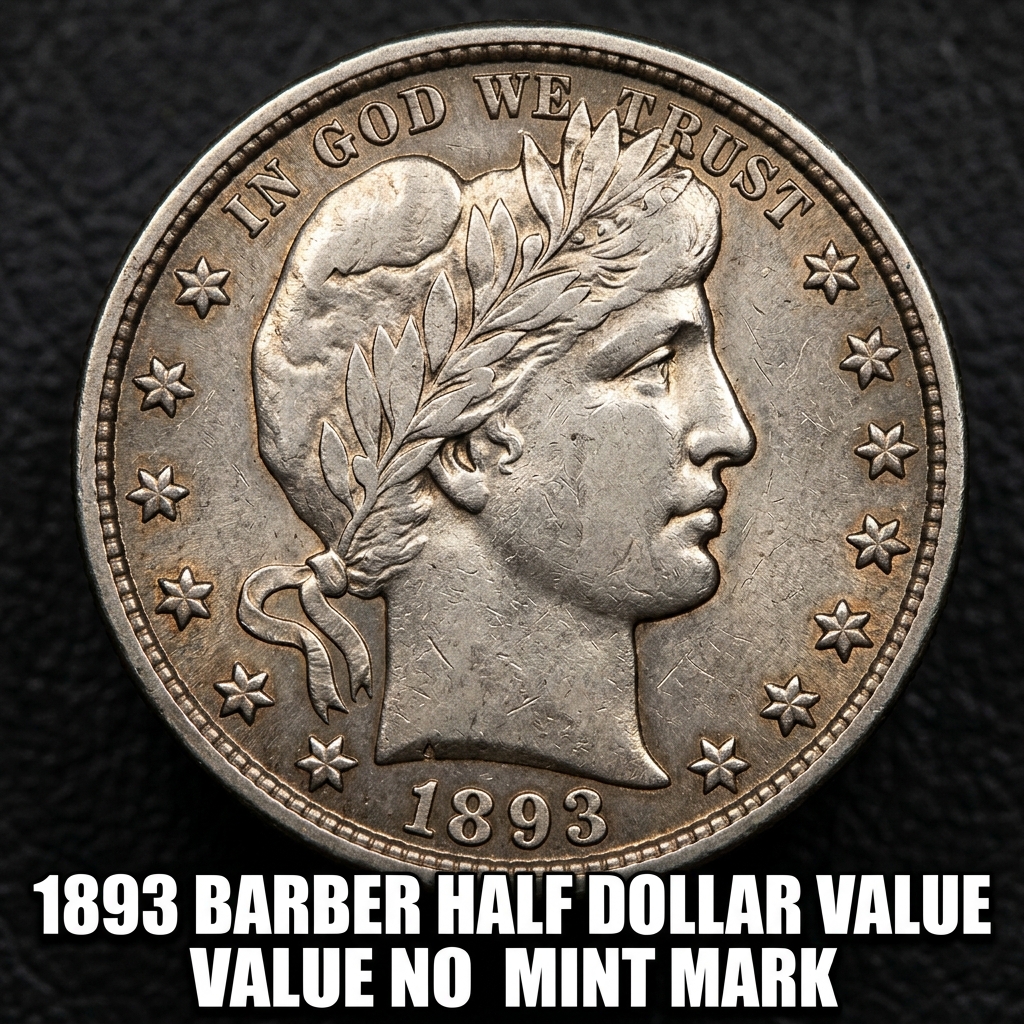
1893 Barber Half Dollar Value with No Mint Mark and What It’s Worth Today

Your Old Coin Could Be Valuable!
Identify It & Know Its Real Value — Free Download


The 1893 Barber Half Dollar with no mint mark is worth anywhere from $20 in heavily worn condition to over $1,000 or more in uncirculated grades. If you’ve stumbled across one of these old silver coins, you’re holding a genuine piece of American numismatic history — and it could be worth more than you think.
What Is the 1893 Barber Half Dollar?
The 1893 Barber Half Dollar was designed by U.S. Mint Chief Engraver Charles E. Barber and first struck in 1892. The no mint mark version was produced at the Philadelphia Mint, which traditionally did not place a mint mark on its coins.
The obverse features a portrait of Liberty wearing a Phrygian cap, surrounded by stars and the date. The reverse displays a heraldic eagle with a shield on its breast, clutching arrows and an olive branch.
These coins are 90% silver, giving them an intrinsic metal value on top of their collectible worth. Even a coin in poor shape has some silver melt value. If you want a quick way to assess your coin’s condition and current market value, tools like a coin identifier and value app can help you get started right from your phone.
Your Old Coin Could Be Valuable!
Identify It & Know Its Real Value — Free Download
How Much Is the 1893 Barber Half Dollar Worth with No Mint Mark?
The value of the 1893 Barber Half Dollar (Philadelphia, no mint mark) depends heavily on its condition, also called its grade. Here’s a breakdown of approximate market values:
Your Old Coin Could Be Valuable!
Identify It & Know Its Real Value — Free Download
| Grade | Condition Description | Estimated Value |
|---|---|---|
| Good (G-4) | Heavy wear, design visible but flat | $20 – $30 |
| Very Good (VG-8) | Moderate wear, some detail remains | $35 – $55 |
| Fine (F-12) | Even wear, major details clear | $60 – $90 |
| Very Fine (VF-20) | Light to moderate wear on high points | $110 – $160 |
| Extremely Fine (EF-40) | Light wear, sharp detail overall | $250 – $350 |
| About Uncirculated (AU-50) | Slight wear on high points only | $400 – $600 |
| Mint State (MS-63+) | No wear, original mint luster | $1,000+ |
The Philadelphia Mint struck 1,826,792 half dollars in 1893, which makes them moderately available in lower grades, but genuinely scarce in high mint state examples.
How to Check the Condition of Your 1893 Barber Half Dollar
Grading coins takes practice, but there are some simple things to look for at home. Start by examining Liberty’s hair above her ear and the eagle’s breast feathers — these are the first areas to show wear.
Your Old Coin Could Be Valuable!
Identify It & Know Its Real Value — Free Download
If the fine hair strands above the ear are still visible and distinct, your coin likely grades Very Fine or better. If they’re blended together into a flat surface, you’re probably looking at a Fine or lower grade coin.
Never clean your coin. Cleaning destroys the original surface and dramatically reduces value, even if the coin looks shinier afterward.
You can also scan your coin using CoinKnow, a popular app that uses image recognition to help identify coins and give you a ballpark value estimate. It’s especially handy when you don’t know exactly what you’re looking at.
Your Old Coin Could Be Valuable!
Identify It & Know Its Real Value — Free Download
The Silver Melt Value Factor
Because the 1893 Barber Half Dollar contains 0.3617 troy ounces of pure silver, it always has a baseline silver melt value. With silver trading around $28–$30 per troy ounce, the raw metal value alone is roughly $10–$11.
This means even a badly worn, barely identifiable 1893 Barber Half Dollar is worth something — and often more than face value. Coin dealers and silver buyers alike will pay at least melt value for these pieces.
If you’re also curious about other silver coins from the same era, you might want to check out what the 1893 Morgan Dollar is worth, as it’s another highly collectible silver coin from the exact same year with a fascinating value range of its own.
Your Old Coin Could Be Valuable!
Identify It & Know Its Real Value — Free Download
Where to Sell or Get Your Coin Appraised
If you think your coin might be in high grade, it’s worth getting a professional opinion. Organizations like PCGS and NGC offer coin grading services that authenticate and encapsulate your coin in a tamper-proof holder, which typically increases buyer confidence and resale value.
For everyday sellers, eBay completed listings are a great free resource to see what similar coins actually sold for — not just what people are asking. Local coin shops and coin shows are also solid options if you want cash in hand without waiting.
CoinKnow can give you a solid starting point before you walk into a shop, so you know whether you’re holding something special or just a common circulated piece. Going in informed always helps you get a fair deal.
—
Your Old Coin Could Be Valuable!
Identify It & Know Its Real Value — Free Download
Frequently Asked Questions
Q: How do I know if my 1893 Barber Half Dollar has no mint mark?
A: Look at the reverse side of the coin, just below the eagle’s tail feathers. If there’s no letter there (no “O,” “S,” or other letter), your coin was struck at the Philadelphia Mint and has no mint mark. That’s the standard for Philadelphia coinage of this era.
Q: Is the 1893 Barber Half Dollar rare?
A: In worn grades, it’s not considered rare — nearly two million were minted. However, in mint state condition (MS-63 and above), the coin becomes genuinely scarce and commands strong premiums at auction. The no mint mark Philadelphia issue is actually the most common of the three 1893 half dollar mint issues.
Q: Should I clean my 1893 Barber Half Dollar before selling it?
A: Absolutely not. Cleaning a coin — even gently with soap and water — can leave microscopic scratches that destroy the original surface. Coin collectors and dealers can spot a cleaned coin immediately, and it significantly lowers the value. Leave it exactly as you found it and let a professional assess it in its natural state.