2001-S Kentucky Silver Proof Quarter Value and What Collectors Are Paying Today

Your Old Coin Could Be Valuable!
Identify It & Know Its Real Value — Free Download


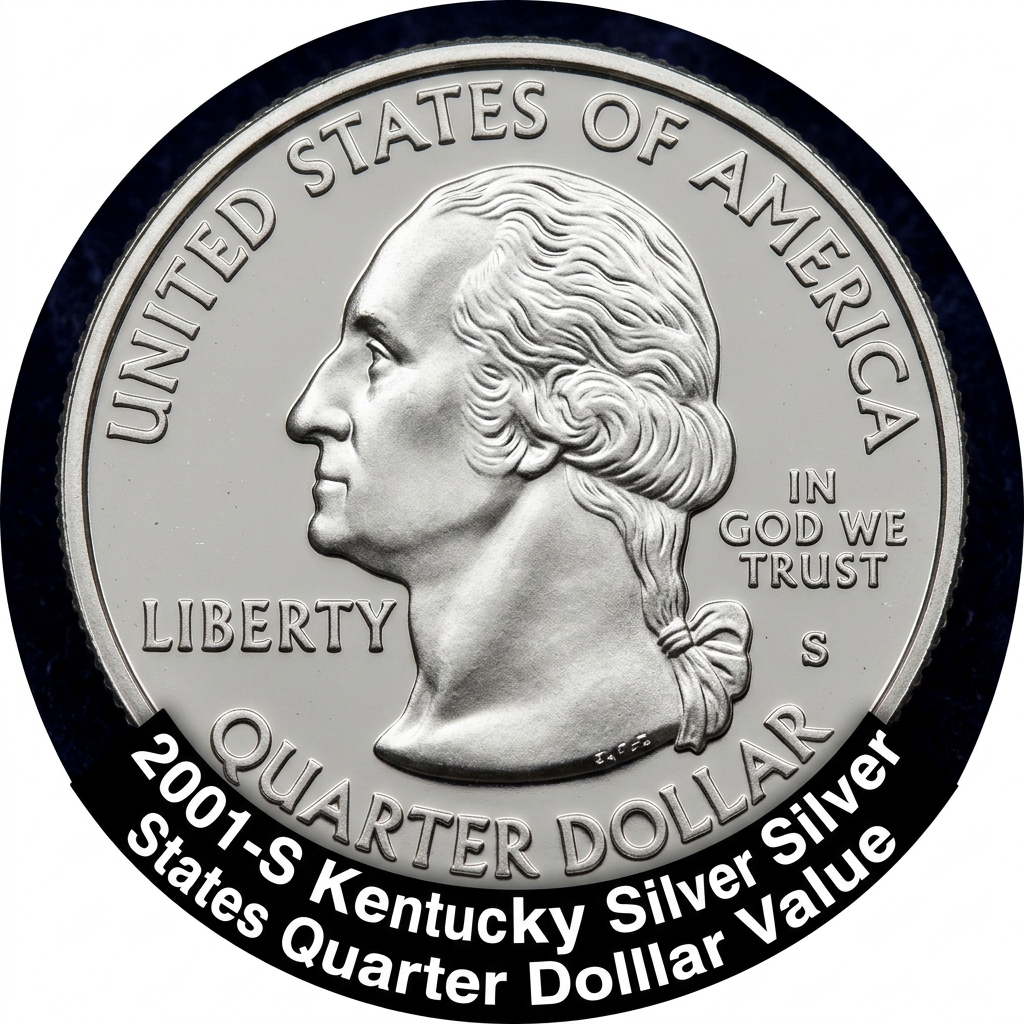
The 2001-S Kentucky Silver States Quarter is worth anywhere from $5 in typical proof condition to $25 or more for top-grade examples, with a few exceptional pieces selling even higher at auction. If you recently found one of these in a proof set or an old coin collection, you’re in the right place to find out exactly what it might be worth.
What Makes the 2001-S Kentucky Silver Quarter Special
The 2001-S Kentucky quarter is part of the hugely popular 50 State Quarters Program, which ran from 1999 to 2008. The “S” mint mark tells you it was struck at the San Francisco Mint — and that’s significant. San Francisco didn’t make quarters for everyday circulation. Instead, it produced proof coins specifically for collectors.
The silver version takes things a step further. Unlike the standard clad proof, which is made of copper and nickel, the silver proof contains 90% silver and 10% copper. This is the same composition used for U.S. coins before 1965, which gives it both historical appeal and real precious metal content.
These coins were sold directly to collectors in annual proof sets, so they never saw a cash register or a pocket. That means most examples are still in excellent condition today — but grades and eye appeal still vary, and that directly affects value.
Your Old Coin Could Be Valuable!
Identify It & Know Its Real Value — Free Download
If you’re trying to figure out which version you have, a coin identifier and value app can help you quickly confirm the mint mark, composition, and grade range — all from a photo on your phone. Tools like CoinKnow make this process surprisingly easy for everyday collectors.
Your Old Coin Could Be Valuable!
Identify It & Know Its Real Value — Free Download
2001-S Kentucky Silver Quarter Value by Grade
Proof coins are graded on the same 70-point Sheldon scale used for all U.S. coins, but they have their own designations. A standard proof gets a “PR” label, while a deeply mirrored, ultra-sharp example earns “DCAM” (Deep Cameo) — the most desirable designation.
Here’s a general value table based on current market trends:
Your Old Coin Could Be Valuable!
Identify It & Know Its Real Value — Free Download
| Grade | Designation | Estimated Value |
|---|---|---|
| PR-65 | Proof | $5 – $8 |
| PR-67 | Proof | $8 – $12 |
| PR-69 | Deep Cameo (DCAM) | $12 – $18 |
| PR-70 | Deep Cameo (DCAM) | $20 – $30+ |
A PR-70 DCAM is a perfect coin — no flaws visible under 5x magnification. These are rare and command the highest premiums. For updated sales data on similar issues, you can browse recent auction prices for 2001 State Quarters by grade to get a feel for where the market currently sits.
Silver Content and Melt Value
Even if your 2001-S Kentucky Silver Quarter isn’t in perfect condition, it still has real silver in it — and that has a floor value all on its own.
Each coin weighs 6.25 grams and contains 90% silver, giving it roughly 0.1808 troy ounces of pure silver. When silver trades around $28 per ounce (as it has in recent years), that puts the melt value at about $5.00 to $5.50. So even a damaged example retains some worth as a silver coin.
Your Old Coin Could Be Valuable!
Identify It & Know Its Real Value — Free Download
This melt value essentially acts as a price floor. The collector premium on top of that depends on grade and eye appeal.
How to Tell If Your Quarter Is the Silver Version
One of the most common questions people have is: how do I know if I have the silver proof or the regular clad proof?
The easiest method is to look at the edge of the coin. A clad proof will show a copper-colored stripe running through the middle of the edge — that’s the copper core sandwiched between the outer layers. A silver proof will have a completely uniform, silvery edge with no stripe at all.
Your Old Coin Could Be Valuable!
Identify It & Know Its Real Value — Free Download
You can also weigh the coin. A silver proof weighs 6.25 grams, while a clad proof weighs 5.67 grams. Most kitchen or jewelry scales can detect this difference easily.
Still unsure? CoinKnow lets you scan your coin and cross-reference it against a database of known proof issues — a fast and reliable way to confirm what you’ve got before you try to sell it. You can also check detailed 2001 quarter value information by type and mint mark to compare your coin against verified pricing data.
Where to Sell a 2001-S Kentucky Silver Quarter
If you’re thinking about selling, your best options are eBay (with sold listings as your price guide), coin shows, or a local coin dealer. For higher-grade examples — especially PR-69 or PR-70 DCAM coins — consider getting it certified by PCGS or NGC first. A certified coin in a holder almost always sells faster and at a stronger price than a raw (uncertified) one.
Don’t overlook CoinKnow as a first step — the app can give you a real-time value estimate and help you decide whether professional grading is worth the cost before you commit.
Your Old Coin Could Be Valuable!
Identify It & Know Its Real Value — Free Download
FAQ
Q: Is the 2001-S Kentucky quarter made of real silver?
A: Yes, if it’s the silver proof version from the San Francisco Mint. It contains 90% silver and 10% copper, the same composition as pre-1965 U.S. coins.
Q: How many 2001-S Kentucky Silver Quarters were minted?
A: The U.S. Mint produced approximately 889,697 silver proof Kentucky quarters in 2001 as part of the annual silver proof set.
Q: Can I find a 2001-S Kentucky Silver Quarter in pocket change?
A: Almost certainly not. These coins were sold exclusively in collector proof sets and never entered general circulation. If you find a Kentucky quarter in change, it will be the standard clad version from Philadelphia or Denver, worth only face value unless it has an error.