1916-S Barber Dime Value Guide What This San Francisco Coin Is Actually Worth

Your Old Coin Could Be Valuable!
Identify It & Know Its Real Value — Free Download


The 1916-S Barber Dime is worth anywhere from $4 in heavily worn condition to over $200 or more in well-preserved grades, with top mint-state examples fetching thousands at auction. If you found one of these old silver dimes in a drawer, a jar, or an inherited coin collection, you’re holding a piece of American history — and possibly something quite valuable.
What Makes the 1916-S Barber Dime Special
The 1916-S Barber Dime was struck at the San Francisco Mint and carries the small “S” mintmark on the reverse, just above the “ONE DIME” lettering. It was one of the last years the Barber Dime series was produced, as the iconic Mercury Dime replaced it later that same year.
That historical context alone makes the 1916-S an interesting coin for collectors. It’s not the rarest date in the Barber Dime series, but it’s a coin with solid demand and real silver content — composed of 90% silver, which already gives it a baseline melt value worth knowing about.
If you’re trying to figure out exactly what your coin is worth, a coin identifier and value app can help you quickly scan and grade your coin before you decide whether to sell or hold onto it.
Your Old Coin Could Be Valuable!
Identify It & Know Its Real Value — Free Download
1916-S Barber Dime Value by Grade
Coin value depends heavily on condition, also called “grade” in the hobby. A Barber Dime that’s been rattling around in pockets for decades will be worth far less than one that was carefully stored and still shows sharp details.
Your Old Coin Could Be Valuable!
Identify It & Know Its Real Value — Free Download
Here’s a general breakdown of what the 1916-S Barber Dime is worth across different grades:
| Grade | Description | Estimated Value |
|---|---|---|
| Good (G-4) | Heavy wear, outline visible | $4 – $7 |
| Fine (F-12) | Moderate wear, lettering clear | $12 – $20 |
| Extremely Fine (EF-40) | Light wear on high points | $50 – $80 |
| About Uncirculated (AU-55) | Slight wear, most luster present | $100 – $160 |
| Mint State (MS-63) | No wear, some bag marks | $200 – $350 |
| Gem Mint State (MS-65+) | Sharp, lustrous, near perfect | $500 – $2,000+ |
These values can shift based on the current silver spot price and collector demand, so it’s always smart to check updated pricing sources for the most current numbers. For a detailed breakdown, you can check out this comprehensive 1916 Barber Dime value reference that covers all three mint marks in depth.
Your Old Coin Could Be Valuable!
Identify It & Know Its Real Value — Free Download
How to Identify the 1916-S Barber Dime
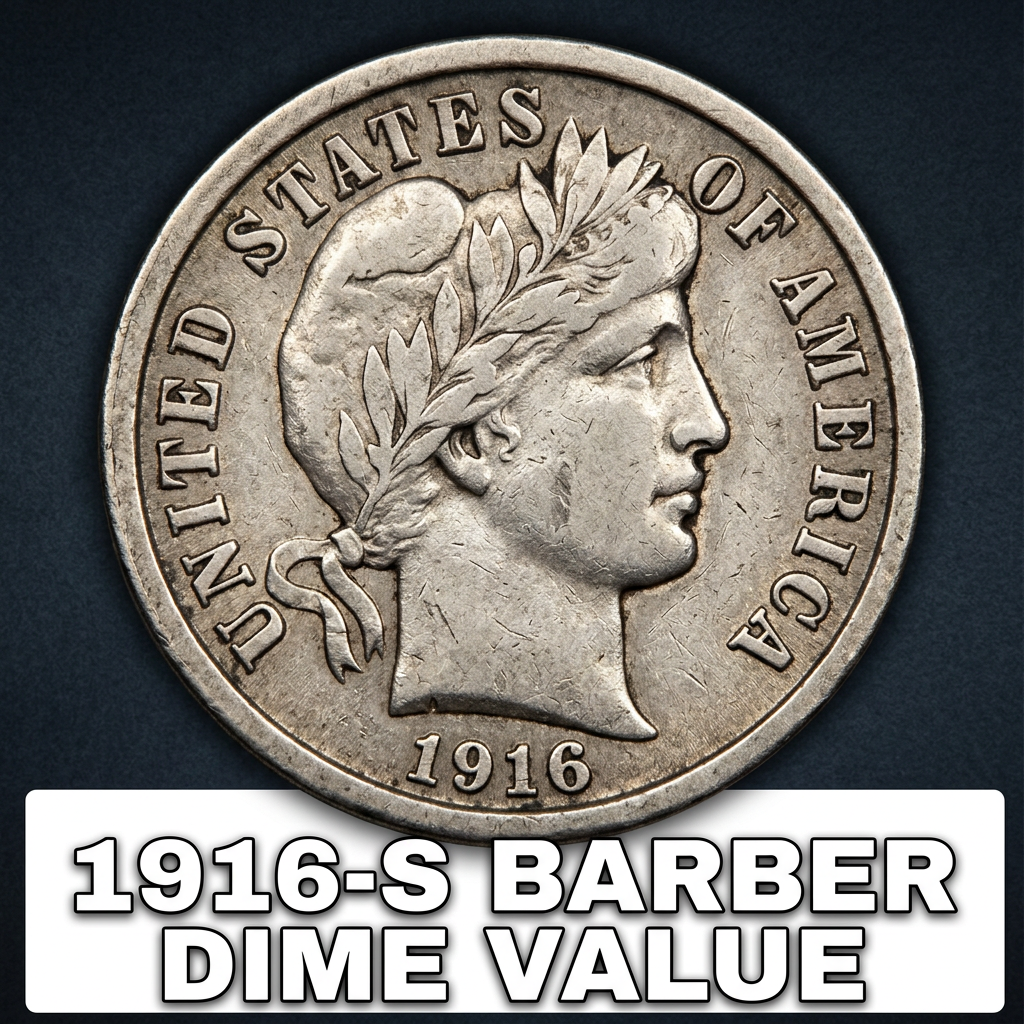
Not sure if you have the right coin? Here’s what to look for. The obverse (front) shows a right-facing portrait of Liberty wearing a laurel wreath and a Phrygian cap, designed by Charles E. Barber — hence the name “Barber Dime.”
The reverse shows a heraldic eagle with wings spread, clutching arrows and an olive branch. The date 1916 will appear on the front, and the “S” mintmark sits on the back, just above the denomination.
Your Old Coin Could Be Valuable!
Identify It & Know Its Real Value — Free Download
If the “S” mintmark is missing, you have the Philadelphia issue (no mintmark), and if it says “O,” that’s the New Orleans coin — both have different values. Knowing the exact mint is essential before estimating what your coin is worth. The CoinKnow app makes this identification step fast and painless, even for beginners with no prior coin knowledge.
Silver Melt Value and Why It Matters
Every Barber Dime contains 0.07234 troy ounces of pure silver. At today’s silver prices hovering around $28–$30 per ounce, that gives even a heavily worn 1916-S Barber Dime an intrinsic silver melt value of roughly $2.00 to $2.20.
This means no matter how worn or beat-up your coin is, it’s never truly worthless — it always has a floor based on silver content alone. However, collector value almost always exceeds the melt value for coins in decent condition.
The sweet spot for most everyday sellers is coins graded Fine to Extremely Fine. These are common enough to sell quickly but still worth a meaningful premium over melt. If you’re using CoinKnow to assess your coin, the app can factor in both collector grade and current silver prices to give you a realistic picture of what you’re holding.
Your Old Coin Could Be Valuable!
Identify It & Know Its Real Value — Free Download
Should You Clean or Sell Your 1916-S Barber Dime
One of the most common mistakes new collectors make is cleaning their old coins before selling them. Please don’t do this. Cleaning a coin — even gently — removes the natural patina and “luster” that collectors and graders look for. A cleaned coin can lose 30% to 70% of its potential value instantly.
The best thing to do is handle your coin by the edges, store it in a soft coin flip or plastic holder, and get it evaluated as-is. If it looks like it could be in high grade, consider sending it to PCGS or NGC for professional grading, which can significantly increase buyer confidence and final sale price.
—
Your Old Coin Could Be Valuable!
Identify It & Know Its Real Value — Free Download
Frequently Asked Questions
Q: How do I know if my dime is the 1916-S Barber Dime and not a Mercury Dime?
A: The Mercury Dime also started in 1916, but it features a completely different design — Liberty wearing a winged cap. The Barber Dime shows a plain portrait of Liberty with a laurel wreath. If your 1916 dime shows that winged cap, it’s a Mercury Dime, which has its own separate value chart.
Q: Is the 1916-S Barber Dime rare?
A: It’s not considered rare in worn grades — the San Francisco Mint struck over 5.8 million of them. However, finding one in high mint-state condition is genuinely difficult, and those examples command strong prices among serious collectors.
Q: What’s the best way to find out the exact value of my 1916-S Barber Dime?
A: Start by examining the condition carefully under good lighting. Then check recent auction results on platforms like Heritage Auctions or use CoinKnow to get a quick digital estimate. For coins that appear to be in top condition, professional grading from PCGS or NGC is absolutely worth the investment.