
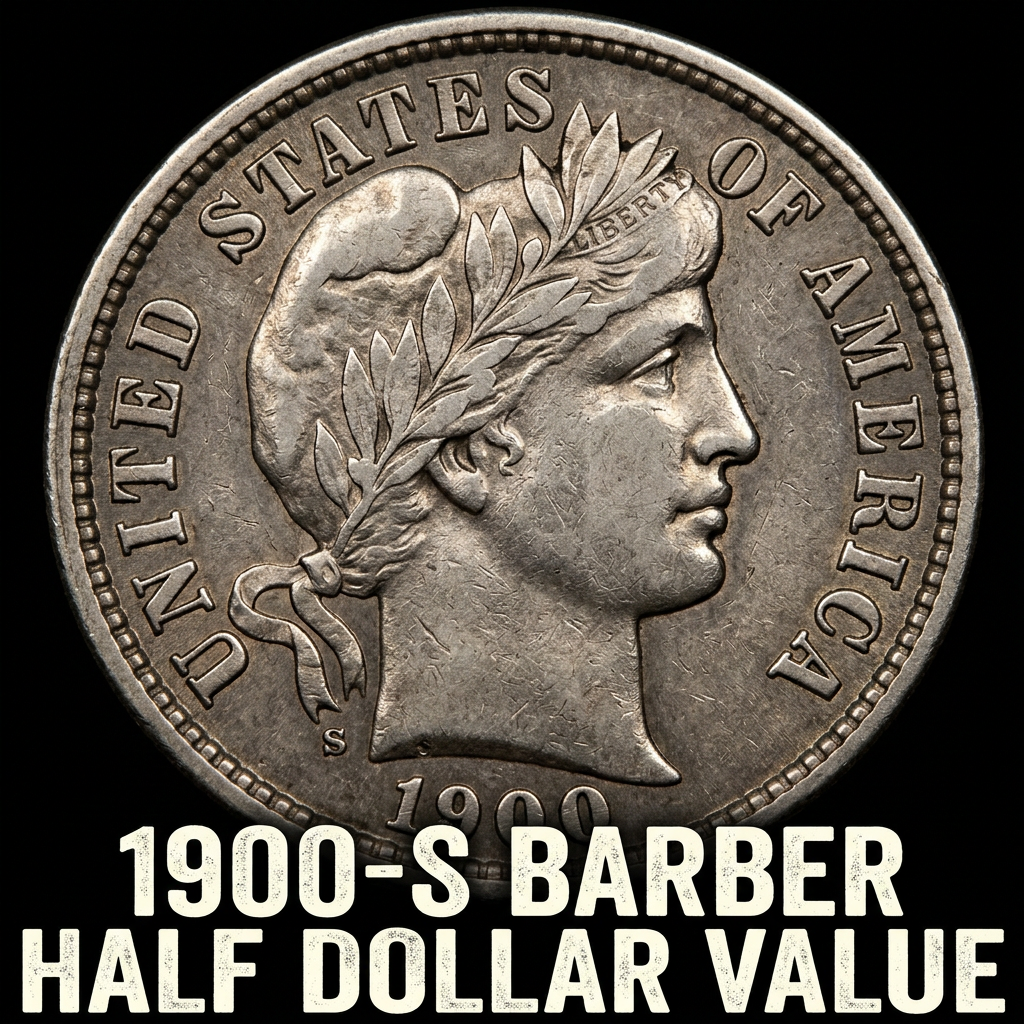
1900-S Barber Half Dollar Value and What Collectors Are Willing to Pay

Your Old Coin Could Be Valuable!
Identify It & Know Its Real Value — Free Download


The 1900-S Barber Half Dollar is worth anywhere from $20 in heavily worn condition to over $1,500 or more in higher mint state grades. If you found one of these old silver coins in a drawer, a jar, or an inherited collection, you’ve stumbled onto something genuinely interesting — and potentially valuable. Read on to find out exactly what you’re holding.
What Makes the 1900-S Barber Half Dollar Special
The 1900-S Barber Half Dollar was minted at the San Francisco Mint, which is where the small “S” mintmark comes from. You’ll find that mintmark on the reverse side of the coin, just below the eagle. Charles E. Barber designed this coin series, which ran from 1892 to 1915, and the San Francisco Mint produced 2,560,322 half dollars in 1900.
That’s not a tiny mintage by any means, but survival rates in high grades are low. Most of these coins spent decades in circulation, getting worn down and losing their fine details. A coin that survived in excellent condition is genuinely rare — and that scarcity drives the value up considerably.
If you’re trying to identify your coin quickly, a coin identifier and value app can scan the coin and give you an instant estimate based on its grade and mintmark. It’s a handy starting point before you visit a dealer.
Your Old Coin Could Be Valuable!
Identify It & Know Its Real Value — Free Download
How to Grade Your 1900-S Barber Half Dollar
Grading is everything when it comes to coin values. The difference between a Good-4 and an MS-63 example can be thousands of dollars, so it’s worth taking a careful look at your coin.
Your Old Coin Could Be Valuable!
Identify It & Know Its Real Value — Free Download
In Good (G-4) condition, the coin will show heavy wear. Liberty’s head on the obverse will be mostly flat, and the letters in “LIBERTY” on her headband will be nearly gone. These are the most common survivors.
In Fine (F-12) condition, you’ll see moderate wear but the major design details are still visible. The hair above Liberty’s forehead shows some detail, and “LIBERTY” is clearly readable. Coins in Very Fine (VF-20 to VF-35) condition retain sharper features and are noticeably more attractive.
Your Old Coin Could Be Valuable!
Identify It & Know Its Real Value — Free Download
Extremely Fine (EF-40 to EF-45) examples show only light wear on the high points. Mint State coins — those that were never circulated — are the crown jewels of any Barber Half collection. Even MS-60 coins command strong premiums, and MS-63 or higher examples are genuinely exciting finds.
1900-S Barber Half Dollar Value Chart
Here’s a quick reference table for current estimated values based on grade:
| Grade | Estimated Value |
|---|---|
| Good (G-4) | $20 – $30 |
| Very Good (VG-8) | $35 – $50 |
| Fine (F-12) | $60 – $90 |
| Very Fine (VF-20) | $100 – $150 |
| Extremely Fine (EF-40) | $200 – $300 |
| About Uncirculated (AU-50) | $350 – $500 |
| Mint State (MS-60) | $600 – $900 |
| Mint State (MS-63) | $1,200 – $1,800+ |
These values are estimates based on recent auction results and dealer pricing. Actual prices vary depending on eye appeal, surface quality, and current market demand. For a broader picture of silver dollar coins from this era, you might also want to check out detailed 1900 silver dollar value information to compare how different coins from the same year are performing in today’s market.
Your Old Coin Could Be Valuable!
Identify It & Know Its Real Value — Free Download
Silver Content and Its Role in the Coin’s Base Value
Even a heavily worn 1900-S Barber Half Dollar has real intrinsic value because it’s made of 90% silver. Each coin contains approximately 0.3617 troy ounces of pure silver.
With silver prices fluctuating around $28–$32 per ounce in recent times, that means even the most worn example has a melt value of roughly $10–$12. Dealers will typically pay at least melt value for any genuine Barber Half Dollar, so you’re never walking away empty-handed.
That said, the collector value almost always exceeds the silver value for coins in Fine condition or better — sometimes by a wide margin. If your coin grades out at EF-40 or higher, it’s definitely worth getting a proper appraisal rather than just selling it for silver.
Your Old Coin Could Be Valuable!
Identify It & Know Its Real Value — Free Download
CoinKnow is a great tool to use here — it can help you quickly assess your coin’s grade and silver value in one place, saving you time before you walk into a coin shop.
Where to Sell Your 1900-S Barber Half Dollar
Once you know what you have, you have several solid options for selling. Local coin dealers are fast and convenient, though they’ll offer wholesale prices. Online platforms like eBay or Heritage Auctions can net you closer to retail value if you’re willing to wait.
For higher-grade examples (EF-40 and above), consider having your coin professionally graded by PCGS or NGC first. A certified coin in a tamper-evident holder sells for significantly more than a raw coin, because buyers have confidence in the grade.
CoinKnow can help you track recent sale prices for the 1900-S Barber Half Dollar so you know exactly what the market is paying before you accept any offer. Knowledge is your best negotiating tool.
Your Old Coin Could Be Valuable!
Identify It & Know Its Real Value — Free Download
FAQ
Q: How do I find the mintmark on my 1900 Barber Half Dollar?
A: Flip the coin to the reverse side and look at the bottom center, just below the eagle’s tail and above the word “HALF.” The “S” mintmark for San Francisco will appear in that small space. If there’s no letter, it was minted in Philadelphia.
Q: Is the 1900-S Barber Half Dollar rare?
A: It’s not considered a key date, but it’s not common in high grades either. The mintage of about 2.56 million sounds large, but very few survived in uncirculated or near-uncirculated condition. In grades above MS-62, it becomes quite scarce and valuable.
Q: Should I clean my 1900-S Barber Half Dollar before selling it?
A: No — never clean an old coin. Cleaning removes the natural patina and surface metal, which significantly reduces the coin’s collector value. A cleaned coin can lose 50% or more of its value compared to an original, uncleaned example in the same grade. Leave it exactly as you found it.