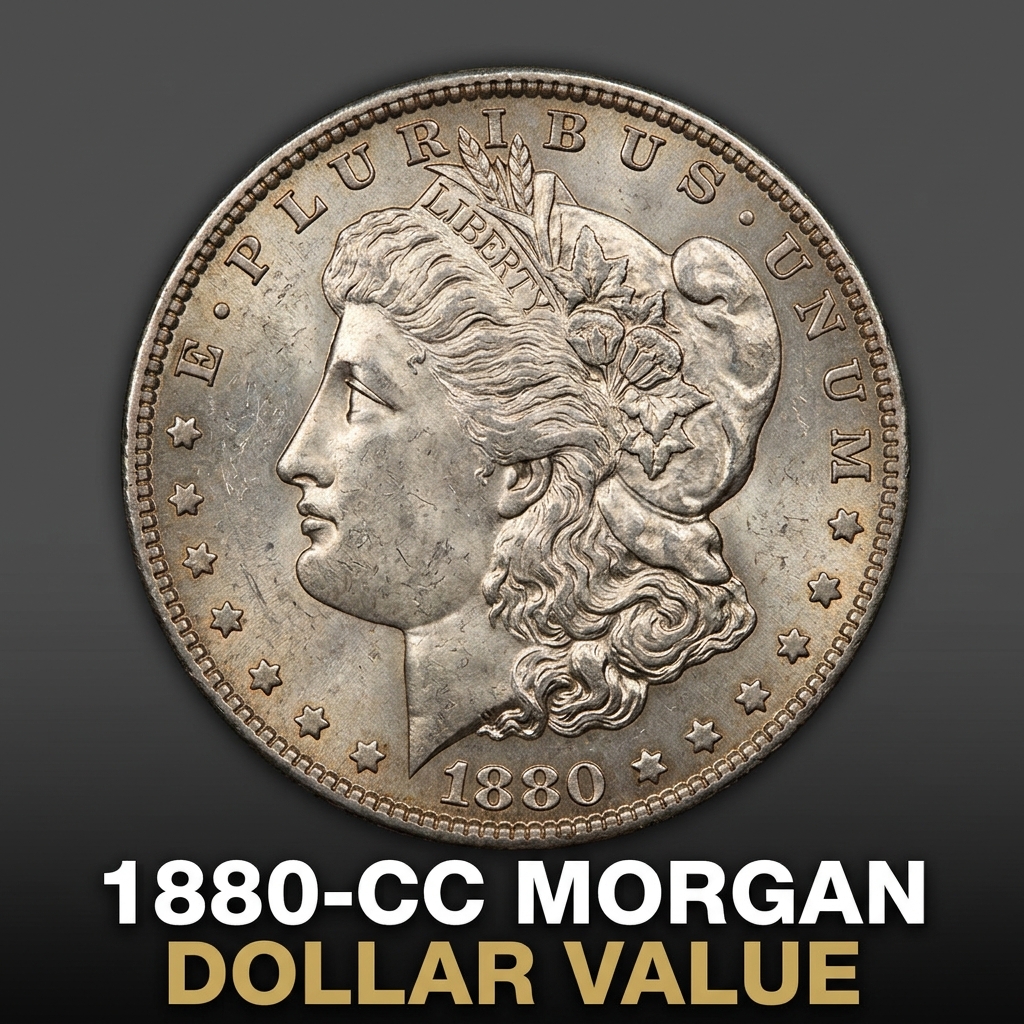
1880-CC Morgan Dollar Value Guide What This Rare Carson City Coin Is Worth Today

Your Old Coin Could Be Valuable!
Identify It & Know Its Real Value — Free Download


The 1880-CC Morgan Dollar is worth anywhere from $150 in heavily worn condition to well over $1,500 or more in high mint state grades — and that’s no small number for a silver coin hiding in a collection box or old drawer.
If you’ve come across one of these coins, you’re in luck. The “CC” mintmark stands for Carson City, Nevada, a mint with a storied history in the American West. Coins from this mint are widely sought after by collectors, and the 1880-CC is no exception. Before you do anything with it, it’s worth taking a few minutes to understand what you actually have.
A great first step is to use a coin identifier and value app to get an instant read on your coin’s identity and approximate value right from your phone. Tools like CoinKnow make this process easy — just snap a photo and get real-time results without needing to visit a dealer first.
—
What Makes the 1880-CC Morgan Dollar Special
The Morgan Dollar series ran from 1877 to 1921, and the Carson City Mint was only in operation during a portion of those years. That limited production window means CC-mint coins are naturally scarcer than those struck in Philadelphia or New Orleans.
Your Old Coin Could Be Valuable!
Identify It & Know Its Real Value — Free Download
The 1880-CC had a mintage of around 591,000 coins — not tiny, but modest by Morgan Dollar standards. Combined with the fact that many were used in commerce and worn down over decades, surviving examples in nice condition are genuinely hard to find.
Collectors have always paid a premium for Carson City Morgans. The Western frontier history, the lower mintages, and the visual appeal of the “CC” mintmark all come together to make coins like the 1880-CC desirable far beyond their face value or silver melt value.
—
Your Old Coin Could Be Valuable!
Identify It & Know Its Real Value — Free Download
1880-CC Morgan Dollar Value by Grade
Coin value depends heavily on condition. Numismatists use a grade scale from 1 to 70, and even small differences in grade can mean hundreds of dollars difference in price. Here’s a general breakdown of what the 1880-CC Morgan Dollar is worth across different grades:
| Grade | Condition | Estimated Value |
|---|---|---|
| G-4 (Good) | Heavy wear, design visible | $150 – $200 |
| VF-20 (Very Fine) | Moderate wear, clear details | $250 – $375 |
| XF-40 (Extremely Fine) | Light wear on high points | $400 – $600 |
| MS-60 (Mint State) | Uncirculated, some marks | $650 – $900 |
| MS-63 (Choice Uncirculated) | Bright luster, few blemishes | $1,000 – $1,500 |
| MS-65 (Gem Uncirculated) | Exceptional luster and strike | $3,500+ |
For the most current auction results and market pricing, you can check out detailed 1880-CC Morgan Dollar price data across all mint state grades to see how the market is moving right now.
—
Your Old Coin Could Be Valuable!
Identify It & Know Its Real Value — Free Download
How to Determine Your Coin’s Grade
Grading a coin takes a trained eye, but you can get a pretty good idea at home by following a few steps.
First, look at the high points of the design — on the Morgan Dollar, these are Liberty’s cheek and hair above the ear on the obverse, and the breast feathers of the eagle on the reverse. If these areas show significant flattening or wear, your coin is circulated.
Next, check the fields (the flat open areas of the coin) under a good light source. Mint state coins will show original luster — a cartwheel-like sheen when you tilt the coin. Bag marks and minor contact marks are normal even on uncirculated coins, but heavy nicks hurt the grade.
If you want a certified, guaranteed grade, professional grading services like PCGS or NGC are the gold standard. A graded and slabbed coin is also much easier to sell for full market value.
Your Old Coin Could Be Valuable!
Identify It & Know Its Real Value — Free Download
—
Silver Melt Value and Why It Still Matters
The 1880-CC Morgan Dollar contains 0.7734 troy ounces of pure silver. With silver prices hovering around $28–$32 per ounce in recent times, the raw melt value of one of these coins is roughly $22–$25.
That’s your floor. No matter the grade or condition, an authentic 1880-CC Morgan Dollar should never sell for less than its silver content. In most cases, of course, the numismatic (collector) value far exceeds the melt value — especially for a Carson City coin.
For a full breakdown of the 1880 silver dollar value including melt, circulated, and mint state estimates, it’s worth bookmarking a reliable price reference alongside your research.
Your Old Coin Could Be Valuable!
Identify It & Know Its Real Value — Free Download
—
Tips for Selling or Keeping Your 1880-CC Morgan Dollar
If you’re thinking about selling, don’t rush. Coin dealers will typically offer 60–80% of retail value, which is fair — they need to make a margin. But if you have a high-grade example, auction houses like Heritage Auctions or Stack’s Bowers can get you closer to full market value from competitive bidders.
If you’re thinking about keeping it, consider storing it properly. Avoid cleaning the coin at all costs — even a gentle wipe can leave hairline scratches that drop the grade and value significantly. Use a proper coin flip or hard plastic holder, and keep it away from humidity and direct light.
Whether you’re selling or holding, CoinKnow is a smart tool to have on hand. It helps you track values over time, identify coin varieties, and get a better sense of what your collection is really worth as the market shifts.
—
Your Old Coin Could Be Valuable!
Identify It & Know Its Real Value — Free Download
FAQ
Q: How can I tell if my dollar has the CC mintmark?
A: Flip the coin to the reverse side and look just above the “DO” in “DOLLAR,” at the base of the eagle’s tail. You should see a small “CC” mintmark. If there’s no mintmark, the coin was struck in Philadelphia.
Q: Is the 1880-CC Morgan Dollar considered rare?
A: It’s not the rarest coin in the Morgan Dollar series, but it is genuinely scarce — especially in higher grades. The Carson City Mint’s reputation and limited output make CC-mint coins desirable, and the 1880-CC commands a strong premium over common-date Morgans.
Q: Should I clean my 1880-CC Morgan Dollar before selling it?
A: Absolutely not. Cleaning a coin — even with gentle polish or a soft cloth — removes the original surface and luster, which collectors call “cleaning.” A cleaned coin is worth significantly less than an original, unaltered example. Leave it exactly as you found it.