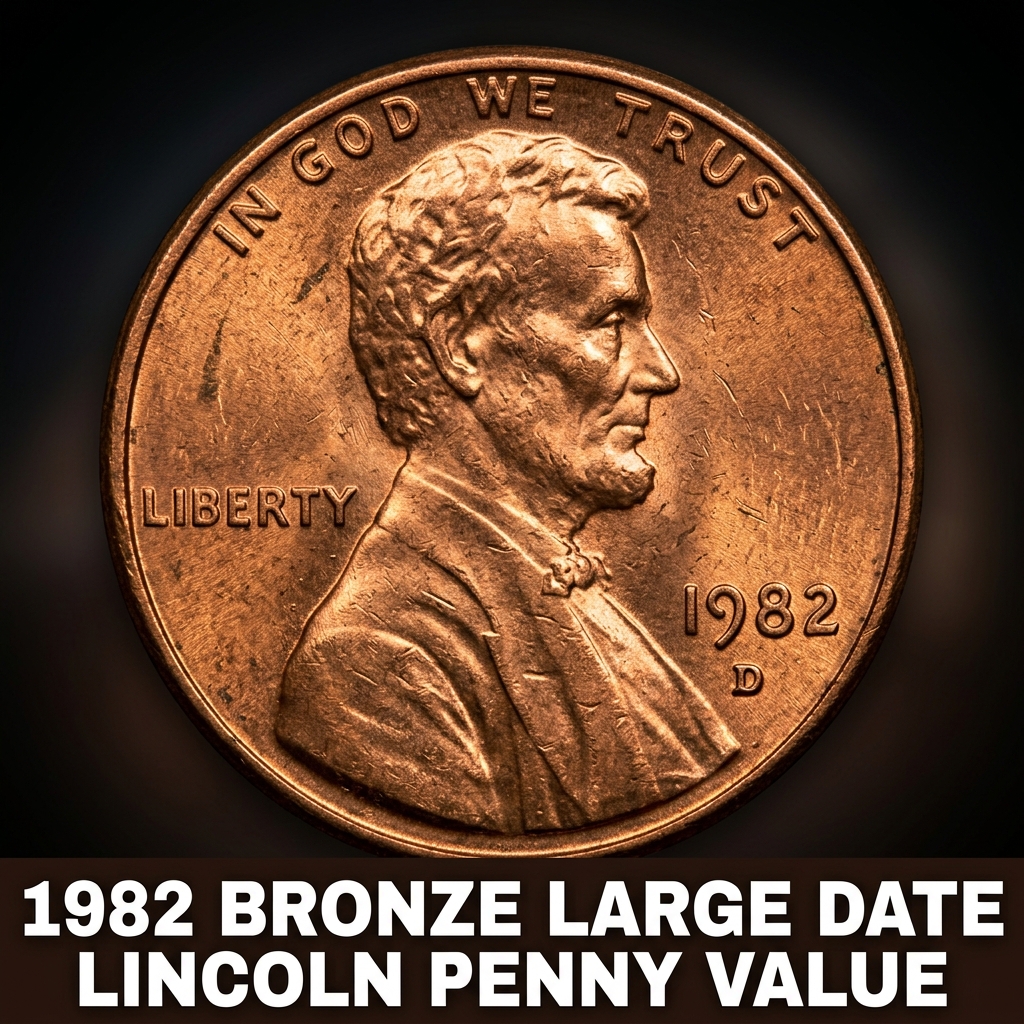
1982 Bronze Large Date Lincoln Penny Value Guide What It’s Worth Today

Your Old Coin Could Be Valuable!
Identify It & Know Its Real Value — Free Download


The 1982 Bronze Large Date Lincoln Penny is worth anywhere from a few cents in heavily worn condition to $3–$10 in uncirculated grades, with exceptionally well-preserved examples occasionally fetching more among dedicated collectors.
If you’ve been sorting through old change or inherited a jar of coins, you might have stumbled across a 1982 Lincoln cent and wondered if it’s worth more than face value. The good news is that 1982 is actually one of the most fascinating years in Lincoln penny history — and knowing exactly which variety you have can make a real difference. Using a coin identifier and value app is one of the easiest ways to quickly figure out which 1982 penny you’re holding before you decide whether to spend it or save it.
Why 1982 Lincoln Pennies Are So Complicated
The year 1982 is unlike almost any other in Lincoln cent production. The U.S. Mint was in the middle of transitioning the penny’s composition — switching from 95% copper (bronze) to a zinc core with copper plating. On top of that, they also changed the size of the date on the coin. The result? Seven distinct varieties were produced in 1982 alone.
The varieties include: Philadelphia and Denver mint strikes, in both bronze and zinc, with either a Large Date or Small Date design. The Philadelphia bronze Large Date and Small Date coins, along with the Denver bronze Large Date and zinc versions, each carry their own collector value.
Your Old Coin Could Be Valuable!
Identify It & Know Its Real Value — Free Download
Understanding which one you have is the first step to knowing its true worth. The CoinKnow app can walk you through exactly how to identify each variety based on photos you take right from your phone.
Your Old Coin Could Be Valuable!
Identify It & Know Its Real Value — Free Download
How to Tell If Your 1982 Penny Is Bronze or Zinc
The simplest test is weight. A genuine bronze 1982 Lincoln penny weighs approximately 3.1 grams, while a zinc penny weighs about 2.5 grams. If you have a digital postal scale at home, that’s all you need.
You can also look at the edge of the coin. Bronze pennies tend to have a more uniform coppery color throughout, while zinc pennies that have been in circulation often show a slightly different patina or even white-gray toning along the rim if the copper plating has worn.
Your Old Coin Could Be Valuable!
Identify It & Know Its Real Value — Free Download
The Large Date vs. Small Date distinction requires a bit more attention. On the Large Date, the “8” in 1982 appears taller and bolder, and the “2” has a distinctive curved tail. On the Small Date, the numbers appear more delicate and evenly spaced. A magnifying glass helps, and so does comparing your coin against reference images — something CoinKnow makes easy right inside the app.
1982 Bronze Large Date Lincoln Penny Value by Grade
Here’s a quick look at approximate values for the 1982 Bronze Large Date penny from the Philadelphia Mint (no mint mark) depending on condition:
| Grade / Condition | Description | Estimated Value |
|---|---|---|
| Good (G-4) | Heavy wear, outlines visible | Face value – $0.05 |
| Fine (F-12) | Moderate wear, some detail | $0.05 – $0.25 |
| Extremely Fine (EF-40) | Light wear on high points | $0.50 – $1.00 |
| About Uncirculated (AU-55) | Slight friction, nearly full luster | $1.00 – $2.00 |
| MS-63 Red | Uncirculated, minor marks | $3.00 – $6.00 |
| MS-65 Red | Gem uncirculated, strong luster | $8.00 – $15.00+ |
For the most up-to-date auction results and certified coin prices, you can browse detailed 1982 Lincoln penny price data by grade and mint mark to see what collectors are actually paying right now.
Your Old Coin Could Be Valuable!
Identify It & Know Its Real Value — Free Download
What Makes the Bronze Large Date Variety Special in 1982
By mid-1982, the Mint had largely shifted to zinc planchets, making late-production bronze coins rarer by default. The Bronze Large Date from Philadelphia is considered a common variety compared to the bronze Small Date, but that doesn’t mean it’s without collector interest — especially in high mint state grades with full red color.
The coin’s real appeal lies in its historical significance. These were among the last true copper pennies produced for general circulation. Copper melt values also add a small premium — a bronze 1982 penny contains roughly 2.95 grams of copper, which at current copper spot prices gives it an intrinsic metal value above face value.
For a full breakdown of how 1982 penny values compare across all seven varieties, the complete 1982 penny value guide including all bronze and zinc varieties is a great resource to bookmark.
Your Old Coin Could Be Valuable!
Identify It & Know Its Real Value — Free Download
Tips for Checking Your 1982 Pennies at Home
Start by separating all your 1982 cents into two groups by weight. Any coin at 3.1 grams is bronze; anything lighter is zinc.
Next, examine the date under a loupe or magnifying glass and identify Large Date vs. Small Date. Check the reverse for a “D” mint mark below the date — that indicates Denver. No mint mark means Philadelphia.
Store any bronze coins separately in a soft coin flip or 2×2 holder. Avoid cleaning them — cleaned coins lose significant collector value. If you want a professional second opinion on a coin’s grade and variety, CoinKnow offers a quick and convenient way to get reliable information without needing to visit a coin shop right away.
—
Your Old Coin Could Be Valuable!
Identify It & Know Its Real Value — Free Download
FAQ
Q: Is the 1982 Bronze Large Date penny rare?
A: It is not considered rare in circulated grades since millions were produced. However, finding one in gem uncirculated condition with full red color (MS-65 or higher) is genuinely uncommon and worth a premium to collectors.
Q: How do I know if my 1982 penny is bronze and not zinc?
A: Weigh it. A bronze 1982 penny weighs 3.1 grams, while a zinc penny weighs 2.5 grams. This is the fastest and most reliable method to tell them apart at home.
Q: Should I get my 1982 Bronze Large Date penny professionally graded?
A: If your coin appears to be uncirculated with strong original red luster, professional grading by PCGS or NGC could be worthwhile. For circulated coins, the cost of grading typically outweighs any added value, so it’s best to have a realistic estimate of grade and condition first.