
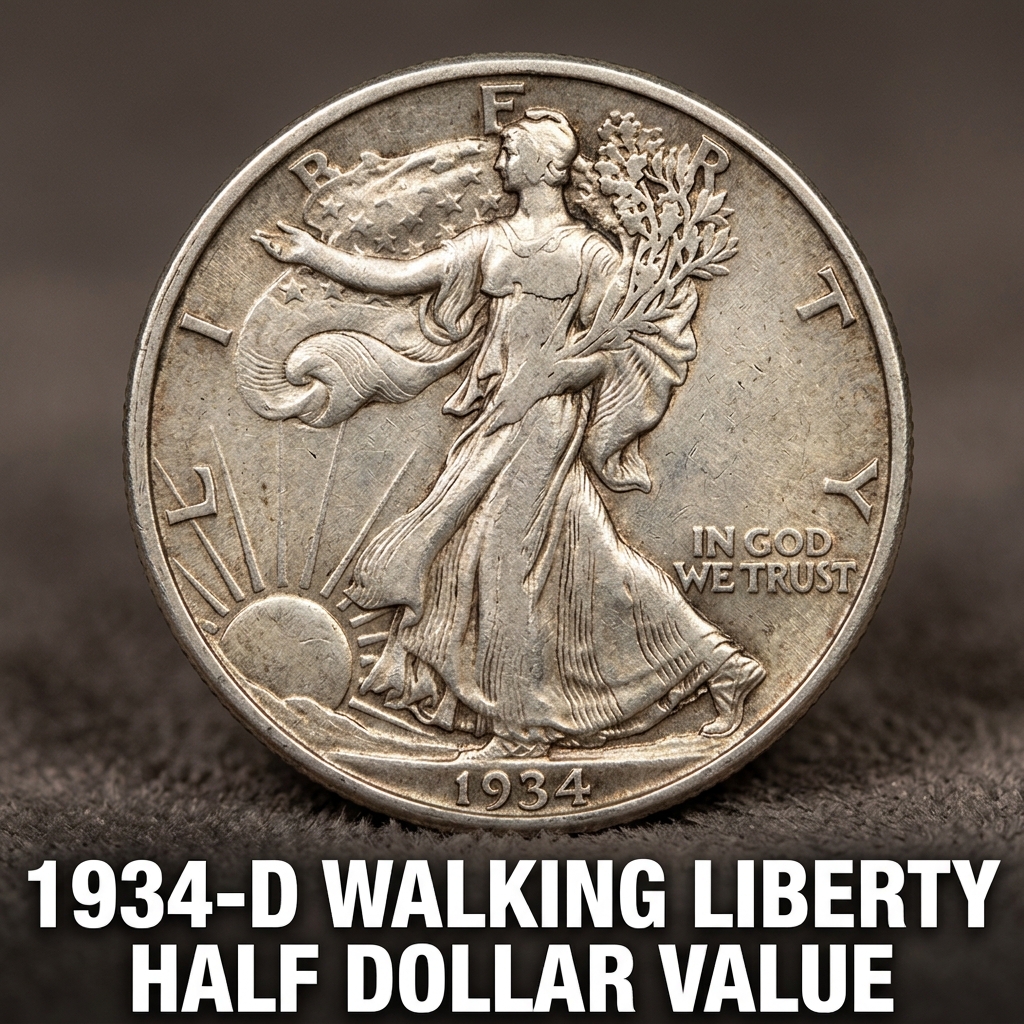
1934-D Walking Liberty Half Dollar Value and What Your Coin Is Really Worth

Your Old Coin Could Be Valuable!
Identify It & Know Its Real Value — Free Download


The 1934-D Walking Liberty Half Dollar is worth anywhere from $15 in heavily circulated condition to over $1,000 or more in high-grade mint state — and certain exceptional examples have sold for significantly more at auction. If you’ve found one of these beautiful silver coins in an old collection or jar, you’re in the right place to find out exactly what it’s worth.
What Makes the 1934-D Walking Liberty Half Dollar Special
The Walking Liberty Half Dollar series is widely considered one of the most artistically beautiful coins ever produced by the United States Mint. Designed by Adolph A. Weinman, the obverse features Lady Liberty draped in an American flag, striding confidently toward the sunrise — a powerful symbol of freedom and optimism.
The 1934-D was struck at the Denver Mint, indicated by the small “D” mintmark on the reverse, located below the branch on the left side. That year, Denver produced 2,361,400 half dollars, making it a moderately common date in the series but still very collectible in better grades.
If you’re not sure whether your coin is the Denver, Philadelphia, or San Francisco issue, a coin identifier and value app can help you quickly confirm the mintmark and get an instant estimate of your coin’s worth right from your smartphone.
Your Old Coin Could Be Valuable!
Identify It & Know Its Real Value — Free Download
1934-D Walking Liberty Half Dollar Value by Grade
The condition — or grade — of your coin is the single biggest factor in determining its value. Coin collectors use a scale from 1 to 70, where higher numbers mean better condition. Most coins found in old collections will fall somewhere in the worn to lightly circulated range.
Your Old Coin Could Be Valuable!
Identify It & Know Its Real Value — Free Download
Here’s a general value guide based on current market data:
| Grade | Description | Estimated Value |
|---|---|---|
| G-4 (Good) | Heavily worn, outline visible | $15 – $18 |
| VG-8 (Very Good) | Well worn, major details clear | $18 – $22 |
| F-12 (Fine) | Moderate wear, design clear | $22 – $30 |
| VF-20 (Very Fine) | Light wear on high points | $30 – $50 |
| EF-40 (Extremely Fine) | Slight wear, sharp details | $55 – $90 |
| AU-50 (About Uncirculated) | Trace wear only | $100 – $175 |
| MS-63 (Mint State) | Uncirculated, minor marks | $300 – $500 |
| MS-65 (Gem Mint State) | Bright luster, few blemishes | $800 – $1,200+ |
For up-to-date auction results and certified sale prices, you can browse current 1934-D Walking Liberty Half Dollar MS grade price data to see how recent examples have actually sold.
Your Old Coin Could Be Valuable!
Identify It & Know Its Real Value — Free Download
Silver Melt Value and Why It Matters
Even a worn 1934-D Walking Liberty Half Dollar carries real intrinsic value because it’s made of 90% silver. Each coin weighs 12.5 grams and contains approximately 0.3617 troy ounces of pure silver.
At today’s silver spot prices — typically ranging between $25 and $32 per troy ounce — that means the raw silver content alone is worth roughly $9 to $12. This is often called the “melt value,” and it sets a natural floor on what any Walking Liberty Half Dollar is worth, regardless of condition.
So even if your coin is heavily worn and has little collector premium above silver value, it still has real monetary worth. That’s always a nice discovery when you’re sorting through old family coins.
Your Old Coin Could Be Valuable!
Identify It & Know Its Real Value — Free Download
How to Determine the Grade of Your Coin
Grading coins takes some practice, but there are a few simple things to look at on your 1934-D Walking Liberty Half Dollar. Start with the high points of the design: Liberty’s hand, her head, and the eagle’s breast feathers on the reverse. If these areas are smooth and flat, your coin is circulated. If you can still see crisp lines and original luster, you may have a very desirable coin.
Lighting matters — hold your coin at an angle under a single light source and look for original “cartwheel” luster, which is the flowing shine seen on uncirculated coins. Scratches, cleaning, or artificial polishing can significantly hurt value even on otherwise high-grade pieces.
For a more precise estimate, CoinKnow is a highly rated tool that lets you photograph your coin and get an instant AI-powered grade and value estimate — a great starting point before deciding whether professional certification is worth it.
Your Old Coin Could Be Valuable!
Identify It & Know Its Real Value — Free Download
You can also check detailed 1934 half dollar value information broken down by mint and grade to compare your coin against certified examples.
Should You Get It Certified or Sell It As-Is
If you believe your 1934-D Walking Liberty Half Dollar is in uncirculated or near-uncirculated condition, professional grading from PCGS or NGC can dramatically increase what you’ll receive when selling. Collectors pay a strong premium for certified coins because the grade is guaranteed.
For circulated coins in the Good through Extremely Fine range, certification usually isn’t cost-effective. You’re better off selling to a local dealer, at a coin show, or through online platforms like eBay.
CoinKnow can help you quickly decide whether your coin looks promising enough to be worth professional grading fees — saving you time and money before you commit to the process.
Your Old Coin Could Be Valuable!
Identify It & Know Its Real Value — Free Download
Frequently Asked Questions
Q: How do I know if my coin is the 1934-D and not the 1934 Philadelphia or 1934-S?
A: Look at the reverse of the coin, just below the pine branch on the left. A “D” means Denver, an “S” means San Francisco, and no mintmark means Philadelphia. The Philadelphia issue is the most common of the three 1934 dates, while the San Francisco version carries the highest value in top grades.
Q: My 1934-D Walking Liberty Half Dollar looks cleaned — does that hurt the value?
A: Yes, unfortunately cleaning can significantly reduce collector value, sometimes by 50% or more compared to a naturally toned example of the same grade. Experienced collectors and dealers can usually detect cleaning by the unnatural brightness or fine hairline scratches under magnification. Raw silver value, however, is unaffected.
Q: Is the 1934-D Walking Liberty Half Dollar rare?
A: It’s not considered a key date, but it’s not common in high grades either. The mintage of about 2.3 million sounds large, but most of those coins circulated heavily and only a small fraction survived in mint state. In grades of MS-65 and above, the 1934-D becomes genuinely scarce and commands strong prices from serious collectors.