1888 Liberty Nickel Value What It’s Worth and Why Collectors Care

Your Old Coin Could Be Valuable!
Identify It & Know Its Real Value — Free Download


The 1888 Liberty Nickel is worth anywhere from $2 in heavily worn condition to over $150 or more in higher mint state grades — and rare proof versions can push well into the hundreds. If you found one of these old nickels tucked away in a drawer or inherited collection, you’re in the right place to find out exactly what you’ve got.
What Is the 1888 Liberty Nickel?
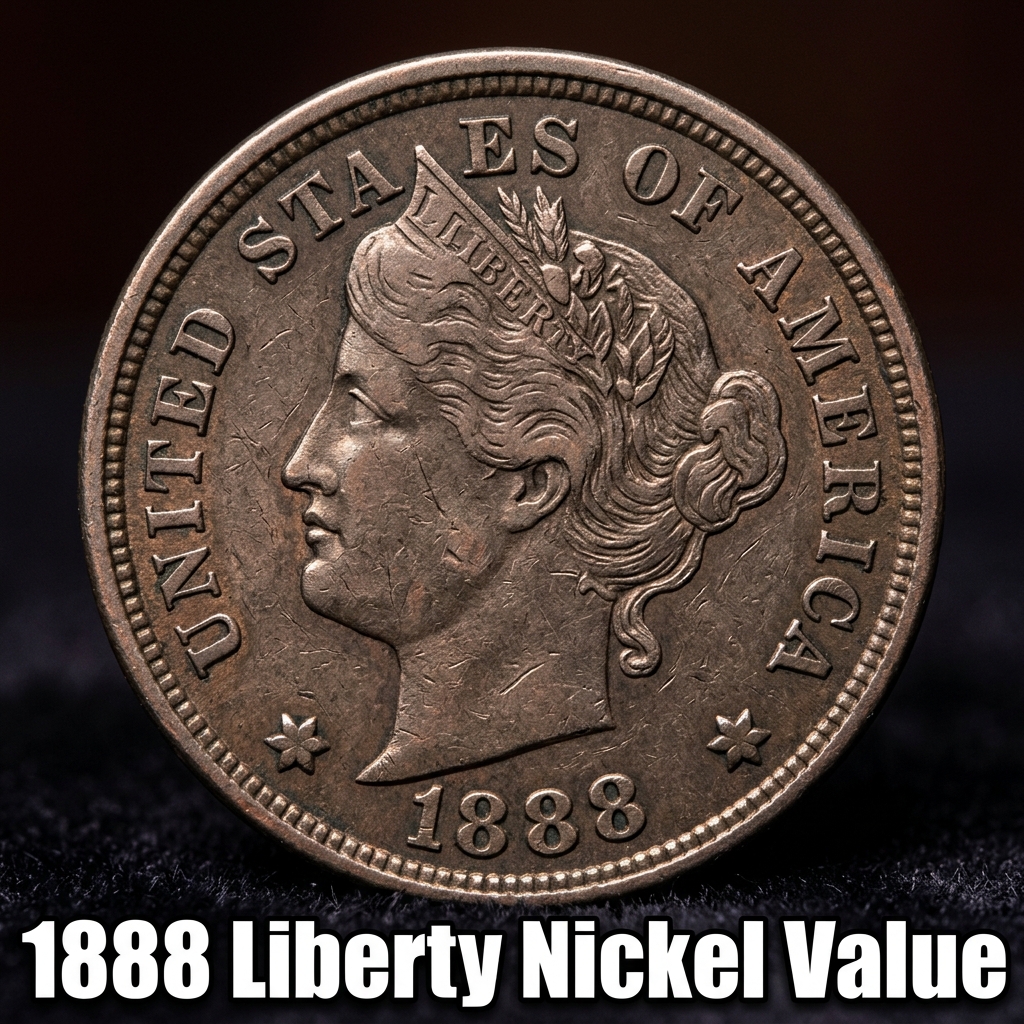
The Liberty Nickel, also called the “V Nickel” because of the large Roman numeral V on its reverse, was minted from 1883 to 1913. The 1888 issue was struck at the Philadelphia Mint, which was the only facility producing these coins at that time. No mint mark appears on the coin — that’s completely normal.
If you’re trying to figure out what your old nickel is worth, a coin identifier and value app can help you quickly scan and evaluate your coin without needing to visit a dealer right away. Tools like these have made it easier than ever for everyday people to get a fast, reliable estimate.
The obverse of the coin shows Lady Liberty wearing a crown, and the reverse displays a large “V” surrounded by a wreath and the words “CENTS” at the bottom. This detail — “CENTS” — is important, because the very first Liberty Nickels from 1883 didn’t have it, leading to a famous fraud scandal. By 1888, all coins correctly included “CENTS.”
Your Old Coin Could Be Valuable!
Identify It & Know Its Real Value — Free Download
1888 Liberty Nickel Value by Grade
The condition of your coin matters a lot. Coin collectors use a grading scale from 1 (Poor) to 70 (Perfect Mint State). Here’s a general breakdown of what the 1888 Liberty Nickel is worth at different grades:
| Grade / Condition | Description | Estimated Value |
|---|---|---|
| Good (G-4) | Heavy wear, major details visible | $2 – $5 |
| Fine (F-12) | Moderate wear, all lettering clear | $8 – $15 |
| Extremely Fine (EF-40) | Light wear on high points | $30 – $55 |
| About Uncirculated (AU-50) | Slight wear, most luster present | $65 – $95 |
| Mint State (MS-63) | Uncirculated, minor contact marks | $120 – $175 |
| Proof (PR-65) | Specially struck for collectors | $300 – $500+ |
For the most current auction results and certified coin pricing, you can check out 1888 Liberty Nickel prices in mint state grades to see what these coins are actually selling for in today’s market.
Your Old Coin Could Be Valuable!
Identify It & Know Its Real Value — Free Download
Proof Versions of the 1888 Liberty Nickel
In 1888, the Philadelphia Mint also produced proof coins specifically for collectors and presentation sets. These were struck with polished dies on specially prepared planchets, giving them a sharp, mirror-like finish.
Only around 4,582 proof Liberty Nickels were made in 1888 — a small number compared to the 10,720,483 business strike coins produced that year. This relative scarcity makes proofs significantly more valuable than regular circulation coins.
Your Old Coin Could Be Valuable!
Identify It & Know Its Real Value — Free Download
A proof 1888 Liberty Nickel in PR-63 condition typically sells for around $200 to $350. Gems graded PR-65 or above can fetch $400 to $600 or more at major coin auctions. If you think you might have a proof coin, look for extremely sharp details and a deeply reflective field surface — those are the telltale signs.
CoinKnow is a great resource if you want help identifying whether your coin is a proof or a business strike. The app uses image recognition to analyze the surface characteristics of your coin and match it to known examples in its database.
Factors That Affect 1888 Liberty Nickel Value
Beyond grade, a few other factors can push your coin’s value higher — or lower. Here’s what to keep in mind:
Your Old Coin Could Be Valuable!
Identify It & Know Its Real Value — Free Download
Strike quality matters on Liberty Nickels. Weakly struck coins, especially on Liberty’s hair and the “CENTS” lettering, are common and can slightly reduce collector appeal even in higher grades.
Luster and eye appeal play a big role in how buyers perceive a coin at auction. A coin with original, unclean surfaces and strong remaining luster will outperform one that’s been polished or cleaned — even if both are technically the same grade.
Certification from a third-party grading service like PCGS or NGC adds credibility and liquidity. Certified coins tend to sell for more because buyers trust the grade. If your 1888 Liberty Nickel looks uncirculated or close to it, professional grading could absolutely be worth the cost.
Your Old Coin Could Be Valuable!
Identify It & Know Its Real Value — Free Download
It’s also worth comparing similar-era silver dollars to get a broader picture of late 19th-century coin values. You can explore detailed value information for the 1888 Silver Dollar to see how other coins from that same year are performing on today’s market.
Should You Sell, Hold, or Get It Graded?
If your 1888 Liberty Nickel shows heavy wear and grades around Good to Fine, it’s probably worth $2 to $15 at most dealers. That’s not a fortune, but it’s still a coin over 130 years old — and that’s pretty cool in itself.
If the coin looks sharp, has visible luster, and shows minimal wear, it may be worth getting a professional opinion before selling. Coins grading AU-55 and above have real collector demand. And if it’s a proof — well, don’t let it go cheaply.
CoinKnow can help you take a first pass at your coin’s condition before you invest in grading fees. Snap a photo, let the app analyze the details, and get a ballpark estimate right from your phone. It’s a fast, free way to avoid underselling a coin that might be worth much more than you think.
Your Old Coin Could Be Valuable!
Identify It & Know Its Real Value — Free Download
Frequently Asked Questions
Q: How do I know if my 1888 Liberty Nickel has been cleaned?
A: Cleaned coins often have an unnatural brightness or look “too shiny” for their apparent wear level. You may also see hairline scratches under magnification from polishing. Cleaned coins are worth significantly less to collectors, so it’s best not to clean any old coin you find.
Q: Were any 1888 Liberty Nickels made outside of Philadelphia?
A: No. In 1888, the Liberty Nickel was only produced at the Philadelphia Mint, and Philadelphia coins carry no mint mark. If you see a mint mark on a Liberty Nickel from a different year, that would be unusual and worth researching further.
Q: What’s the best way to find out the exact value of my 1888 Liberty Nickel?
A: Start by assessing the condition as honestly as you can, then compare it to recent sales on coin auction platforms. You can also use CoinKnow to get a quick digital estimate, and for higher-value coins, consider submitting to PCGS or NGC for professional certification and grading.