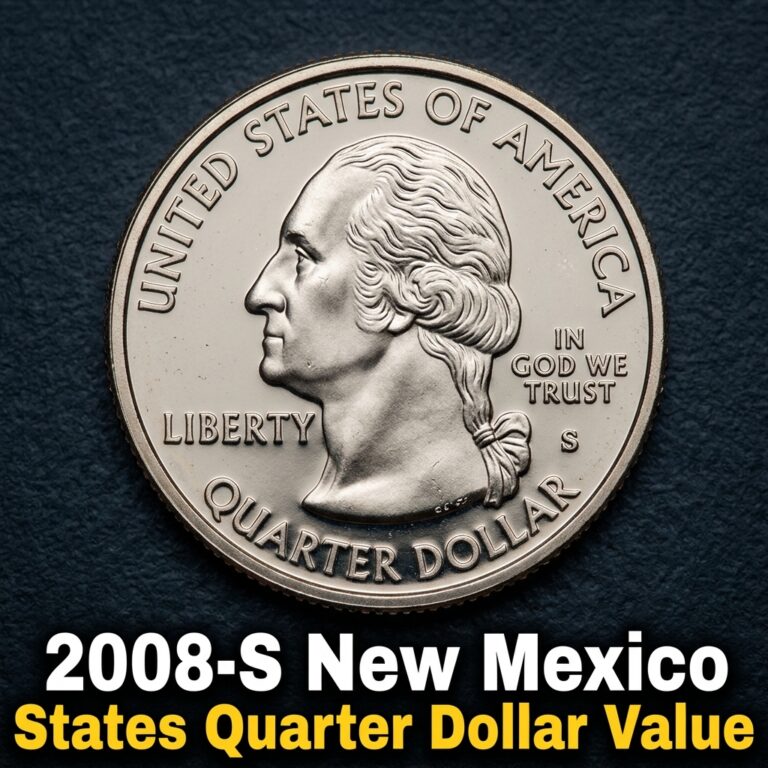
1989-P Jefferson Nickel Value: What Is Your Coin Worth?

Your Old Coin Could Be Valuable!
Identify It & Know Its Real Value — Free Download


The 1989-P Jefferson Nickel is worth anywhere from its face value of $0.05 in worn condition to over $600 in high-grade mint state with Full Steps. While most of these coins found in pocket change are common, certain high-quality specimens and errors can be quite valuable to collectors today.
| Condition / Grade | Estimated Value |
|---|---|
| Circulated (Average Wear) | $0.05 – $0.15 |
| Uncirculated (MS60 – MS64) | $1.00 – $5.00 |
| High Grade (MS65 – MS66) | $10.00 – $25.00 |
| Mint State with Full Steps (FS) | $50.00 – $650.00+ |
Identifying Your 1989-P Jefferson Nickel
If you’ve just emptied your piggy bank or found a shiny coin in your change, identifying the 1989-P Jefferson Nickel is the first step toward determining its worth. This coin features the classic portrait of Thomas Jefferson, the third U.S. President, on the obverse.
The “P” mint mark located on the right side of the obverse, just behind Jefferson’s ponytail, indicates that the coin was struck at the Philadelphia Mint. In 1989, the Philadelphia Mint produced a massive number of these nickels—specifically 898,812,000 units. Because nearly 900 million were made, they are not inherently rare.
To get an instant look at your coin’s specifics, you can use a top coin identifier and value app to scan the surface for tiny details. Most 1989-P nickels you find in daily life will show signs of wear, such as scratches and dullness, which usually keeps their value close to five cents. However, if the coin looks like it just came from the bank in a fresh roll, you might have something better.
Your Old Coin Could Be Valuable!
Identify It & Know Its Real Value — Free Download
Understanding the 1989-P Jefferson Nickel Value and Grading
When collectors talk about value, they focus heavily on “grade.” A grade is a numerical score from 1 to 70 that describes the coin’s condition. For the 1989-P nickel, the leap in price happens when you move from “Circulated” to “Mint State” (MS).
A coin in MS65 condition is considered a “Gem,” showing very few marks and possessing a strong luster. If you are curious about the current market trends, you can check the 1989-P nickel auction price data to see what recent sales have achieved. Generally, common mint state coins sell for a few dollars, but as the grade climbs to MS67 or higher, the price skyrockets because very few coins escaped the mint without minor damage.
Your Old Coin Could Be Valuable!
Identify It & Know Its Real Value — Free Download
Using a tool like CoinKnow can help you compare your coin against high-resolution images of various grades to see where yours fits. Most people find that their “shiny” coins are actually MS63 or MS64, which are nice but very common.
| Grade Designation | Description | Price Range |
|---|---|---|
| MS63 | Typical strike, some marks | $1 – $3 |
| MS65 | Strong luster, very few marks | $15 – $25 |
| MS67 | Virtually perfect to the eye | $100 – $200 |
The “Full Steps” Phenomenon: Why It Matters
If you want to find a 1989-P Jefferson Nickel worth hundreds of dollars, you must look at the reverse side of the coin. Specifically, look at Monticello, Jefferson’s home. At the base of the building, there is a set of steps.
Your Old Coin Could Be Valuable!
Identify It & Know Its Real Value — Free Download
In the world of nickel collecting, “Full Steps” (FS) is a designation given to coins where at least five or six steps are clearly visible and not blurred together. During the minting process, the metal often doesn’t flow perfectly into the dies, resulting in “mushy” steps. A 1989-P nickel with Full Steps is a rarity.
Collectors will pay a massive premium for this detail. While a standard MS66 nickel might sell for $20, an MS66 Full Steps version could easily fetch over $100. Always keep an eye out for these crisp lines when searching through your change. To dive deeper into these specific variations, you can find more 1989-P nickel value and variety info online to aid your search.
1989-P Jefferson Nickel Errors and Varieties
Errors are where the real excitement begins for everyday treasure hunters. Since the Philadelphia Mint produced nearly a billion nickels in 1989, mistakes were bound to happen. These “mints mistakes” can turn a Five-cent piece into a valuable collector’s item.
Your Old Coin Could Be Valuable!
Identify It & Know Its Real Value — Free Download
One common error to look for is the “Double Die.” While there are no major recognized 1989-P doubled dies that command thousands of dollars, minor doubling on the letters or the date can still add a premium of $10 to $50. Another popular error is the “Off-Center Strike,” where the coin blank was not aligned properly, resulting in a partial image.
If you suspect you have an error, CoinKnow is an excellent resource to identify the type of mistake. Other things to look for include “Die Cracks”—raised lines caused by a breaking mold—and “Clipped Planchets,” where the coin looks like a bite was taken out of it. These unique pieces are often sold on eBay for significantly more than their face value.
| Error Type | What to Look For | Value Estimate |
|---|---|---|
| Off-Center Strike | Design is missing on one side | $5 – $100+ |
| Die Crack | Raised jagged lines on surface | $2 – $15 |
| Broadstruck | Coin is flatter and wider than normal | $10 – $30 |
How to Care for Your 1989-P Nickels
Once you’ve identified a potentially valuable 1989-P Jefferson Nickel, you need to protect it. The biggest mistake beginners make is trying to clean their coins. Never, ever scrub a coin with soap, water, or polish. Cleaning a coin creates microscopic scratches that instantly destroy its numismatic value.
Instead, handle your nickels by the edges only. Oils from your skin can cause “toning” or corrosion over time. Store your best finds in PVC-free plastic flips or cardboard “2×2” holders. This keeps them safe from environmental damage and physical scratches.
Your Old Coin Could Be Valuable!
Identify It & Know Its Real Value — Free Download
If you believe your coin is a high-grade Full Steps version or a major error, it might be worth sending to a professional grading service like PCGS or NGC. However, grading costs money, so make sure the estimated value justifies the expense. Utilizing CoinKnow to pre-screen your coins can save you a lot of money on unnecessary grading fees.
Conclusion: Is the 1989-P Nickel Worth Keeping?
For the average American, the 1989-P Jefferson Nickel is a reliable piece of currency worth exactly five cents. However, the world of coin collecting is all about the exceptions. If you find one that is exceptionally shiny, has perfectly clear steps on the back, or features a strange minting error, it is absolutely worth setting aside.
While you won’t retire off a single 1989-P nickel, finding a coin worth $20 or $50 in your pocket change is a thrilling experience. Keep your eyes sharp, check those mint marks, and always look at the steps on Monticello!
| Summary Tip | Action Step |
|---|---|
| Check Condition | Look for original mint luster and few scratches. |
| Verify Mint Mark | Ensure the “P” is present on the obverse. |
| Inspect the Steps | See if 5 or 6 lines are visible on Monticello. |
FAQ
Q: Why is the “P” mint mark important on a 1989 nickel?
A: The “P” stands for the Philadelphia Mint. While it doesn’t make the coin rare (since millions were made), it helps collectors categorize the coin. In 1989, nickels were also made in Denver (“D”) and San Francisco (“S” for Proofs).
Your Old Coin Could Be Valuable!
Identify It & Know Its Real Value — Free Download
Q: Can I find a 1989-P nickel in circulation today?
A: Yes, these coins are very common in circulation. You likely have one in your pocket or couch cushions right now. While most are only worth face value, it’s always worth checking for errors or high-grade condition.
Q: What is the highest price ever paid for a 1989-P Nickel?
A: High-grade specimens with the Full Steps designation have sold for over $600 at major auctions. The price depends entirely on the grade and the quality of the strike on the reverse.
Q: How can I tell if my 1989 nickel is a “Proof”?
A: Proof nickels were made specifically for collectors and have a mirror-like finish. However, all 1989 Proof nickels were minted in San Francisco and bear an “S” mint mark. If your coin has a “P,” it is a business strike intended for circulation, not a Proof.