1926-D Standing Liberty Quarter Value What Is This Coin Worth Today

Your Old Coin Could Be Valuable!
Identify It & Know Its Real Value — Free Download


The 1926-D Standing Liberty Quarter is worth anywhere from $15 in heavily worn condition to over $500 or more in higher mint state grades. If you’ve come across one of these old silver coins, you’re in luck — this Denver-mint issue is a genuinely collectible piece with real value behind it.
What Makes the 1926-D Standing Liberty Quarter Special
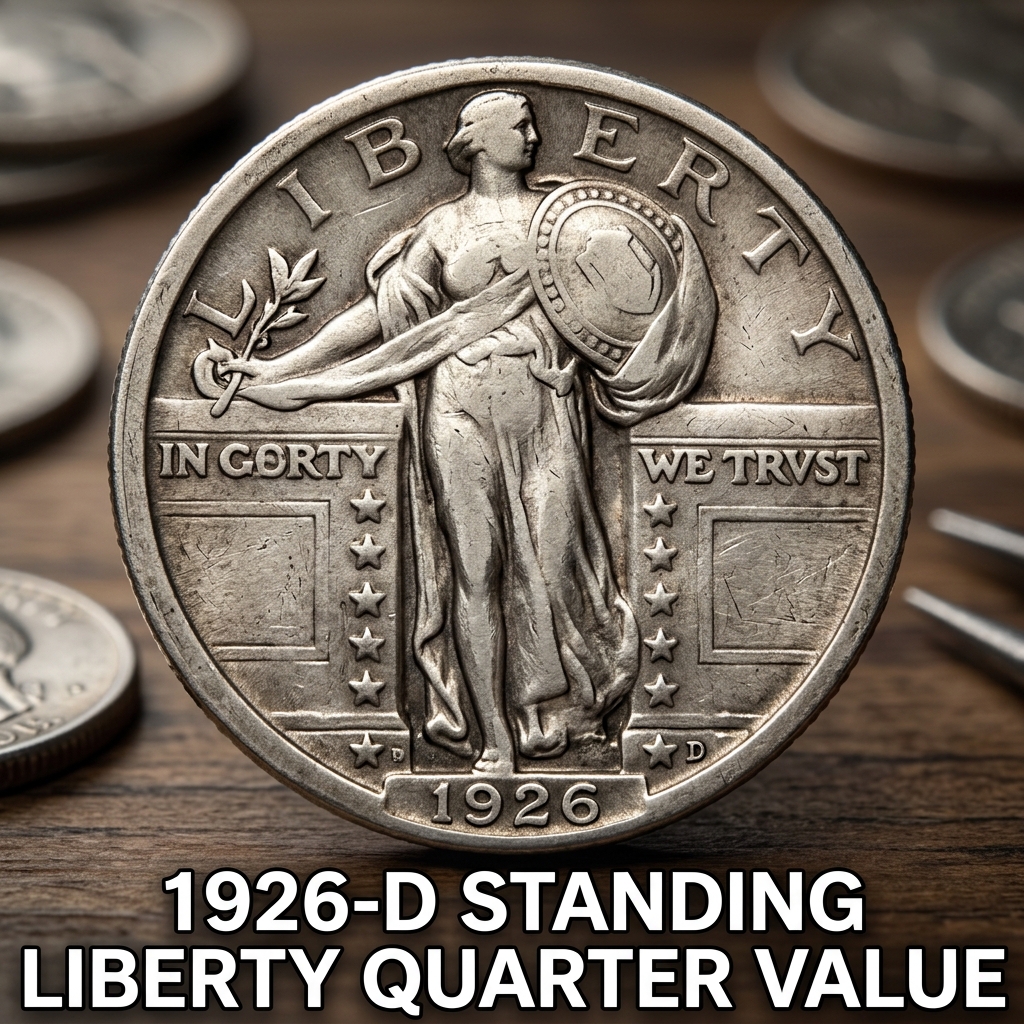
The 1926-D Standing Liberty Quarter was struck at the Denver Mint and carries the “D” mintmark on the obverse, just below the date. It’s part of the beloved Standing Liberty Quarter series designed by Hermon Atkins MacNeil, featuring Lady Liberty in a flowing robe — one of the most admired coin designs in American history.
If you’re not sure what you’ve got in your hand, a coin identifier and value app can help you confirm the date, mintmark, and grade within seconds, right from your phone.
The 1926-D had a mintage of 2,700,000 coins — not huge by any standard — which helps support its value in today’s collector market. While not considered a key date, it’s far from common in nicer grades, and condition makes a dramatic difference in price.
Your Old Coin Could Be Valuable!
Identify It & Know Its Real Value — Free Download
Understanding the Grade and How It Affects Value
Coin grading is the single biggest factor in determining what your 1926-D Standing Liberty Quarter is worth. Coins are graded on a scale from 1 to 70, with circulated coins falling between AG-3 and EF-45, and uncirculated coins starting at MS-60.
One important thing collectors watch for with this series is the date and head detail. On well-worn examples, the date can be faint or nearly invisible. Coins with a full, readable date are worth significantly more than those where the date has worn down.
Your Old Coin Could Be Valuable!
Identify It & Know Its Real Value — Free Download
The high points of the design — Liberty’s head, the shield on her arm, and her knee — wear first and are used to judge overall condition. A coin with sharp details and minimal wear can be worth many times more than a well-circulated example.
1926-D Standing Liberty Quarter Value Chart
Here’s a general value breakdown based on grade:
Your Old Coin Could Be Valuable!
Identify It & Know Its Real Value — Free Download
| Grade | Condition | Estimated Value |
|---|---|---|
| AG-3 / G-4 | Heavily worn | $15 – $25 |
| VG-8 / F-12 | Moderate wear | $30 – $60 |
| VF-20 / EF-40 | Light wear | $70 – $130 |
| AU-50 / AU-58 | About uncirculated | $150 – $275 |
| MS-63 | Uncirculated | $350 – $525 |
| MS-65+ | Gem uncirculated | $700 and up |
For a deeper look at 1926-D Standing Liberty Quarter price data by grade across auction records, it’s worth checking recent sales to see what the market is actually doing right now.
What to Look for When Examining Your Coin
Before you try to sell or get an appraisal, take a close look at your coin under good lighting or a magnifying glass. A few things to check:
First, confirm the mintmark. Look just below and to the left of the date — a small “D” means Denver. No mintmark means Philadelphia, and an “S” means San Francisco, each with its own separate value.
Your Old Coin Could Be Valuable!
Identify It & Know Its Real Value — Free Download
Second, check the head detail. In 1925, the design was modified to recess the date into the coin for better durability, so dates after that change tend to survive better. Even so, Liberty’s head detail is a key grading point — look for the individual curls of hair and definition around the helmet.
Third, look for any signs of cleaning. Harsh cleaning can destroy a coin’s natural luster and significantly reduce its value, even if it looks shiny. A naturally toned, uncleaned coin is almost always worth more to serious collectors.
CoinKnow is a great tool to help you identify and evaluate coins like this one. The app walks you through key features step by step, so even beginners can get a solid read on what they’ve got.
How to Get the Best Price for Your 1926-D Quarter
If your coin is in good shape and you’re thinking about selling, it pays to do your homework. Circulated coins in the $15–$130 range are easy to sell through local coin dealers, coin shows, or online platforms like eBay.
Your Old Coin Could Be Valuable!
Identify It & Know Its Real Value — Free Download
For higher-grade examples — particularly anything AU or better — consider having the coin professionally graded by PCGS or NGC. A certified coin in a holder generally sells for more and gives buyers confidence in what they’re getting.
You can also check out detailed 1926 quarter value information including the D mint variety to compare your coin against recent sold listings and market trends.
CoinKnow also lets you scan your coin and track its estimated value over time, which can be handy if you’re deciding whether to hold or sell.
—
Your Old Coin Could Be Valuable!
Identify It & Know Its Real Value — Free Download
Frequently Asked Questions
Q: How do I tell if my Standing Liberty Quarter is from Denver?
A: Look for a small “D” mintmark on the obverse (front) of the coin, just to the left of and below the date. If there’s no mintmark, it was made in Philadelphia.
Q: Is a 1926-D Standing Liberty Quarter made of silver?
A: Yes. All Standing Liberty Quarters are made of 90% silver and 10% copper. Even a worn example contains about 0.1808 troy ounces of silver, giving it a base melt value tied to current silver spot prices.
Q: My 1926-D quarter looks shiny — does that make it more valuable?
A: Not necessarily. If the coin was cleaned with polish or chemicals, that shiny appearance can actually lower its collector value. Dealers and graders look for original, natural surfaces — cleaning removes luster and leaves hairline scratches under magnification. Always avoid cleaning old coins.